
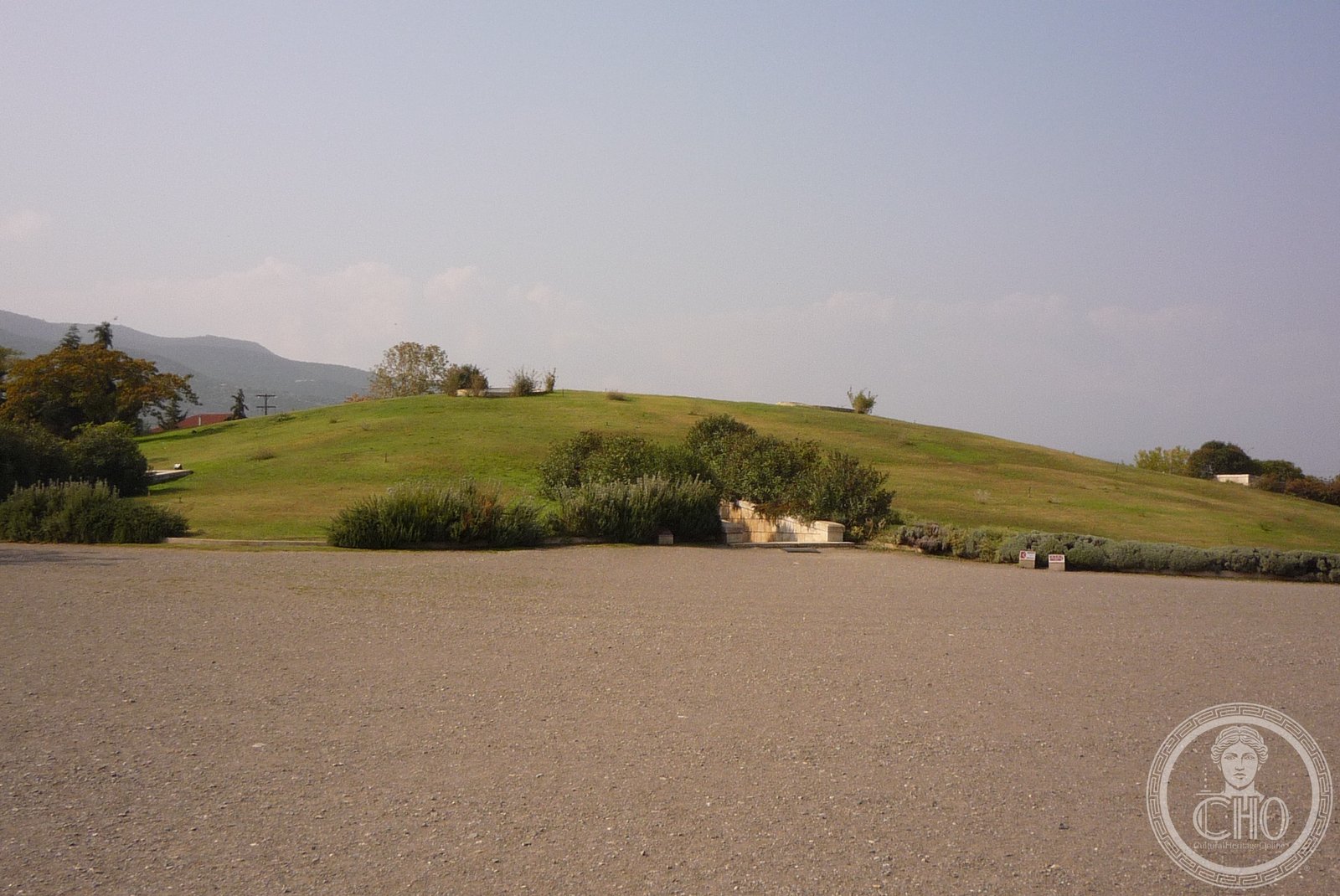
The first capital of the Kingdom of Macedon, where archaeologist Manolis Andronikos broke into the only unlooted Macedonian royal tomb in 1977 and found a golden larnax containing cremated bones identified as those of Philip II — father of Alexander the Great.
At a glance
Near the village of Vergina in the Imathia Regional Unit of Central Macedonia, under a large tumulus mound approximately 110 metres in diameter and 12 metres high, lies the site of ancient Aigai — the first capital of the Kingdom of Macedon. The royal cemetery here contains the tombs of the Macedonian kings; the most extraordinary is the main chamber tomb identified as that of Philip II (r. 359–336 BC), discovered unlooted in November 1977. UNESCO World Heritage Site since 1996, the site is now enclosed in a museum built within the Great Tumulus itself, preserving the tombs in situ in a controlled atmosphere. The gold larnax, diadem, and grave goods of Philip II represent one of the most extraordinary archaeological finds of the 20th century.
Key facts
- Location: Vergina village, Imathia Regional Unit, Central Macedonia, Greece
- UNESCO WHS: 1996 (“Archaeological Site of Aigai”)
- Period: c. 650–168 BC (Macedonian Kingdom); key tombs c. 336–317 BC
- Excavator: Manolis Andronikos, University of Thessaloniki; discovery November 1977
- Key find: Gold larnax (casket) with 16-pointed Macedonian star, containing cremated bones of Philip II wrapped in purple and gold cloth
- Identification evidence: Healed wound to right eye socket (Philip II was blinded at Methone, 354 BC); age ~40–50 years at death
- Significance: Only unlooted Macedonian royal tomb found in modern times
History
Aigai served as the first capital of the Argead dynasty, the ruling house of Macedon, until the capital was moved to Pella in the 4th century BC. Even after the transfer, Aigai retained its sacred status as the traditional burial place of Macedonian kings — a practice continued for centuries. The city itself was largely destroyed by the Galatians in 279 BC, but the cemetery continued in use. It was covered by a large artificial mound, the Great Tumulus, whose purpose as a royal burial site was forgotten over subsequent centuries.
On 8 November 1977, the Greek archaeologist Manolis Andronikos of the University of Thessaloniki broke through the roof of a four-chambered tomb of exceptional quality in what he later described as the most dramatic moment of his career. The main chamber was intact and unlooted — an extraordinarily rare circumstance for any ancient Greek tomb, let alone one of royal quality. The chamber contained a golden larnax decorated with the 16-pointed star of Macedon, holding cremated human bones wrapped in a purple cloth interwoven with gold thread, alongside a gold-and-iron diadem, an iron and gold sword, silver cups, bronze vessels, and ivory-inlaid wooden furniture.
The identification of the tomb as Philip II’s rests on anatomical and archaeological evidence: examination of the cremated bones identified a healed cut wound to the right eye socket, consistent with the historical record of Philip II’s blinding by an arrow at the siege of Methone in 354 BC; the individual was approximately 40–50 years old at death, consistent with Philip II’s age (46) when assassinated in 336 BC; and the quality and nature of the grave goods are consistent with the wealthiest known ruler of the period.
What you see
The museum at Vergina is built inside and over the Great Tumulus, preserving the tombs in situ in a dramatically darkened, climate-controlled interior. The main chamber tomb of Philip II is visible through a reconstructed façade with a painted frieze depicting a royal hunt — one of the finest ancient Greek paintings to survive. Visitors walk past the tombs on elevated walkways and can observe the larnax, grave goods, and burial context through protective barriers. The museum display also includes finds from other tombs in the Great Tumulus, including a tomb identified as that of Alexander IV (Alexander the Great’s son) and another attributed to Philip III Arrhidaeus.
A separate display presents the gold larnax, gold diadem, iron and gold sword, bronze vessels, and ivory objects from Philip II’s tomb in extraordinary close-up. The larnax is arguably the most significant single portable object to survive from the ancient Macedonian world: a masterpiece of goldsmithing approximately 33 cm long, its lid decorated with the 16-pointed Macedonian star in repousé gold, its interior still holding the wrapped cremated bones as Andronikos found them in 1977.
Practical information
- Address: Vergina village, Imathia Regional Unit, Central Macedonia, Greece (signposted from Veria)
- Opening hours: Mon 12:30–20:00; Tue–Sun 08:00–20:00 (summer); reduced hours in winter — verify before visiting
- Admission: Full ticket for site and museum; reduced for students and EU citizens over 65
- Photography: No flash photography inside the museum
- Duration: Allow 2–3 hours minimum
Getting there
Vergina is approximately 13 km southeast of the city of Veria (Veroia) and approximately 75 km southwest of Thessaloniki. By car from Thessaloniki: take the E75/A1 motorway south, exit at Veria, follow signs toward Vergina (well signposted). By public transport: KTEL bus from Thessaloniki to Veria, then local bus or taxi to Vergina (taxis are inexpensive from Veria). The nearest airport is Thessaloniki Makedonia Airport (SKG), approximately 85 km, well-served by international and domestic routes.
Nearby
- Ancient Pella (~60 km northeast) — the second capital of Macedon, birthplace of Alexander the Great, with spectacular floor mosaics
- Veria (Veroia) (13 km) — Byzantine-era city with a remarkable concentration of early Christian churches and the ‘Bema of St Paul’
- Dion Archaeological Site (~60 km south) — Macedonian sacred city at the foot of Mount Olympus; extensive ancient remains and museum
- Mount Olympus (~80 km south) — Greece’s highest mountain and mythological home of the gods; hiking trails from Litochoro
Sources
- Andronikos, M. (1984). Vergina: The Royal Tombs and the Ancient City. Athens: Ekdotike Athenon
- Bartsiokas, A. (2000). The eye injury of King Philip II and the Skeletal Evidence from the Royal Tomb II at Vergina. Science 288(5465), 511–514
- Borza, E. N. (1990). In the Shadow of Olympus: The Emergence of Macedon. Princeton University Press
- UNESCO World Heritage Centre. “Archaeological Site of Aigai (modern name Vergina).” whc.unesco.org. Accessed June 2026
- Wikipedia contributors. “Aigai.” Wikipedia. Accessed June 2026
Find it on the map
See this place and what’s around it →
📷 Become a Cultural Heritage Online photographer
Share your photos of places: they stay published under your name as the author. The more they're seen, the more you get noticed — and soon a contest will reward the most appreciated photos.
Log in or sign up free to add a photo