
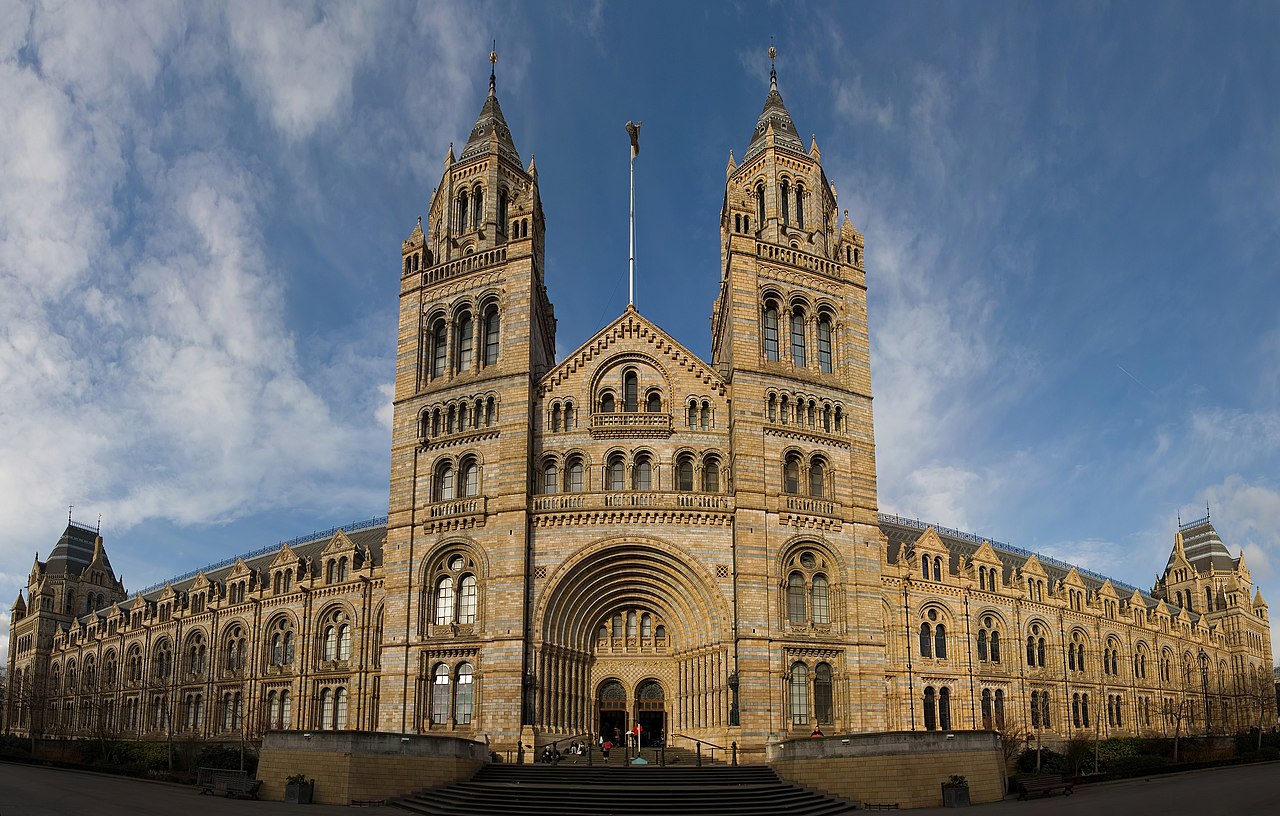
Natural History Museum — London
Alfred Waterhouse’s 1881 terracotta cathedral to natural science — every surface carved with animals, plants, and fossils, the Central Hall’s soaring nave ending beneath a 25-metre blue whale skeleton — is the most beautiful museum building in Britain.
At a glance
The Natural History Museum occupies the south side of Cromwell Road in South Kensington, its 220-metre facade of sand-coloured Romanesque arches, terracotta cladding, and twin campanile towers constituting one of the most immediately recognisable institutional elevations in London. Alfred Waterhouse designed the building between 1873 and 1880, conceiving it as a “cathedral to nature” in which every external surface would be carved with animals, birds, and plants drawn from the museum’s own collections. Inside, the Central Hall — a vaulted nave running the full depth of the building — houses under its rib-vault the 25-metre skeleton of a blue whale named Hope, suspended as if mid-dive, the first thing every visitor sees. The museum holds over 80 million specimens including the world’s largest collections of insects, plants, and rocks.
Key facts
- Architect: Alfred Waterhouse (1830–1905); also designed Manchester Town Hall and Pembroke College Cambridge
- Opened: 18 April 1881 as the British Museum (Natural History); independent museum from 1963
- Style: Romanesque Revival; Lombardic detail; entire exterior clad in two tones of terracotta (buff for living species, blue-grey for extinct)
- Terracotta programme: over 700 animals and plants represented in the exterior carvings; designed by Waterhouse with the museum’s own taxonomists
- Central Hall feature: blue whale skeleton “Hope,” 25.2 metres long, suspended since 2017; previously Diplodocus cast “Dippy” (1905–2017)
- Collection: 80 million specimens; includes the world’s largest insect collection (34 million specimens)
- GPS: 51.4967° N, 0.1764° W
History
The Natural History Museum collections originated with Sir Hans Sloane, whose bequest to the nation in 1753 founded the British Museum. The natural history departments — botany, zoology, mineralogy, palaeontology — remained part of the British Museum until the pressure of expanding collections in the mid-19th century created the need for a dedicated building. The architect Francis Fowke drew initial plans before his death in 1865; Waterhouse, appointed in 1868, redesigned the building entirely, choosing a Romanesque Revival vocabulary that he believed suited the scientific content better than the Neoclassical style of the British Museum itself.
Waterhouse’s most consequential decision was to abandon conventional stone facing in favour of terracotta, then a new and unpopular industrial building material. He specified two tones: buff for panels depicting living species, blue-grey for extinct ones — a chromatic iconographic system that made the building’s entire skin a taxonomy of natural history. The carving programme, designed by Waterhouse in collaboration with the museum’s scientific staff, represents an extraordinary synthesis of artistic and scientific knowledge: the Dodo on the east wing, the ammonites in the window arches, the fish running along the sill courses are all rendered with taxonomic accuracy rather than decorative licence.
Richard Owen, the museum’s first superintendent and the man who coined the word “dinosaur,” shaped the building’s intellectual purpose: it was to be a place of popular instruction as much as scientific research. The Grand Hall was conceived as a public promenade where visitors could encounter the collection’s greatest objects. In 2017, the Diplodocus cast that had occupied the Grand Hall since 1905 was replaced by the blue whale skeleton Hope — a switch that simultaneously updated the museum’s messaging (from the age of dinosaurs to the health of current oceans) and preserved the tradition of a single spectacular specimen dominating the space.
What you see
The Cromwell Road facade extends 220 metres, its rhythm of Romanesque arches in two tones of terracotta punctuated by the twin 61-metre campanile towers at the east and west ends of the central block. The main entrance arch, deeply moulded, is flanked by carved animals at every order; the tympanum above the door carries a figure of Adam naming the animals. The material — terracotta rather than stone — gives the facade an unusual luminosity, its buff and grey tones shifting with the light throughout the day in ways that stone does not.
Inside, the Central Hall is a barrel-vaulted nave 26 metres high, its walls lined with terracotta panels of living species, its floors in mosaic, its rib vault painted with 162 species of plants. The blue whale Hope hangs from the roof on steel cables, 25 metres of oceanic mammal suspended in the museum air, its skeleton the most immediately arresting single object in any British museum. At the far end of the hall, a marble staircase rises to a landing where a seated marble figure of Charles Darwin — installed in 1885 — surveys the hall that is, in large measure, his intellectual legacy.
Practical information
- Address: Cromwell Road, South Kensington, London SW7 5BD, United Kingdom
- Hours: daily 10 am–5:50 pm; last admission 5:30 pm
- Admission: free (permanent collection); charges apply for temporary exhibitions
- Time needed: minimum 2–3 hours for highlights; a full day for the complete museum
- Highlights: Hope the blue whale; Dinosaur Gallery (including T. rex skeleton); Hintze Hall architecture; Vault minerals exhibition
Getting there
South Kensington Underground station (Circle, District, Piccadilly lines) is a five-minute walk via the Exhibition Road tunnel. Heathrow Airport is 25 km west; Piccadilly Line direct takes 45 minutes to South Kensington. GPS: 51.4967, -0.1764.
Nearby
- Victoria and Albert Museum — the world’s greatest decorative arts museum, directly across the road on Cromwell Road; free admission
- Science Museum — London’s science and technology museum, adjacent to the Natural History Museum; free admission
- Hyde Park and Kensington Gardens — London’s largest park complex, five minutes north on foot; the Serpentine Galleries and the Albert Memorial
- Royal Albert Hall — the circular Victorian concert venue, ten minutes north-west on foot
Sources
- Wikipedia, Natural History Museum, London, accessed June 2026
- Official museum website: nhm.ac.uk
- Mark Girouard, Alfred Waterhouse and the Natural History Museum, Yale University Press, 1981
- Richard Owen, On the Nature of Limbs, 1849 — historical context for the museum’s scientific mission
Find it on the map
See this place and what’s around it →📷 Diventa un fotografo di Cultural Heritage Online
Condividi le tue foto dei luoghi: restano pubblicate con la tua firma come autore. Più vengono viste, più ti fai conoscere — e presto un concorso premierà le foto più apprezzate.
Accedi o registrati gratis per aggiungere una foto