
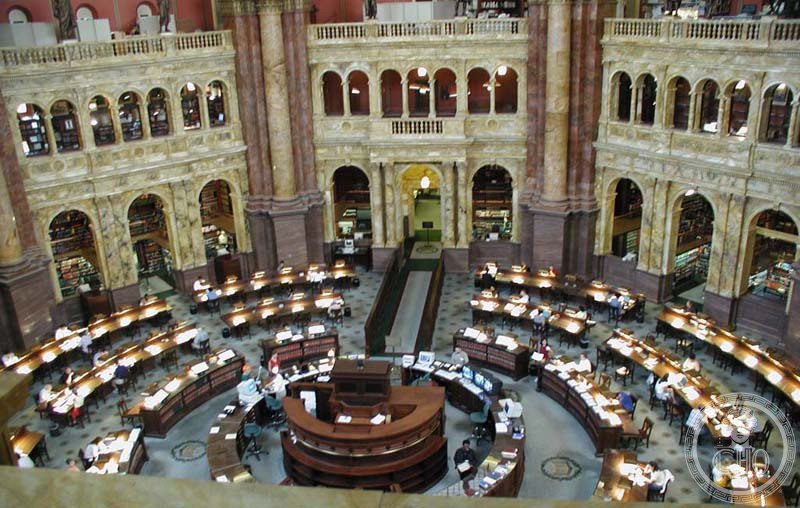
The copper-domed Jefferson Building — the largest library building in the world at its 1897 opening — contains in its Great Hall and Main Reading Room the most spectacular public interior in America: a gilded, mosaic-covered monument to human knowledge.
At a glance
The Library of Congress Thomas Jefferson Building stands on Capitol Hill, its copper dome and Italian Renaissance facade facing the US Capitol from across First Street SE. Designed by Smithmeyer & Pelz and completed under the supervision of Bernard Green, it opened on 1 November 1897 as the largest library building in the world. The Great Hall — a two-storey marble entrance hall with a mosaic-covered vaulted ceiling, gilded columns, and allegorical figures in coloured glass mosaic — leads to the eight-tier Main Reading Room under a 160-foot dome. Sixteen bronze statues representing the fields of human knowledge ring the dome’s collar; the lantern above them opens onto painted allegorical figures of civilisation. The building is the first and most celebrated of the Library of Congress’s three Capitol Hill buildings and remains the architectural landmark of American intellectual life.
Key facts
- Architects: Smithmeyer & Pelz (design, 1873); Bernard Green (construction superintendent, 1889–1897); Edward Pearce Casey (completion)
- Opened: 1 November 1897; dedicated as the Thomas Jefferson Building in 1980
- Style: Italian Renaissance Beaux-Arts; copper dome; polychrome marble interior; mosaic ceilings
- Main Reading Room dome: 48.8 metres (160 feet) high; 16 bronze statues of human achievement; eight-tiered gallery
- Collection: over 173 million items (2024) — the largest library collection in the world
- Heritage: National Historic Landmark (1965)
- GPS: 38.8889° N, 77.0044° W
History
The Library of Congress was established in 1800 as a reference library for Congress, housed in the Capitol building. The original collection was destroyed when the British burned Washington in 1814; Thomas Jefferson sold his personal library of 6,487 volumes to Congress as a replacement in 1815. By 1870, the collection had grown sufficiently that it needed a dedicated building, and after lengthy debate a site on Capitol Hill was chosen and a design competition held. Smithmeyer & Pelz won with an Italian Renaissance design that evolved over the following two decades of congressional deliberation about cost, style, and programme before construction finally began in 1888.
The architect of record for the critical construction phase was Bernard Green, an Army engineer who oversaw both the structural work and the interior decoration programme. The decorative scheme was executed by some fifty American sculptors and artists, many of them graduates of the Beaux-Arts schools of Paris — the building was conceived as a statement of the maturity of American culture, capable of producing art equal to the great libraries of Europe. The mosaic programme of the Great Hall, the carved allegorical figures on the facade, and the bronze work of the Main Reading Room were executed to a unified iconographic programme representing the totality of recorded human knowledge.
The building was renamed the Thomas Jefferson Building in 1980 to distinguish it from the two subsequently constructed Capitol Hill annexes (the Adams Building, 1939, and the Madison Building, 1980). A comprehensive restoration from 1984 to 1995 cleaned and repaired the exterior and returned the Great Hall to its 1897 appearance. The building receives over 1.5 million visitors annually.
What you see
The First Street facade presents a central pavilion with a triangular pediment above Corinthian columns, flanked by projecting wings. The dome — copper-sheathed, rising to a lantern with a gilded flame — sits above the central mass and is visible from the Mall. The facade decorative programme includes forty portrait medallions of famous writers and scholars carved into the spandrels; the torch-bearing figure at the apex represents “Knowledge.”
Inside, the Great Hall takes an entire city block. The floor is white, red, and grey marble in geometric patterns; the lower walls are white marble with bas-relief work; the vaulted ceiling above the stair galleries carries mosaic panels of figures representing the twelve subjects of knowledge. The Main Reading Room itself — entered through the double doors beneath the dome — is among the most moving interiors in American architecture: a round room 97 feet in diameter, its eight tiers of catalogue and reference shelves rising to the drum, above which the sixteen bronze statues of Moses, Homer, Shakespeare, Newton, Bacon, and others stand in permanent attendance on whoever happens to be reading below.
Practical information
- Address: 10 First Street SE, Washington DC 20540, United States
- Hours: Monday–Saturday 8:30 am–4:30 pm; closed Sundays and federal holidays
- Admission: free; visitors welcome to the public areas (Great Hall, Main Reading Room gallery) without a pass
- Research access: researchers 16 and older may register for a reader card to use the reading rooms
- Guided tours: free docent tours Monday–Saturday at regular intervals; orientation theatre shows a short film
- Time needed: 1–2 hours for public areas; half-day or more for researchers
Getting there
The Library of Congress is on Capitol Hill, one block south-east of the US Capitol. Metro station Capitol South (Blue/Orange/Silver Line) is a five-minute walk. Ronald Reagan Washington National Airport (DCA) is 6 km south; Dulles International Airport is 47 km west. The National Mall museums (Smithsonian) are a 10–15 minute walk west. GPS: 38.8889, -77.0044.
Nearby
- United States Capitol — the congressional building and its dome, one block north-west; free tours available
- Supreme Court of the United States — the marble neoclassical court building, directly adjacent north
- National Mall museums — the Smithsonian Institution’s free museums (Natural History, American History, Air & Space, etc.), 10 minutes on foot west
- Eastern Market — Capitol Hill’s historic public market, active since 1873, ten minutes south-east on foot
Sources
- Wikipedia, Library of Congress, accessed June 2026
- Library of Congress official website: loc.gov
- John Y. Cole, On These Walls: Inscriptions and Quotations in the Buildings of the Library of Congress, LOC, 1995
- National Historic Landmark designation, 1965
Find it on the map
See this place and what’s around it →📷 Become a Cultural Heritage Online photographer
Share your photos of places: they stay published under your name as the author. The more they're seen, the more you get noticed — and soon a contest will reward the most appreciated photos.
Log in or sign up free to add a photoIs this page about you?
This page is read by travellers and heritage enthusiasts who find it on Google. Tell us how you are connected to this place and we will take it from there.