

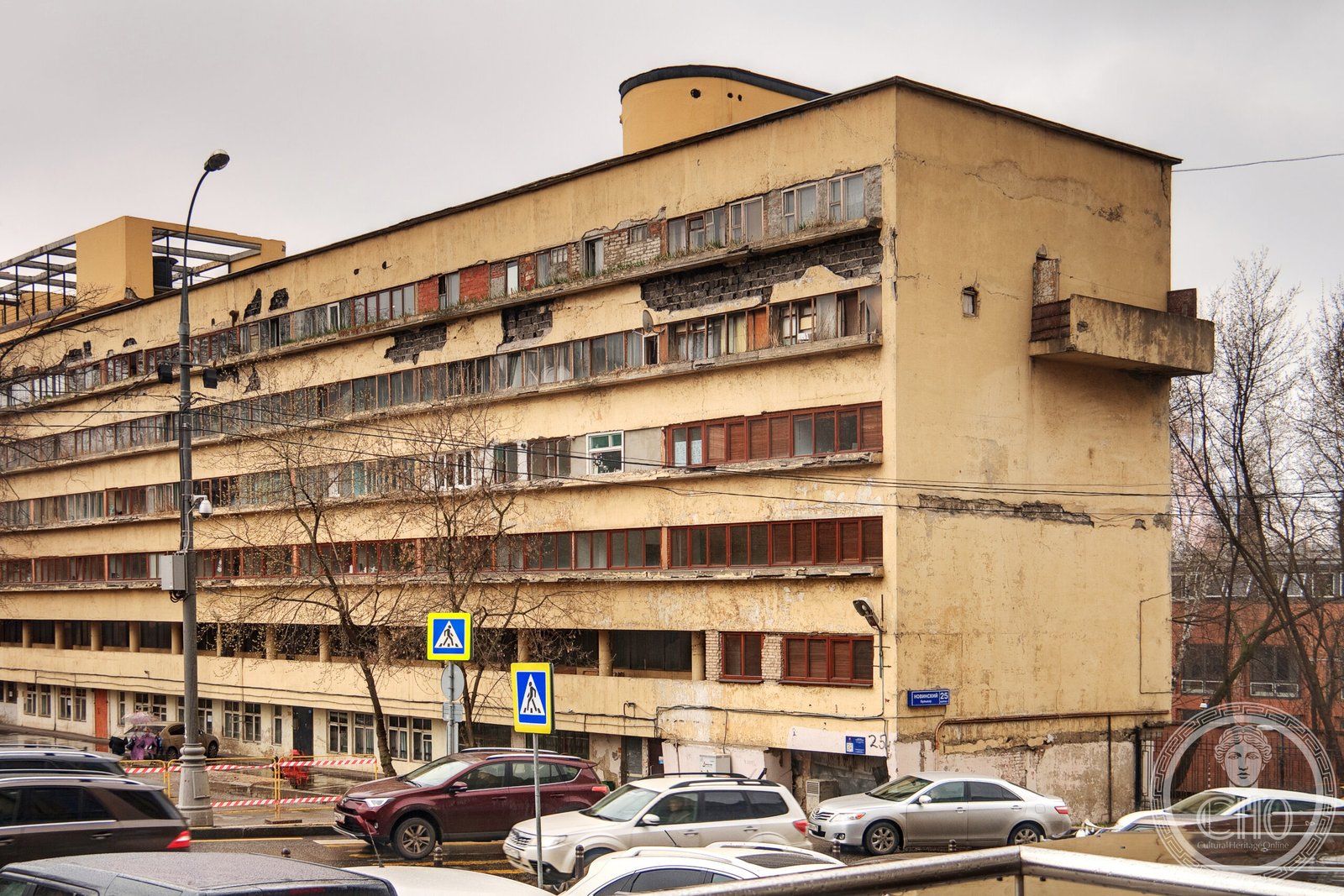
The Narkomfin Building is one of the most celebrated monuments of Soviet Constructivism and avant-garde housing design. Built between 1928 and 1932 on Novinsky Boulevard in Moscow, it was conceived by architects Moisei Ginzburg and Ignaty Milinis as a radical social experiment — a collective living machine intended to dissolve the boundary between private and communal life. Restored in 2020, it stands today as a landmark of modernist architecture and urban utopia.
At a glance
- Type
- Residential apartment building
- Period
- 1928–1932
- Style
- Soviet Constructivism
- Location
- 25 Novinsky Boulevard, Moscow, Russia
- Coordinates
- 55.7572° N, 37.5811° E
- Architect(s)
- Moisei Ginzburg, Ignaty Milinis
Overview
The Narkomfin Building was designed for employees of the People's Commissariat of Finance (Narkomfin) as a prototype for the ideal Soviet communal dwelling. Elevated on pilotis above a landscaped ground plane, the long slab block contains 54 apartments in a novel split-level configuration, connected by a glassed corridor to a separate communal block housing shared kitchens, a library, gymnasium, childcare facilities, and a laundry. Ginzburg and Milinis intended residents to gradually relinquish private domestic routines in favour of shared socialist living.
History
Commissioned in 1928, the Narkomfin was built as part of the Soviet state's effort to define a new way of life through architecture. When Stalin consolidated power, the utopian vision fell out of favour and the building was subdivided into smaller conventional flats during post-war housing shortages. Decades of neglect followed, and by 2010 the structure appeared on UNESCO's World Monuments Watch list of endangered sites. A comprehensive restoration project began in 2016 under architect Alexei Ginzburg — grandson of the original designer — and was completed in July 2020, returning the building to something close to its original form.
Architecture & Design
Soviet Constructivism was a parallel modernist movement to Western Art Déco that emerged in the USSR from the early 1920s. Where Art Déco celebrated ornament, luxury, and streamlined glamour, Constructivism embraced industrial materials, rational geometry, and collective purpose. The Narkomfin exemplifies this approach: a reinforced concrete frame raised on pilotis (anticipating Le Corbusier's Five Points), ribbon windows running the full length of the facade, a roof terrace for communal use, and a parti that separates sleeping from living spaces across split-level F-type units. Every element was subordinated to a social programme rather than aesthetic effect.
Cultural significance
The Narkomfin Building is widely regarded as the canonical example of the Soviet dom-kommuna (commune house) typology and one of the most important residential buildings of the twentieth century. It influenced architects from Le Corbusier to the post-war welfare housing movements across Europe. Its 2020 restoration was celebrated internationally as a landmark conservation achievement, and it remains a pilgrimage site for architects, historians, and anyone interested in the intersection of political ideology and built form.
Visiting today
The restored building now contains private apartments and is not open for interior visits. The exterior on Novinsky Boulevard can be viewed freely at any time. Architectural tours of Moscow sometimes include the building; check local tour operators in advance. The neighbourhood around the Moscow River embankment offers pleasant walking routes connecting the Narkomfin to other Constructivist landmarks.
Getting there
The nearest Moscow Metro stations are Barrikadnaya and Smolenskaya, both on the Circle and Arbatsko-Pokrovskaya lines, each around 10 minutes' walk. From central Moscow, the building is accessible by trolleybus along the Garden Ring (Sadovoye Koltso). Address: 25 Novinsky Boulevard, Moscow.
Sources & resources
Find it on the map
See this place and what’s around it →Record researched and written by Luigi De Marchi for Cultural Heritage Online, 2026.
📷 Become a Cultural Heritage Online photographer
Share your photos of places: they stay published under your name as the author. The more they're seen, the more you get noticed — and soon a contest will reward the most appreciated photos.
Log in or sign up free to add a photoIs this page about you?
This page is read by travellers and heritage enthusiasts who find it on Google. Tell us how you are connected to this place and we will take it from there.