
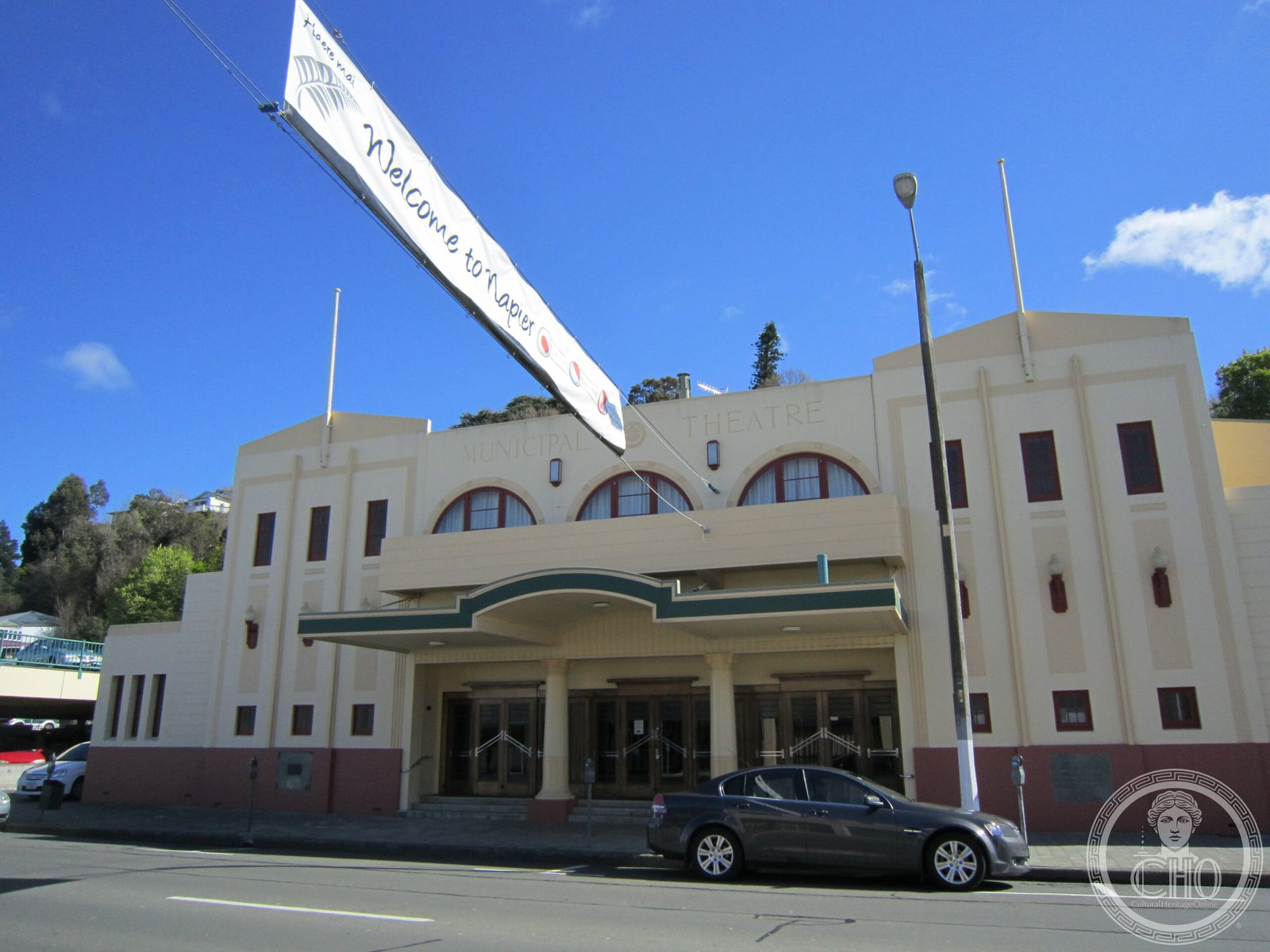
Born from catastrophe and rebuilt in the architectural language of its moment, the Napier Municipal Theatre stands as one of the most evocative monuments to a city that reinvented itself in Art Deco after a single devastating morning in February 1931. The Hawke Bay earthquake of magnitude 7.8 killed 256 people and flattened almost every building in Napier; what rose in its place over the following years was an entire city centre in the streamlined, geometric idiom of 1930s modernism, creating what is now internationally recognised as the Art Deco Capital of the World. The Municipal Theatre, designed by J.T. Watson and completed in 1938, was among the grandest of the rebuilds: a stepped facade with a tower, curvilinear forms, and stylised ornament typical of the decade decorating a building that still operates as a working performing arts venue. Every February, Napier hosts its Art Deco Weekend festival drawing 50,000 visitors in period costume, and the Municipal Theatre remains the symbolic centrepiece of that celebration of recovery, style, and civic pride.
At a glance
- Type
- Performing Arts Theatre
- Period
- Completed 1938
- Style
- Art Deco / Streamline Moderne
- Location
- Tennyson Street, Napier, Hawke Bay, New Zealand
- Coordinates
- 39.4928 S, 176.9170 E
- Architect(s)
- J.T. Watson
Overview
The Napier Municipal Theatre is the principal performing arts venue of Napier, a city of approximately 65,000 on the Hawke Bay coast of New Zealand North Island. The building is integral to the remarkable urban phenomenon of Napier Art Deco precinct: a virtually intact 1930s city centre that survives because the 1931 earthquake that destroyed the previous Victorian and Edwardian townscape was followed immediately by reconstruction at a moment when Art Deco and Streamline Moderne were the dominant architectural fashions. The concentrated scale and consistency of the resulting precinct is unusual anywhere in the world. The theatre holds Category I status as a New Zealand Historic Place, the highest designation in the country heritage classification system, reflecting both the quality of its architecture and its role as a cultural anchor of the Napier community. It continues to operate as a live performance venue hosting touring productions, local drama, and events including the annual Art Deco Weekend that has made Napier a significant heritage tourism destination.
History
The earthquake that struck Hawke Bay at 10:47 on the morning of 3 February 1931 was the deadliest natural disaster in New Zealand recorded history. The 7.8 magnitude event lasted two and a half minutes and destroyed the centres of both Napier and the nearby city of Hastings. In Napier, fires broke out in the ruins and burned for two days, destroying much of what the earthquake had left standing. The death toll reached 256. What followed was one of the most concentrated episodes of planned urban reconstruction in the Southern Hemisphere: a new city centre was designed, financed, and largely built within five years, with the dominant architectural style being Art Deco as applied by local architects working from pattern books, trade catalogues, and the influence of international trends filtering into New Zealand. The Municipal Theatre was among the later and grander buildings of this reconstruction wave, completed in 1938 as the economic pressure of the Great Depression began to ease.
Architecture and Design
J.T. Watson design for the Municipal Theatre deploys the vocabulary of 1930s theatre architecture within the Streamline Moderne variant of Art Deco that was particularly suited to the curvilinear forms architects preferred for entertainment venues in this period. The facade is organised around a central stepped tower that rises above the street line, with horizontal banding and geometric ornamental elements that give the building visual energy while maintaining the civic dignity expected of a public venue. Curved corners, smooth rendered surfaces, and stylised decorative panels in the spandrels between windows are characteristic of the aesthetic that Watson and his contemporaries applied across Napier rebuilt centre. The entrance foyer and auditorium interior continue the Deco language with period-appropriate light fittings, patterned terrazzo floors, and decorative plasterwork. The building is constructed in reinforced concrete, which was partly mandated by the post-earthquake building codes that required earthquake-resistant construction throughout the rebuilt city centre.
Cultural significance
The Napier Municipal Theatre is significant both as architecture and as symbol. Architecturally it represents a high point of New Zealand Art Deco design, a style that arrived in the country primarily through the filter of 1930s reconstruction rather than through the gradual urban evolution typical elsewhere. Symbolically the theatre embodies Napier collective experience of trauma and regeneration: the community lost everything in the earthquake and rebuilt not just buildings but a coherent civic identity expressed in consistent architectural style. The Art Deco precinct of which the theatre is the centrepiece has been nominated as a UNESCO World Heritage Site, with New Zealand authorities actively pursuing international recognition for this unique urban ensemble. The theatre role as a performing arts venue also represents continuity of cultural life: Napier Operatic Society and other local groups have used the building continuously, connecting generations of residents to the rebuilt city that rose from the 1931 disaster.
Visiting today
The Napier Municipal Theatre can be viewed from Tennyson Street as part of a self-guided Art Deco walking tour of central Napier; maps are available at the Art Deco Trust visitor centre on Tennyson Street, which also runs guided walking tours. Interior access depends on the performance schedule; tickets for events are available through the theatre box office. The best time to experience Napier Art Deco precinct is during the annual Art Deco Weekend in February, when the city hosts a week of events, vintage car displays, and guided tours with participants in 1930s dress. The Art Deco Trust visitor centre nearby provides comprehensive information on the precinct, the earthquake history, and the reconstruction story.
Getting there
Napier is served by Hawke Bay Airport with direct flights from Auckland, Wellington, and Christchurch. The airport is approximately 8 kilometres north of the city centre; taxis and rental cars are the primary options from the airport. By road, Napier is approximately 4.5 hours from Wellington via State Highway 2 and 5 hours from Auckland via State Highway 2 through the Hawke Bay hill country. The Municipal Theatre is located on Tennyson Street in the central Art Deco precinct, which is entirely walkable. Intercity bus services connect Napier to Wellington and other North Island centres, with the bus terminal in the city centre.
Sources and resources
Find it on the map
See this place and what’s around it →Record researched and written by Luigi De Marchi for Cultural Heritage Online, 2026.
📷 Become a Cultural Heritage Online photographer
Share your photos of places: they stay published under your name as the author. The more they're seen, the more you get noticed — and soon a contest will reward the most appreciated photos.
Log in or sign up free to add a photoIs this page about you?
This page is read by travellers and heritage enthusiasts who find it on Google. Tell us how you are connected to this place and we will take it from there.