

At a Glance
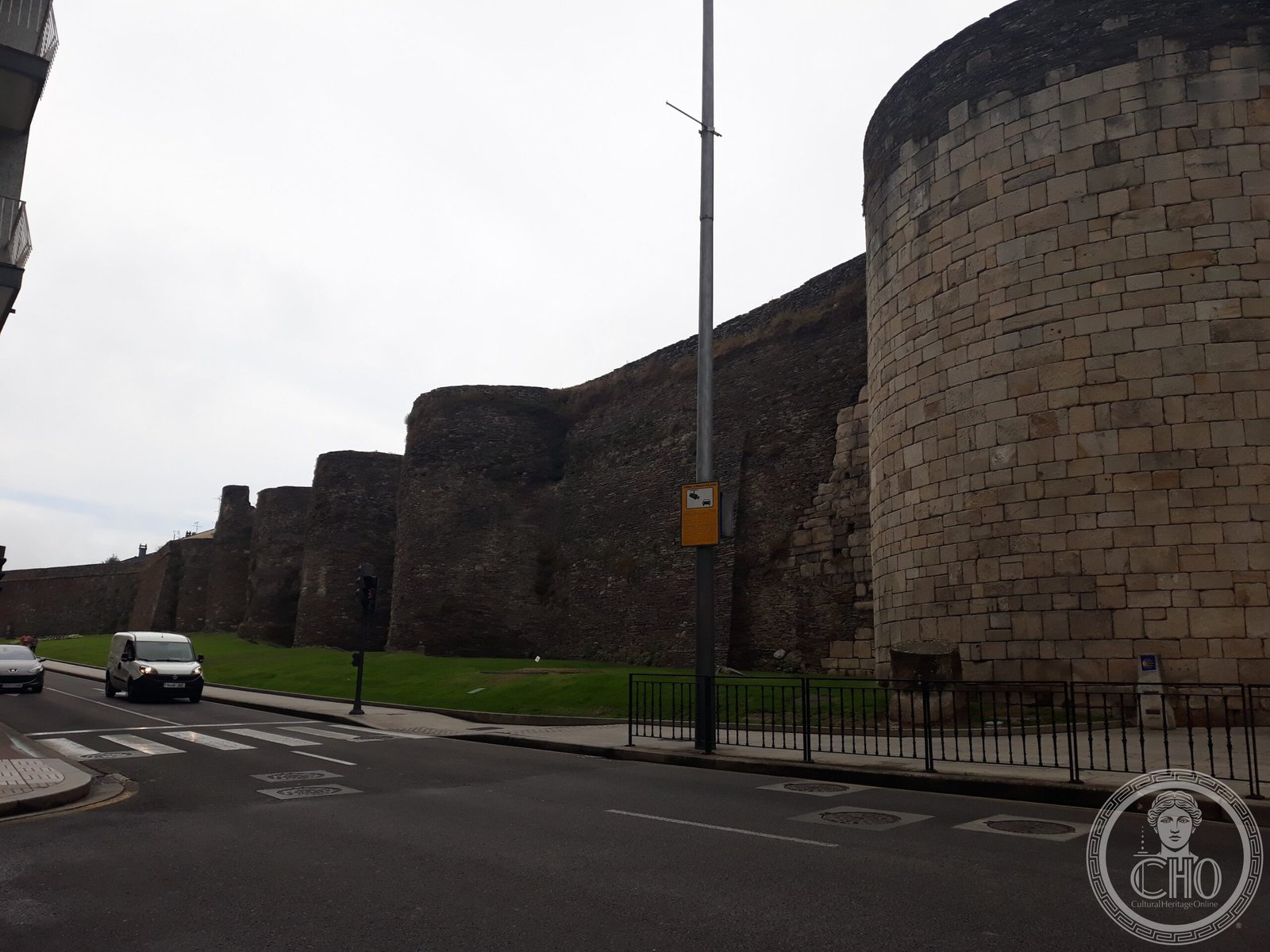
The Roman walls of Lugo, in Galicia in north-western Spain, are the only surviving example of Roman walls that enclose a complete urban area and are still fully intact — a 2.1-kilometre circuit of massive stone masonry built in the 3rd–4th century AD that encircles the entire historic city centre. UNESCO inscribed them in 2000 (ref. 987) as the finest preserved Roman defensive circuit in the western Roman Empire. A continuous rampart walkway (paseo de ronda) allows visitors to walk the full perimeter of the ancient walls at the level of the Roman battlements — an experience available at almost no other Roman military site in the world.
Roman Lucus Augusti
The city of Lugo was founded by the Romans between 26 and 13 BC as Lucus Augusti — a colony intended to consolidate Roman control over the recently conquered Gallaeci and Cantabrian peoples of north-western Iberia. It became the capital of the province of Gallaecia (a sub-division of Hispania Tarraconensis) and a significant administrative, commercial and road-network centre. The Roman city occupied approximately the same area as the historic walled core today; the street grid of the Roman city is still legible in the current urban fabric.
The Walls
The walls were built in the late 3rd century AD (c. 260–310 AD), during the era of military crisis when Roman frontier cities across the empire were being fortified against increasing instability. They are built of local slate and granite schist, with courses of cut stone bonded with Roman concrete. The circuit is 2.117 km long, the walls average 10 metres high and 4.2 metres thick at the base, and they are reinforced by 71 semicircular towers (originally 85) projecting from the outer face at regular intervals — a defensive system designed to provide interlocking fields of fire along the entire wall face. Ten gateways punctuate the circuit; ten of the original Roman gates survive in various degrees of preservation.
The Rampart Walk
The defining experience of Lugo is the paseo de ronda — the continuous walkway along the top of the walls, which runs the full 2.1 km circuit and is open to the public year-round, free of charge. Walking the circuit takes approximately 45–60 minutes at a gentle pace. From the rampart, views extend over the modern city on one side and the historic centre on the other; the scale of the Roman engineering becomes physically apparent — the walls are massive, and their construction in tight domestic stone makes them feel both indestructible and organic. This walkable circuit is what makes Lugo unique among Roman walled cities: at Avila, at Carcassonne, at Conwy, you can walk sections; at Lugo, you walk it all.
The Historic Centre
Within the walls, Lugo retains a compact and liveable historic centre of considerable quality. The Cathedral of Santa María (begun 1129, with Romanesque nave, Gothic chapels and a 18th-century Baroque facade) is one of the major Romanesque cathedrals of northern Spain. The Campo Castelo (the Roman forum area) is now the central plaza. Roman bath remains are visible at the Termas Romanas site, and the Museo Provincial houses an important collection of Galician-Roman antiquities including altars, mosaics and the remarkable Castro culture gold and silver torcs.
Practical Information
The rampart walk is free and open every day. The Museo Provincial on Praza da Soledad is open Tuesday–Saturday (free on Sundays). The cathedral can be visited daily. Lugo is 100 km east of Santiago de Compostela by motorway (A-6; 1 hour), and 450 km from Madrid (4 hrs). ALSA and Monbus coaches connect Lugo with Santiago, A Coruña and Madrid. GPS (city centre/walls): 43.010° N, 7.560° W.
The Camino Connection
Lugo lies on the Camino Primitivo — the oldest route of the Camino de Santiago, considered the most challenging and the most historically authentic of the Camino routes. Pilgrims who walk the Camino Primitivo from Oviedo to Santiago pass through Lugo, entering the old city through one of the Roman gates and sleeping within the ancient walls. The Camino route enters via the Porta Miñá (the best-preserved of the original Roman gates) and exits through the Porta Nova.
Nearby
Santiago de Compostela (100 km west) is the natural companion destination, with its UNESCO-listed cathedral and historic centre. The Ribeira Sacra wine region — terraced vineyards on the dramatic canyon of the Sil and Miño rivers — is 60 km south and among Galicia’s most spectacular landscapes. The coastal cities of A Coruña and Pontevedra are 100–120 km west.
Find it on the map
See this place and what’s around it →📷 Become a Cultural Heritage Online photographer
Share your photos of places: they stay published under your name as the author. The more they're seen, the more you get noticed — and soon a contest will reward the most appreciated photos.
Log in or sign up free to add a photo