

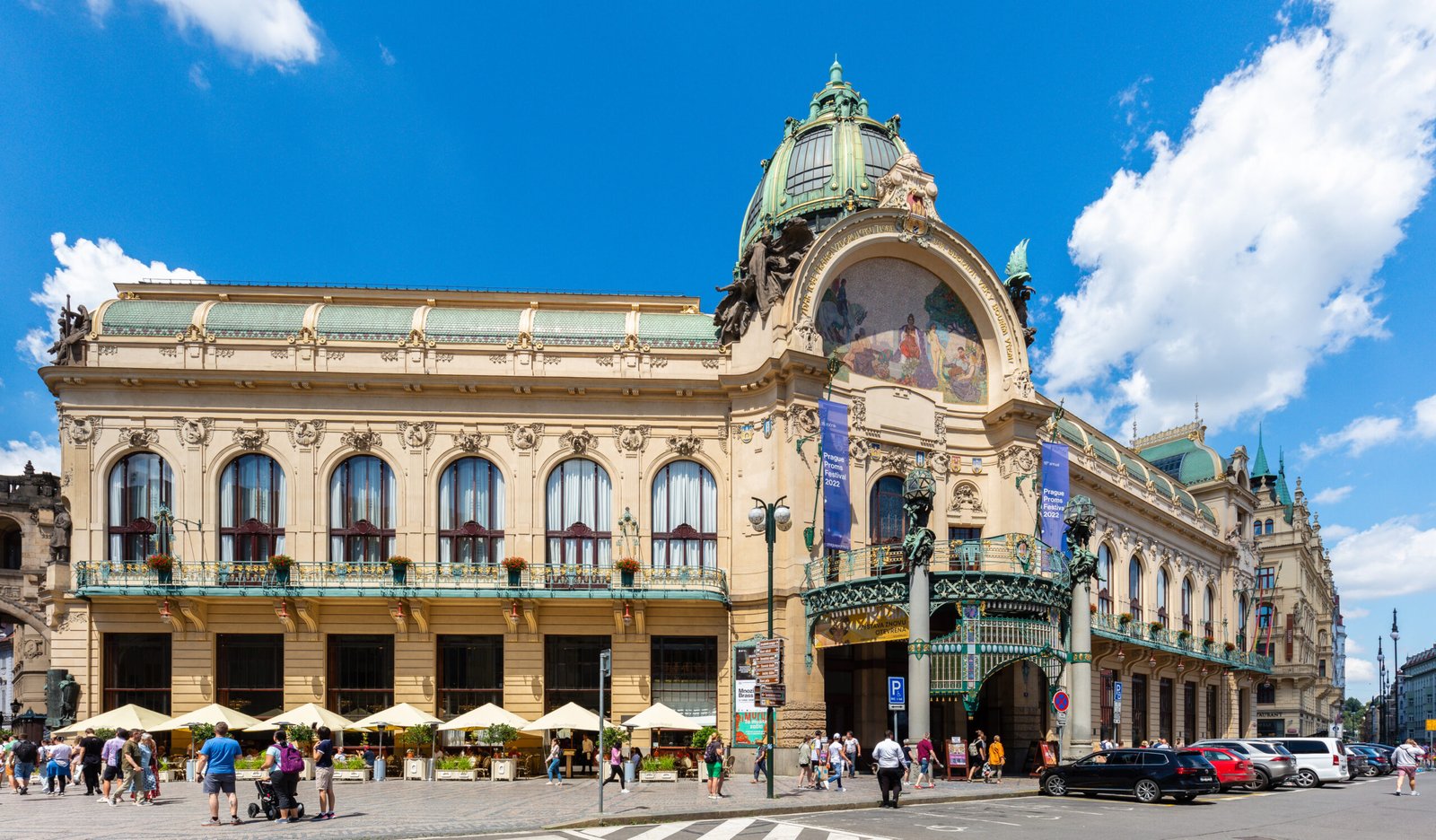
The grandest civic statement of Czech Art Nouveau: a concert hall, café and ceremonial building where, in 1918, Czechoslovak independence was declared from the balcony.
At a glance
The Municipal House stands on Náměstí Republiky, beside the medieval Powder Gate, on the site of the former Royal Court that once served as the seat of Bohemian kings. Built between 1905 and 1912 to designs by Antonín Balšánek and Osvald Polívka, it was conceived as a representative building for the Czech nation — a place for concerts, balls, exhibitions and civic ceremony. Nearly every leading Czech artist of the era contributed: Alfons Mucha decorated the Lord Mayor’s Hall, and the central Smetana Hall remains one of Prague’s principal concert venues. On 28 October 1918, the independent state of Czechoslovakia was proclaimed here.
Key facts
- Built: 1905–1912
- Architects: Antonín Balšánek and Osvald Polívka
- Style: Czech Art Nouveau (Secese)
- Address: Náměstí Republiky 5, 110 00 Prague 1, Czech Republic
- GPS: 50.087620, 14.428240 — Open in Google Maps
- Interiors: Smetana Hall; Lord Mayor’s Hall decorated by Alfons Mucha
- Status: Active concert hall, café and event venue; protected cultural monument
History
The building rose on a charged site: the Royal Court palace, residence of Bohemian kings in the fifteenth century, had stood here before falling into ruin. At the start of the twentieth century the city chose the plot for a representative house of culture, and a competition went to Balšánek and Polívka. Construction ran from 1905 to 1912, and the result drew on the whole circle of Czech artists then defining a national style — Mucha, Max Švabinský, Jan Preisler and the sculptor Ladislav Šaloun among them.
The house quickly became a stage for history as well as music. On 28 October 1918, with the Habsburg empire collapsing, Czech leaders proclaimed independent Czechoslovakia from the Municipal House. Smetana Hall has hosted the opening concert of the Prague Spring music festival, traditionally Smetana’s Má vlast, for decades. The building was restored in the 1990s.
What you see
The façade curves around the corner of the square in pale stone and iron, crowned by a glass-and-iron canopy over the entrance and a large semicircular mosaic, Homage to Prague, set into the gable above. Wrought-iron lamps, garlands and allegorical figures cover the front; the dome rises behind. Next door, the dark Gothic mass of the Powder Gate makes the contrast deliberate — old Prague and new, side by side.
Inside, the spaces escalate from the celebrated café, with its marble, brass and mirrors, to the circular Smetana Hall under a glass dome, ringed by balconies and stage murals. The Lord Mayor’s Hall, smallest and richest, is entirely Mucha’s: murals of Slavic concord and civic virtue wrap the walls and ceiling in his unmistakable line.
Practical information
- Access: The café and restaurant are open to all; the historic interiors are seen on guided tours or by attending a concert
- Concerts: Smetana Hall hosts a regular programme; book ahead for the Prague Spring festival
- Time needed: 60–90 minutes for a guided tour
- Photography: Permitted on tours; check current rules for concerts
Getting there
The Municipal House is on Náměstí Republiky in the centre of Prague’s Old Town, beside the Powder Gate. The metro station Náměstí Republiky (Line B) is a two-minute walk; numerous trams stop nearby. From Old Town Square, walk east along Celetná Street, passing under the Powder Gate, and the building is directly ahead.
Nearby
- Powder Gate (Prašná brána), immediately adjacent
- Old Town Square and the Astronomical Clock, a short walk west
- Praha hlavní nádraží — the city’s Art Nouveau main station
Sources
- Národní památkový ústav (National Heritage Institute of the Czech Republic) — cultural monument record
- Obecní dům — official building documentation and programme
- Prague City Tourism — heritage descriptions
Find it on the map
See this place and what’s around it →Record researched and written by Luigi De Marchi for Cultural Heritage Online, 2026.
📷 Become a Cultural Heritage Online photographer
Share your photos of places: they stay published under your name as the author. The more they're seen, the more you get noticed — and soon a contest will reward the most appreciated photos.
Log in or sign up free to add a photoIs this page about you?
This page is read by travellers and heritage enthusiasts who find it on Google. Tell us how you are connected to this place and we will take it from there.