
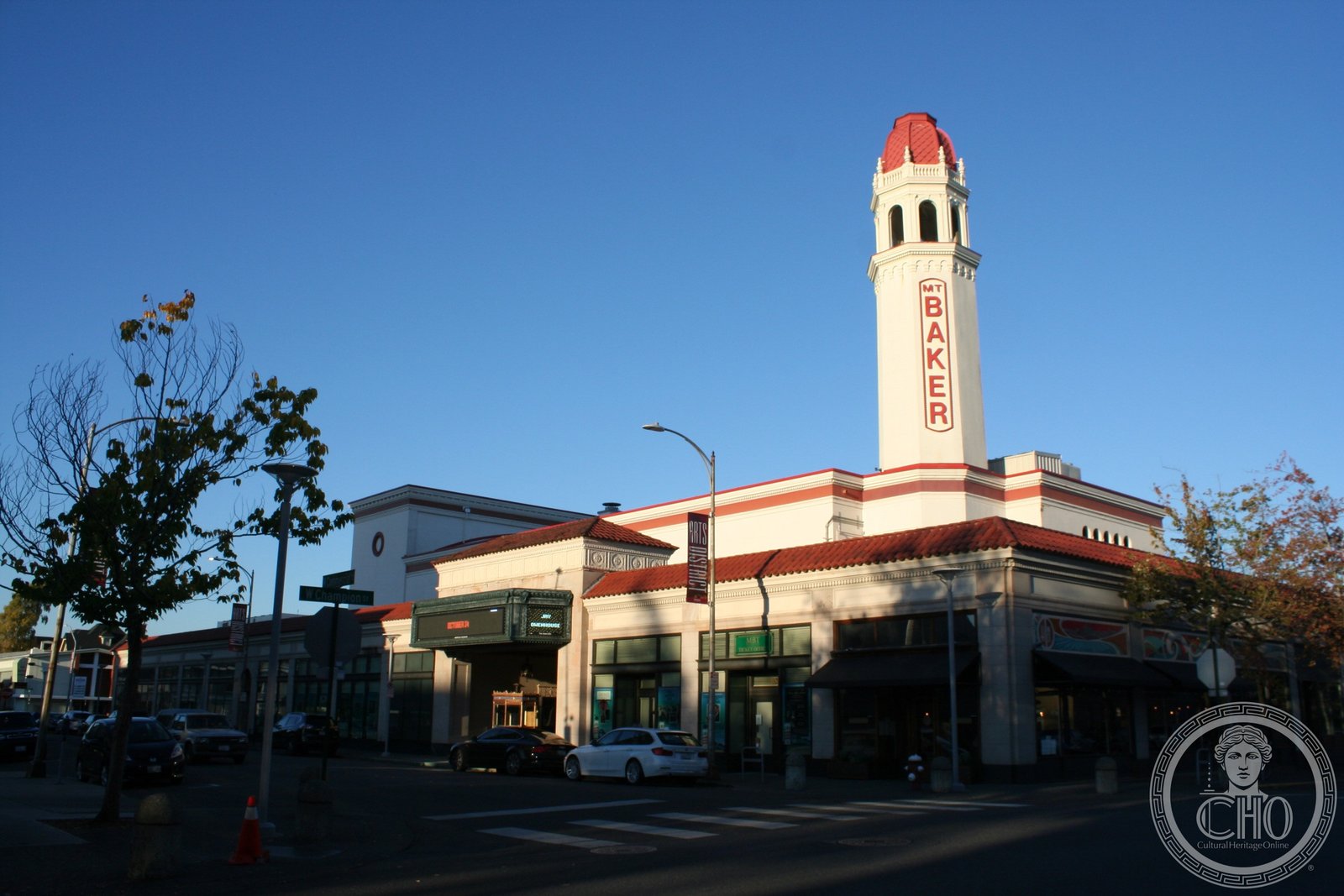
Opened in 1927 in downtown Bellingham, the Mount Baker Theatre is one of the Pacific Northwest’s most elaborately ornamented surviving theaters, its Moorish Revival and Spanish Colonial interior a vivid record of the Roaring Twenties’ appetite for theatrical exoticism.
At a glance
Bellingham sits at the northern edge of Puget Sound, forty miles south of the Canadian border and within sight of the San Juan Islands. When the Mount Baker Theatre opened in 1927, it was the grandest building in a prosperous timber and fishing town that was beginning to attract Western Washington University students and look beyond resource industries toward a more diversified economy. The theater’s elaborate interior — Moorish arches, star-patterned ceilings, polychrome plasterwork — was designed to transport audiences from an everyday mill town to somewhere imagined and distant, a function the 1920s picture palace shared with the decorative ambition of Art Deco and the travel fantasies of the broader period. Still operating today as a performing arts center, the Mount Baker Theatre remains the most complete example of late-twenties theatrical ornamentation remaining in Washington State.
Key facts
- Opened: 1927
- Style: Moorish Revival / Spanish Colonial Revival
- Address: 104 North Commercial Street, Bellingham, Washington 98225
- Current use: Performing arts center — concerts, dance, theater, film
- GPS: 48.7504° N, −122.4769° W
- Status: National Register of Historic Places; active venue
History
Bellingham in the 1920s was a consolidated city — four separate towns (Whatcom, Sehome, Bellingham, and Fairhaven) had merged in 1903 — with a mixed economy of salmon canneries, coal shipping, and lumber. Commercial Street was the downtown spine, and the new theater was positioned at its heart. The building opened in the silent film era; the arrival of sound two years later required technical retrofitting, as it did for theaters nationwide. The ornate interior, designed in the Moorish and Spanish Colonial idiom that Hollywood had popularized through its own theater construction, cost significantly more per seat than a plain house would have — a deliberate signal that Bellingham’s civic ambitions matched those of larger Pacific Coast cities.
The theater survived the Depression, the transition to television, and the multiplex era through a combination of its central location, its scale (the main auditorium holds well over a thousand people), and the loyalty of a community that found in it a civic gathering place beyond its function as entertainment. Restoration campaigns beginning in the 1990s addressed the building’s structural condition and recovered much of the original ornamental plasterwork. Today the Mount Baker Theatre Foundation manages the venue as a regional performing arts presenter, hosting touring Broadway productions, orchestral concerts, dance companies, and community events.
What you see
The exterior on Commercial Street is relatively restrained: a brick facade with arched window openings and a vertical marquee sign. The ornamental richness that defines the building is reserved for the interior. The main auditorium is a horseshoe of arched alcoves lining the side walls, each framed with Moorish-patterned plasterwork — geometric, polychrome, densely layered. The ceiling above the main floor and balcony carries a stylized night sky, plaster stars and crescent motifs set against deep blue, making the room feel simultaneously vast and intimate. Scalloped archways, tiled medallions, and pointed niches modeled after Andalusian and North African palace interiors appear at every level, applied with the enthusiasm characteristic of the American interpretation of Moorish ornament in the 1920s.
The backstage infrastructure has been upgraded repeatedly to accommodate modern touring productions, but the sight lines and acoustic properties of the original horseshoe auditorium have been preserved. Arriving for an evening event, visitors pass from the plain Pacific Northwest daylight of Commercial Street into an interior of deliberate fantasy — which was precisely the architectural intention.
Practical information
- Events: active presenting venue; check the Mount Baker Theatre calendar for current programming
- Tickets: available at the box office (104 N Commercial Street) and online
- Tours: periodic public tours of the interior; check the venue website for schedule
- Parking: public parking garage 1 block east on Chestnut Street; street parking on Commercial Street
- Time needed: 30 minutes for the lobby and auditorium; full evening for a performance
Getting there
Bellingham International Airport (BLI) is approximately 4 miles northwest of downtown; the theater is a 10-minute drive or taxi ride from the terminal. The Bellingham Amtrak station — served by the Cascades corridor linking Seattle and Vancouver, British Columbia — is approximately 3 miles south in the Fairhaven district; a local Whatcom Transit bus connects Fairhaven to downtown in under 10 minutes, and the theater is a straightforward ride-share from the platform. Anacortes, the ferry terminal for Washington State Ferries service to the San Juan Islands, lies about 18 miles south-southwest via SR-20. Local Whatcom Transit routes connect the downtown core.
Nearby
- Whatcom Museum (Lightcatcher Building) — regional art and natural history, including a 2009 Tod Williams Billie Tsien pavilion, 2 blocks south on Prospect Street
- Western Washington University — campus with a significant outdoor sculpture collection on Sehome Hill, 1 mile southeast
- Bellingham Waterfront District — redeveloped industrial waterfront on Bellingham Bay, 6-minute walk west of the theater
- Whatcom Falls Park — old-growth forest preserve with a 1939 WPA stone bridge, 2 miles east
Sources
- Mount Baker Theatre, Bellingham — venue history and programming
- National Register of Historic Places — Mount Baker Theatre nomination
- Washington State Department of Archaeology and Historic Preservation — historic theater records
- Whatcom Museum — Bellingham architectural history collection
- Wikimedia Commons — building image
Find it on the map
See this place and what’s around it →Record researched and written by Luigi De Marchi for Cultural Heritage Online, 2026.
📷 Become a Cultural Heritage Online photographer
Share your photos of places: they stay published under your name as the author. The more they're seen, the more you get noticed — and soon a contest will reward the most appreciated photos.
Log in or sign up free to add a photoIs this page about you?
This page is read by travellers and heritage enthusiasts who find it on Google. Tell us how you are connected to this place and we will take it from there.