
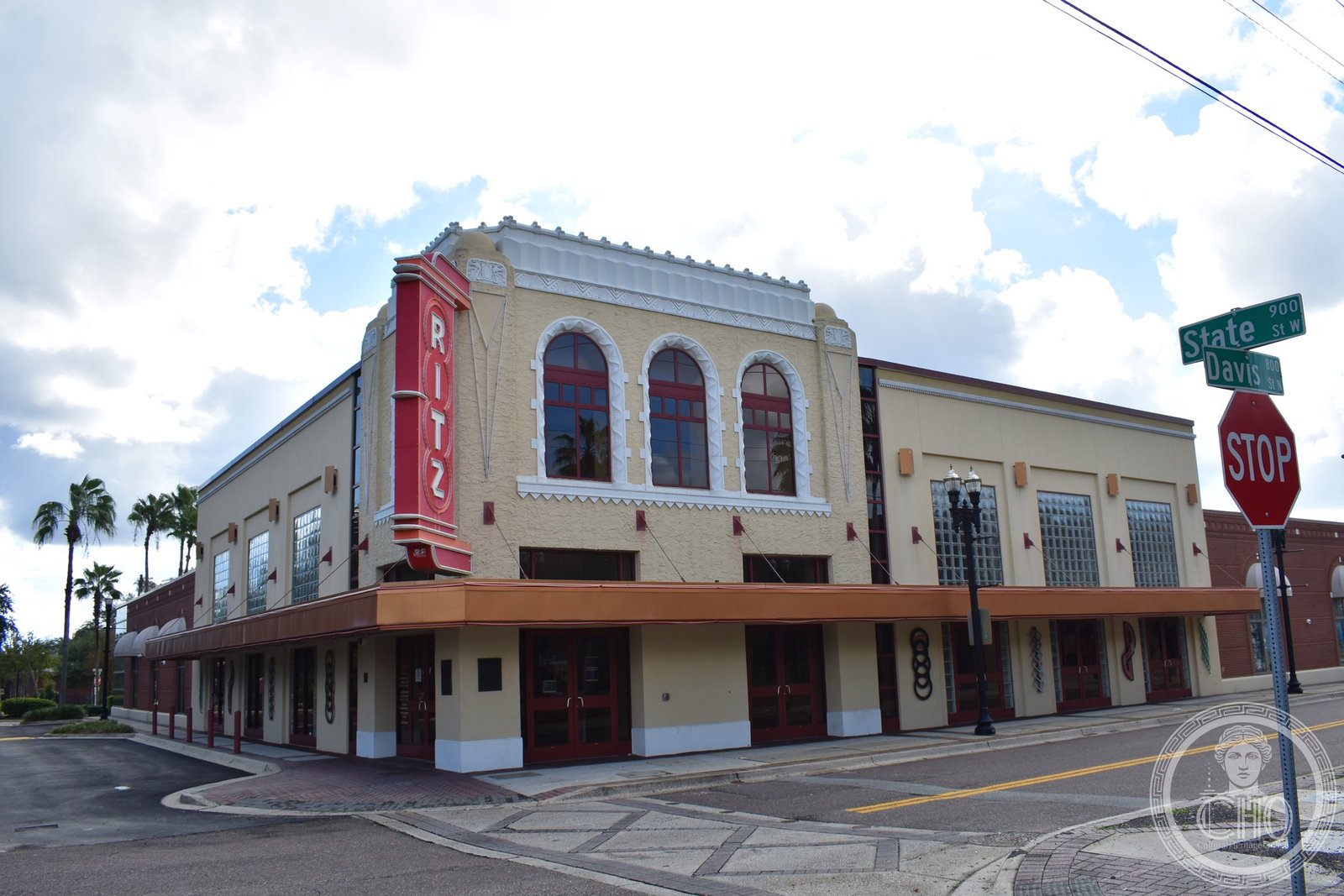
Built in Jacksonville’s LaVilla district at the height of the Jazz Age, the Ritz Theatre opened in 1929 as one of Florida’s foremost African American performance venues, and its Art Deco facade still defines this block of North Davis Street.
At a glance
LaVilla was Jacksonville’s African American cultural and commercial hub through much of the early twentieth century — a district dense with jazz clubs, barbershops, and theaters within walking distance of the railroad. The Ritz opened in 1929 into this world, offering films, vaudeville, and live music to audiences who were excluded from the city’s segregated downtown houses. The building’s Art Deco front — stepped terracotta ornament, a vertical marquee, geometric banding along the cornice — announced ambition and modernity in equal measure. After decades of decline following desegregation’s dispersal of the segregated entertainment economy, the Ritz was rescued from demolition, restored, and reopened as a performing arts center and museum devoted to LaVilla’s history. It remains an active stage and the most visible monument to a district that shaped Jacksonville’s musical identity.
Key facts
- Built: 1929
- Style: Art Deco (Zigzag Moderne)
- Address: 829 North Davis Street, Jacksonville, Florida 32209
- District: LaVilla Historic District
- Current use: Ritz Theatre & LaVilla Museum — performing arts and cultural exhibits
- GPS: 30.3260° N, −81.6645° W
- Status: Active performing arts venue
History
LaVilla’s rise as an African American cultural district accelerated after the Great Fire of 1901 rebuilt Jacksonville’s west side, and by the 1920s the neighborhood concentrated a remarkable density of music, commerce, and community life. The Ritz Theatre, opening in 1929, arrived at the district’s height. Jacksonville sat at the crossroads of Atlantic Coast Line and Seaboard Air Line railroads, and the performers who moved up and down the Eastern Seaboard — blues musicians, jazz orchestras, traveling vaudeville companies — passed through LaVilla’s performance circuit.
Desegregation in the 1960s and urban renewal policies of the following decades fragmented the neighborhood that had sustained the Ritz. The theater fell into disuse, and by the 1980s faced demolition. A preservation campaign organized around the building’s cultural significance succeeded in saving the structure. Restoration work recovered the Art Deco exterior, and the Ritz reopened in phases as the Ritz Theatre & LaVilla Museum, combining performance programming with permanent and rotating exhibits on African American history in Jacksonville and the region.
The museum’s collection documents LaVilla’s decades as a center of Black commerce and culture, and the theater’s stage has since hosted jazz, gospel, spoken word, and community events connecting the restored building back to its original purpose.
What you see
The Ritz’s facade presents a compact Art Deco composition in brick and terracotta: a central vertical marquee rising above a recessed entrance, flanked by geometric ornamentation in the stepped, angular vocabulary of late-1920s Zigzag Moderne. Polychrome terracotta detailing accents the cornice and entrance surround, adding depth to what is otherwise a modest street-front presence. The proportions are tight — this was a neighborhood theater built for a working district, not a grand picture palace — but the ornamental quality of the stonework places it firmly in the commercial Deco tradition that characterized American movie houses of the period.
Inside, the restored auditorium recovers the original scale and orientation of the 1929 house, with updated technical infrastructure for contemporary performances. The adjacent museum galleries occupy spaces connected to the theater block, their displays anchored by the building’s own history as the entry point to LaVilla’s story.
Practical information
- Museum hours: Tuesday–Saturday, daytime; verify current hours before visiting
- Performance tickets: available through the Ritz Theatre box office; programs range from jazz to spoken word
- Admission: museum admission applies; performance tickets separate
- Accessibility: ground-floor entry; accessible seating available
- Time needed: allow 1–2 hours for museum and theater lobby
Getting there
Jacksonville International Airport (JAX) lies roughly 12 miles north-northwest; the drive follows I-95 south toward downtown then west into LaVilla. The Jacksonville Amtrak station — served by the Silver Meteor and Silver Star on the New York–Miami corridor — is approximately 1.5 miles south, within a short ride. The LaVilla neighborhood sits just west of downtown Jacksonville; from the core of downtown, North Davis Street is a 10–15 minute walk along Bay Street. Surface parking lots adjoin the theater block.
Nearby
- Prime Osborn III Convention Center — the converted 1919 Union Terminal rail shed, 1 mile east, preserving the architectural frame of LaVilla’s railroad economy
- Museum of Science and History (MOSH) — riverside natural and cultural history museum, 1.5 miles northeast on the St. Johns River
- Cummer Museum of Art & Gardens — fine arts collection with formal riverfront gardens, 2.5 miles west in Avondale
- Riverside Arts Market — Saturday market under the Fuller Warren Bridge, 1 mile south across the river
Sources
- Ritz Theatre & LaVilla Museum, Jacksonville — official programming and history pages
- National Register of Historic Places — LaVilla Historic District documentation
- Florida Division of Historical Resources — African American cultural heritage resources
- Jacksonville Historical Society — LaVilla neighborhood history
- Wikimedia Commons — building image
Find it on the map
See this place and what’s around it →Record researched and written by Luigi De Marchi for Cultural Heritage Online, 2026.
📷 Become a Cultural Heritage Online photographer
Share your photos of places: they stay published under your name as the author. The more they're seen, the more you get noticed — and soon a contest will reward the most appreciated photos.
Log in or sign up free to add a photoIs this page about you?
This page is read by travellers and heritage enthusiasts who find it on Google. Tell us how you are connected to this place and we will take it from there.