
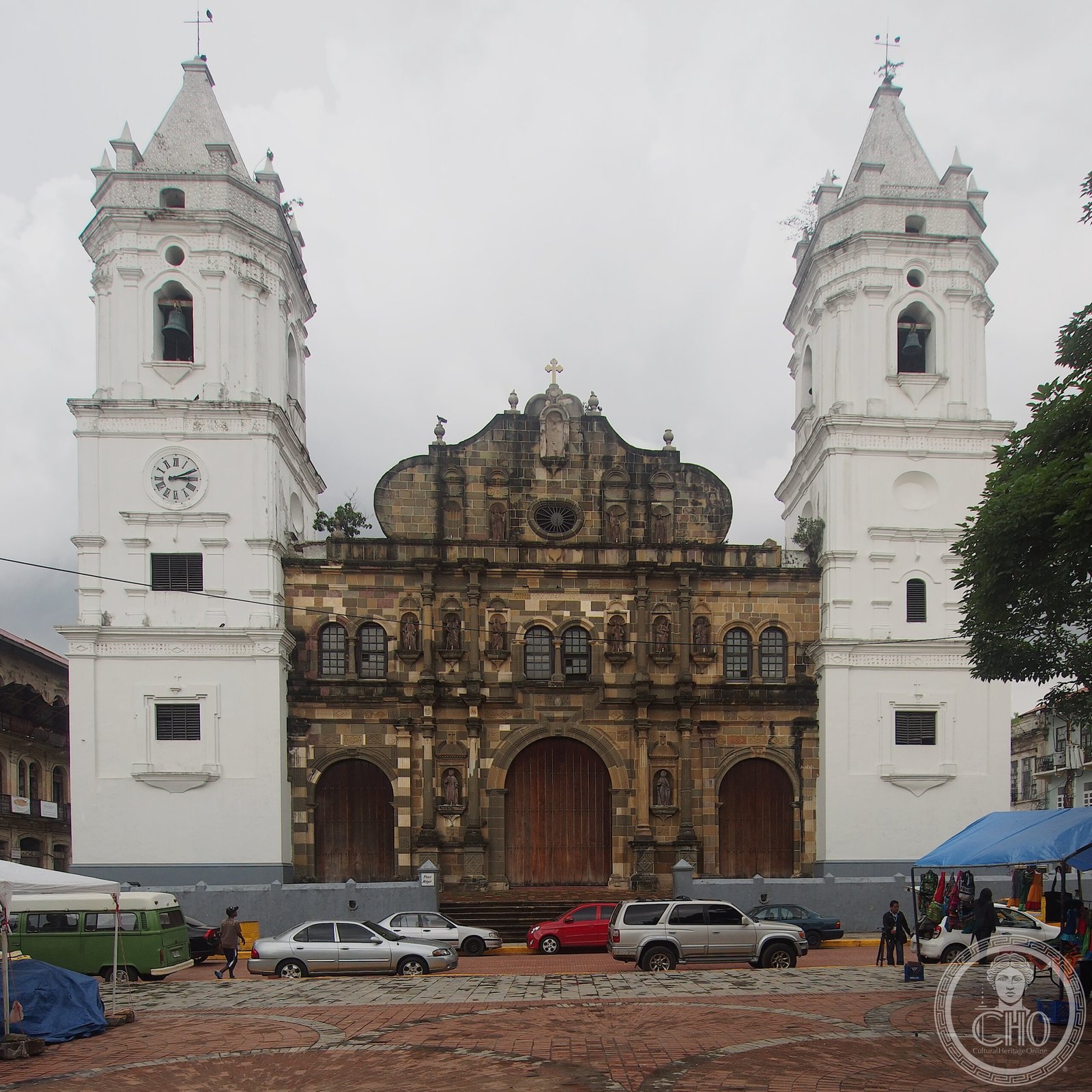
In Panama City, the Metropolitan Cathedral of Santa María la Antigua is the institutional heir of the diocese of Santa María la Antigua del Darién, erected in 1513 by Pope Leo X, the first diocese on the American mainland, and of the later cathedral of Our Lady of the Assumption at Panama Viejo, built in stone between 1619 and 1626. On 28 January 1671 the forces of the privateer Henry Morgan attacked Panama Viejo. A fire destroyed the cathedral, never rebuilt on that site. Its origin remains disputed among historians: some sources attribute it to Morgan’s men, others to an order by the Spanish governor Juan Pérez de Guzmán to blow up the gunpowder stores to deny the city to the pirates, and contemporary accounts already failed to agree on who was responsible. In 1673 the city was moved to the San Felipe peninsula, today’s Casco Viejo, a more defensible site fortified against future pirate attacks. A provisional wooden structure of 1674 was replaced, from 1688, by the present stone building. Construction proceeded in stages, façade 1688-1741, main body 1741-1762, side towers 1762-1796, until the consecration on 4 April 1796 by Bishop Remigio de la Santa y Ortega, a project of 108 years in all. One source attributes the design to the military engineer Nicolás Rodríguez, though the attribution is not confirmed by the more authoritative sources. The style is described inconsistently as Renaissance, sometimes called “Jesuit”, or as colonial Baroque, probably because the more than one hundred years of construction spanned several stylistic currents. The bell towers are traditionally described as inlaid with mother-of-pearl from the Pearl Islands, the archipelago in the Gulf of Panama. This claim is widely repeated by Panamanian sources, including the archdiocese itself, but it has not been possible to trace it to a primary archival document. The original bells were partly melted in a fire in 1737. A restoration between 2015 and 2019 replaced the bells with eight new ones cast in Spain, and installed a new hand-carved marble altar and a pipe organ of around eight tonnes. The building was declared a national historic monument in 1941 and raised to a minor basilica on 22 December 2014, as announced by Archbishop José Domingo Ulloa Mendieta, in office since 2010 and never made a cardinal. On 27 January 2019, during World Youth Day in Panama, Pope Francis personally consecrated the cathedral’s new altar. According to the archdiocese’s official website, Panama’s independence from Spain was proclaimed from the cathedral steps in 1821, and on 3 November 1903, as reported by Archbishop Ulloa and other sources, the first Te Deum for the separation of the isthmus from Colombia was sung here. These details, though relatively well supported, would merit further independent verification. No damage to or use of the cathedral is documented during the US invasion of December 1989 against the regime of Manuel Noriega, whose refuge was instead the apostolic nunciature, a different building. In the immediate aftermath, however, between February and March 1990, the newly elected president Guillermo Endara held a thirteen-day hunger strike inside the cathedral. He used it as office, meeting room and even bedroom, sleeping on a cot and taking only water and consecrated hosts, to press the US administration to release around a billion dollars of aid promised to Panama after the invasion.
About the Metropolitan Cathedral Basilica
In Panama City, the Metropolitan Cathedral of Santa María la Antigua is the institutional heir of the Diocese of Santa María la Antigua del Darién, erected in 1513 by Pope Leo X as the first diocese on the American mainland, and of the later Cathedral of Our Lady of the Assumption at Panamá Viejo, built in stone between 1619 and 1626. On 28 January 1671, forces under pirate Henry Morgan attacked Panamá Viejo; a fire — whose origin remains disputed among historians, attributed variously to Morgan’s men or to a Spanish governor’s order to blow up the gunpowder magazines to deny the city to the pirates, with contemporary accounts themselves unable to agree — destroyed the cathedral there, never rebuilt on that site.
Key facts
- 1688-1796: the current cathedral built over 108 years after the city’s 1673 relocation.
- 28 January 1671: Henry Morgan’s raid destroys the original Panamá Viejo cathedral.
- Bell towers traditionally said to be inlaid with mother-of-pearl from Panama’s own Pearl Islands.
- 1941: declared a National Historic Monument.
- 22 December 2014: elevated to minor basilica status.
- 27 January 2019: Pope Francis consecrates the new altar during World Youth Day.
History
Institutional heir to a cathedral destroyed in Henry Morgan’s 1671 pirate raid on Panamá Viejo, this cathedral rose over 108 years in the fortified new city of Casco Viejo, its towers carrying a strong local tradition — though not an archivally documented one — of mother-of-pearl inlay from Panama’s own Pearl Islands. Pope Francis personally consecrated its restored altar during World Youth Day in January 2019, a rare direct papal touch on a building whose deeper connections to Panama’s 1821 and 1903 independence moments remain only lightly sourced.
What you see
A stone facade blending Renaissance and colonial Baroque elements, the product of construction spanning more than a century, rises with twin bell towers over Casco Viejo’s Plaza de la Independencia. Inside, three principal naves lead to a sanctuary raised seven steps above the floor, above a crypt of bishops, restored between 2015 and 2019 with a new hand-carved marble altar and an eight-ton pipe organ.
Practical information
- Opening hours: generally open daily outside services; check current hours before visiting.
- Address: Plaza de la Independencia, Casco Viejo, Panama City, Panama.
Getting there
The cathedral stands on Plaza de la Independencia in Casco Viejo, Panama City’s historic district. GPS: 8°57′09″N, 79°32′07″W.
Nearby
- Panamá Viejo — the ruined original city and cathedral site, destroyed in 1671, roughly 7 km away.
Sources
- Wikipedia (English and Spanish) — “Metropolitan Cathedral of Panama City” and “Catedral de Panamá”
- Arquidiócesis de Panamá — official site, “El 230° Aniversario de la Dedicación de la Catedral Basílica Santa María la Antigua”
- Wikipedia — “Panamá Viejo” and “Henry Morgan’s Panama expedition”
- Litos Online — “Restoration of the Holy Church Cathedral Metropolitan Basilica Santa María de la Antigua, Panama”
Find it on the map
See this place and what’s around it →📷 Become a Cultural Heritage Online photographer
Share your photos of places: they stay published under your name as the author. The more they're seen, the more you get noticed — and soon a contest will reward the most appreciated photos.
Log in or sign up free to add a photo