
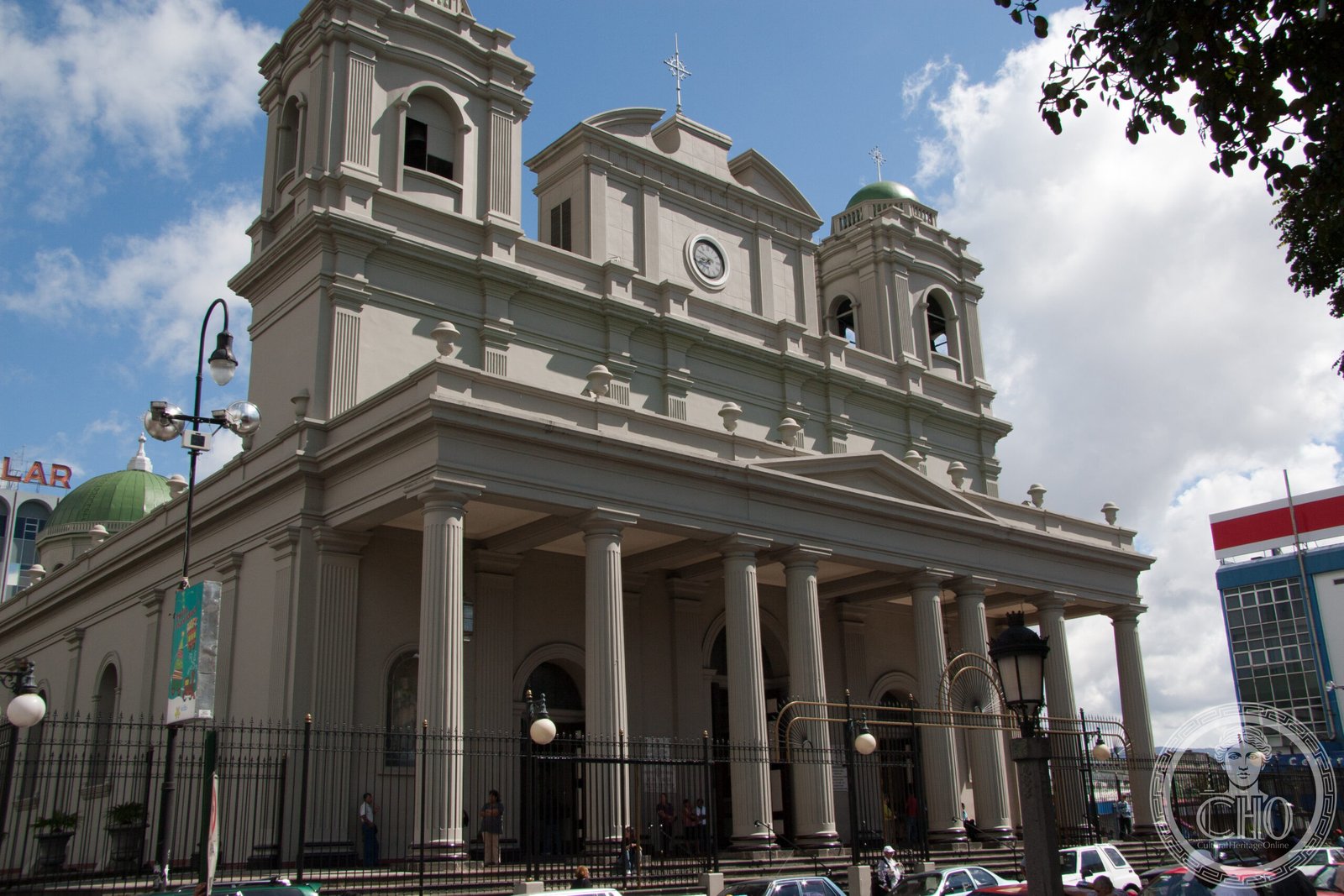
In San Jose, the capital of Costa Rica, the Spanish crown granted the city the title of villa in 1813, with the duty to build a temple fitting its new rank. The building, begun in 1825 under the architect Eusebio Rodriguez, was inaugurated in 1827 and raised to cathedral in 1850, when Monsignor Anselmo Llorente y La Fuente became the first bishop of Costa Rica. Damaged over time by several earthquakes that the sources do not name individually, the building was assessed in 1871 by the architect Jose Quirce and the carpenter Manuel Conejo, who recommended replacing the roof, then of cane, clay and wood. The rebuilding, begun under the direction of Bishop Llorente himself, who died in September of that same year, went on under the priest Domingo Rivas Salvatierra and was substantially completed between 1877 and 1878 by the Guatemalan carpenter Ramon Estrada, who made the dome, the pulpit, the choir and the details of the columns. The building seen today corresponds largely to that reconstruction. A later earthquake, in 1879, damaged the masonry bell towers, which were replaced with metal towers made in Europe. According to a source not fully verified, an earthquake of 1888 in the Fraijanes area destroyed them again. The earthquakes of 1990 and 1991 seriously damaged the structure, leading to a strengthening with new towers of reinforced concrete. During that work a colonial-era cemetery was found on the north side of the church, with the remains of fifteen people, along with indigenous ceramic finds dated between 300 BC and AD 300 and an ancient Christian cross, recovered by the National Museum. Mainly neoclassical in style with Baroque elements, the building was declared a national historic and architectural monument on 21 May 1998, by decree 26936-C. The diocese of San Jose was erected on 28 February 1850 by Pope Pius IX, raised to a metropolitan archdiocese on 16 February 1921 by Pope Benedict XV, and ceded further territory in 2005 for the new diocese of Cartago. The present archbishop is Monsignor Jose Rafael Quiros Quiros, installed on 4 July 2013. No source links this cathedral specifically to the abolition of the Costa Rican army in 1948-49 under Jose Figueres Ferrer, a major national event but one with no documented tie to the building. On 7 December 2021 Archbishop Quiros designated the cathedral as the National Shrine of Costa Rica, on the centenary of the archdiocese. Pope John Paul II came here on 3 March 1983, to meet Costa Rican priests, seminarians and religious, during the only papal visit the country has ever received.
About the Metropolitan Cathedral
In San José, Costa Rica, the Spanish Crown granted the city the title of villa in 1813, with an obligation to build a temple befitting its new status; the building, begun in 1825 under architect Eusebio Rodríguez, was inaugurated in 1827 and elevated to cathedral status in 1850, when Monsignor Anselmo Llorente y La Fuente became Costa Rica’s first bishop. Damaged over time by several unnamed earthquakes, the building was assessed in 1871 by architect José Quirce and carpenter Manuel Conejo, who recommended replacing its cane, clay, and wood roof; reconstruction, begun under Bishop Llorente before his death that September, continued under priest Domingo Rivas Salvatierra and was substantially completed between 1877 and 1878 by Guatemalan carpenter Ramón Estrada, who executed the dome, pulpit, choir, and column details — the building seen today largely reflects this reconstruction.
Key facts
- 1825-1827: the first cathedral built, elevated to that status in 1850.
- 1871-1878: substantially rebuilt into its current form after cumulative earthquake damage.
- 1990-1991: earthquakes prompt reinforced-concrete towers and uncover a colonial-era cemetery.
- 21 May 1998: declared a national architectural-historical monument.
- 3 March 1983: Pope John Paul II visits, in Costa Rica’s only papal visit to date.
- 7 December 2021: designated Costa Rica’s National Sanctuary.
History
Rebuilt repeatedly across the 19th and 20th centuries after cumulative earthquake damage, this cathedral’s current form dates largely to an 1871-1878 reconstruction, with its bell towers rebuilt at least twice more after further quakes. The 1990-1991 earthquakes that prompted its final reinforcement also uncovered an unexpected colonial-era cemetery beside the church, alongside indigenous ceramics dating back some two thousand years — a reminder of how much older the site’s human history runs than the cathedral standing on it today.
What you see
A neoclassical facade with Baroque touches fronts Parque Central, its twin bell towers now built in reinforced concrete after successive earthquake rebuilds, topped by a metal-clad dome. The cathedral was declared Costa Rica’s National Sanctuary in 2021, a century after its own elevation to archdiocesan status.
Practical information
- Opening hours: generally open daily outside services; check current hours before visiting.
- Address: Calle Central, between Avenidas 2 and 4, facing Parque Central, San José, Costa Rica.
Getting there
The cathedral fronts Parque Central in downtown San José. GPS: 9°55′58″N, 84°04′44″W.
Nearby
- Parque Central — San José’s historic main square, facing the cathedral.
Sources
- Wikipedia (Spanish) — “Catedral metropolitana de San José”
- Wikipedia (Spanish) — “Arquidiócesis de San José (Costa Rica)”
- Vatican.va — Apostolic Journey of Pope John Paul II to Central America, March 1983.
- Iglesia Católica de Costa Rica (iglesiacr.org) — designation of the National Sanctuary, December 2021.
- Catholic-Hierarchy.org and GCatholic.org — Archdiocese of San José listings.
Find it on the map
See this place and what’s around it →📷 Become a Cultural Heritage Online photographer
Share your photos of places: they stay published under your name as the author. The more they're seen, the more you get noticed — and soon a contest will reward the most appreciated photos.
Log in or sign up free to add a photo