

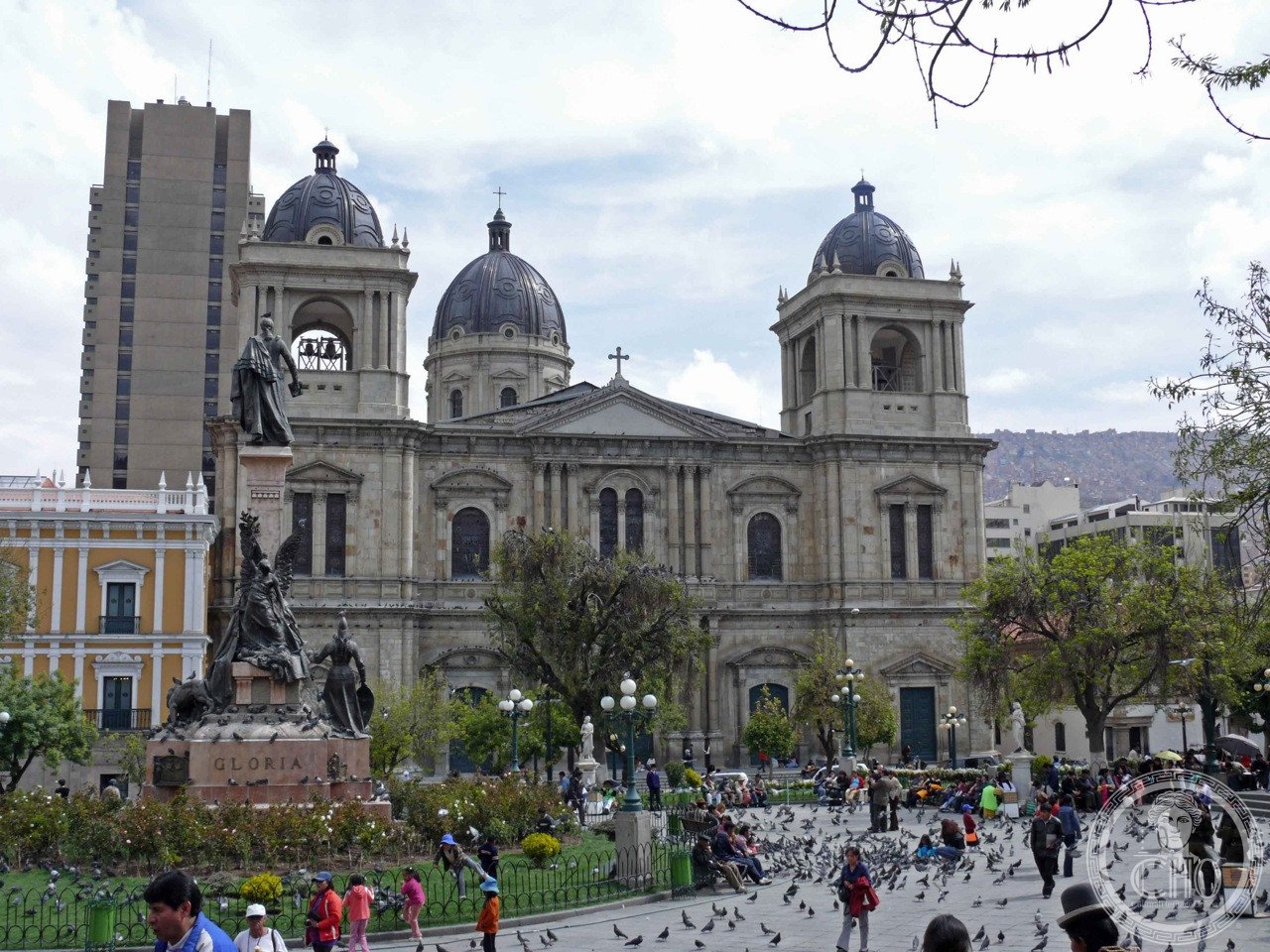
In La Paz, Bolivia, a first cathedral on this site was begun in 1606 under the guidance of fray Domingo de Valderrama, the first bishop to actually govern the diocese erected on 4 July 1605 by Pope Paul V, and completed between 1685 and 1692. The building, damaged by structural cracks, was demolished starting in 1826-1831. President Andrés de Santa Cruz commissioned the priest Manuel Sanahuja to build a new one, whose works began on 24 March 1835. The current cathedral was inaugurated in 1925, coinciding with the centenary of the founding of the Republic of Bolivia, while the interior decoration continued until 1932, with the contribution, at a later stage, of the architect Antonio Camponovo. The two side towers of the facade were completed towards the end of the Eighties, according to some sources in time for the visit of Pope John Paul II in 1988, although sources differ on the exact year between 1987 and 1989, and this detail should therefore be treated with caution. In Neoclassical style with Baroque elements, the building has five naves, each with its own entrance on the two-tiered facade, an altar and a choir base in marble imported from Italy with bronze inlay, and a side chapel holding the remains of Marshal Andrés de Santa Cruz. The diocese was elevated to a metropolitan archdiocese on 18 June 1943; the current archbishop is Percy Lorenzo Galván Flores, in office since 23 May 2020. The cathedral stands on Plaza Murillo, next to the Palazzo Quemado and the Assemblea Legislativa Plurinazionale, the country’s most politically contested square, the scene of unrest in 1809, 1811, 1814, 1862, 1865, 1871, 1898, 1946 — when President Gualberto Villarroel was lynched there — and in 2002. On 26 June 2024 the square was occupied by armed forces in an attempted coup lasting a few hours under General Juan José Zuñiga, with no documented specific assault on the cathedral building. According to a recent tradition, documented at least for the inauguration of President Rodrigo Paz on 8 November 2025, new presidents receive inside the cathedral the blessing of several command batons, although it is not possible to establish how far back this custom goes. Pope John Paul II visited this cathedral on 10 May 1988, meeting the country’s religious sisters there, and Pope Francis held a meeting with civil authorities there on 8 July 2015, as part of a shortened stop in La Paz, according to the press of the time, precisely because of the risks linked to the city’s altitude, which exceeds 3,600 metres.
About the Metropolitan Cathedral
In La Paz, Bolivia, a first cathedral on this site began in 1606 under Fray Domingo de Valderrama, the first bishop to actually govern the diocese erected on 4 July 1605 by Pope Paul V, and was completed between 1685 and 1692; damaged by structural cracks, it was demolished starting around 1826-1831. President Andrés de Santa Cruz commissioned Father Manuel Sanahuja to build a replacement, with construction beginning on 24 March 1835; the current cathedral was inaugurated in 1925, timed to Bolivia’s republican centenary.
Key facts
- 24 March 1835: construction of the current cathedral begins.
- 1925: inaugurated, timed to Bolivia’s republican centenary.
- 10 May 1988: Pope John Paul II meets Bolivia’s religious sisters here.
- 8 July 2015: Pope Francis meets civil authorities here during his Bolivia visit.
- 18 June 1943: La Paz elevated to a metropolitan archdiocese.
- Stands on Plaza Murillo, site of recurring political unrest since the 19th century.
History
Built over ninety years, from an 1835 start to its 1925 centennial inauguration, this cathedral has stood at the center of Bolivia’s most politically charged square through recurring unrest — including the 1946 lynching of President Gualberto Villarroel nearby and a brief 2024 coup attempt on the same plaza — while also hosting two of Bolivia’s few confirmed papal visits, John Paul II in 1988 and Francis in 2015, both documented directly by the Vatican’s own published itineraries.
What you see
A Neoclassical facade with Baroque touches rises in two tiers on Plaza Murillo, its central dome flanked by twin bell towers completed in the late 1980s; inside, five naves each with their own facade entrance lead to an altar and choir base in Italian marble with bronze inlay, and a side chapel holding the remains of Marshal Andrés de Santa Cruz.
Practical information
- Opening hours: generally open daily outside services; check current hours before visiting.
- Address: Plaza Murillo, corner of Calle Comercio and Calle Socabaya, La Paz, Bolivia.
Getting there
The cathedral fronts Plaza Murillo in central La Paz, at an altitude of roughly 3,600-4,000 meters depending on the district. GPS: 16°29′47″S, 68°08′03″W.
Nearby
- Palacio Quemado and the Plurinational Legislative Assembly — both facing the cathedral across Plaza Murillo.
Sources
- Wikipedia (English and Spanish) — “Metropolitan Cathedral of La Paz”
- Catholic-Hierarchy.org and GCatholic.org — Archdiocese of La Paz records.
- Vatican.va — official texts, Pope John Paul II’s 1988 and Pope Francis’s 2015 visits to La Paz Cathedral.
- Visión 360, Unitel and La Patria — coverage of President Rodrigo Paz’s November 2025 inauguration.
Find it on the map
See this place and what’s around it →📷 Become a Cultural Heritage Online photographer
Share your photos of places: they stay published under your name as the author. The more they're seen, the more you get noticed — and soon a contest will reward the most appreciated photos.
Log in or sign up free to add a photo