

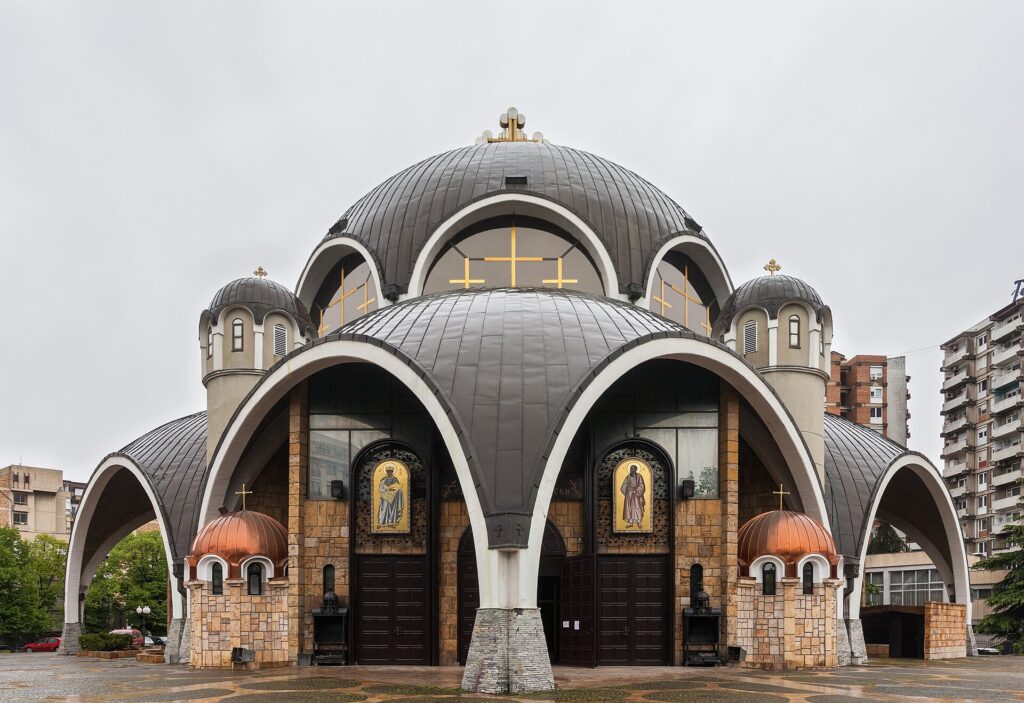
In Skopje, the capital of North Macedonia, work on the cathedral of Saint Clement of Ohrid began in 1972 and was completed with the consecration on 12 August 1990, a date chosen deliberately for the one thousand one hundred and fiftieth anniversary of the birth of the patron saint. The design is by the Macedonian architect Slavko Brezoski, trained in Belgrade, who had already worked in Brazil and Libya and was dean of the faculty of architecture of Skopje from 1970 to 1987. He had returned to the city just after the devastating earthquake of 26 July 1963, which destroyed much of Skopje, and worked on the rebuilding of the city. No source documents a direct causal link between the earthquake and the later construction of this particular cathedral, which should therefore be understood within the broader context of Yugoslav reconstruction modernism, not as an immediate consequence of the earthquake. The building has a central plan of 36 by 36 metres and is «made only of domes and arches», in the current description. It holds a central dome of about 650 square metres, an archiepiscopal throne 3.5 metres high, a polycandelon weighing five tonnes with about 400 bulbs, and a fresco of Christ Pantocrator of 70 square metres whose eyes are a metre and a half across. The bell tower, 45 metres high, holds three Austrian bells. The Macedonian Orthodox Church declared its autocephaly unilaterally in 1967, on the bicentenary of the abolition of the historic archdiocese of Ohrid, an act condemned at the time by the Serbian Orthodox Church, which declared the bishops involved schismatic. For fifty-five years no major Orthodox church recognised it, until the turning point of May 2022, when first the ecumenical patriarchate of Constantinople and then the Serbian synod received the Macedonian Church into communion, as the Orthodox archdiocese of Ohrid. This cathedral, built only in 1972-1990, is not documented as the physical setting of specific events tied either to the declaration of 1967 or to the reconciliation of 2022, but it remains the symbolic and institutional seat of the Church whose leaders were the protagonists of that story. The present archbishop, Stefan, born Stojan Veljanovski, elected in 1999, became on 16 May 2022 the first archbishop of Ohrid canonically recognised by the Serbian synod since the time of Archbishop Dositej, at the end of the eighteenth century. Mother Teresa was born in Skopje on 26 August 1910, but no direct link between her and this Orthodox cathedral is on record: her house museum stands elsewhere in the city, on the site of the former Catholic church of the Sacred Heart of Jesus where she was baptised, a different building of a different confession, and the two places should not be confused or linked editorially.
About the Cathedral
In Skopje, North Macedonia, construction of the Cathedral Church of St. Clement of Ohrid began in 1972 and was completed with its consecration on 12 August 1990, a date chosen to mark the 1,150th anniversary of the birth of the cathedral’s patron saint. The design is by Macedonian architect Slavko Brezoski, trained in Belgrade, who had earlier worked in Brazil and Libya and served as dean of Skopje’s architecture faculty from 1970 to 1987.
Key facts
- 1972-1990: the cathedral built, consecrated on the patron saint’s 1,150th anniversary.
- 1967: the Macedonian Orthodox Church unilaterally declares autocephaly.
- 16 May 2022: the Serbian Orthodox Church formally recognizes it, ending a 55-year schism.
- Central dome roughly 650 square meters, bell tower 45 meters tall.
- Archbishop Stefan, in office since 1999, the first canonically recognized since the 18th-century Archbishop Dositej.
- No documented connection to Mother Teresa, born in Skopje but baptized in a separate Catholic church.
History
Built between 1972 and 1990 in the modernist idiom of post-earthquake Yugoslav Skopje, this cathedral became the seat of a church that had declared its own independence in 1967 and then waited 55 years for any of its fellow Orthodox churches to recognize it — a schism that finally ended in May 2022, when the Serbian Orthodox Church granted formal autocephaly and Archbishop Stefan became the first Archbishop of Ohrid canonically recognized by Belgrade since the 18th century.
What you see
A centrally planned, 36-by-36-meter modernist structure “composed only of domes and arches,” its cascading grey stone-clad cupolas and ribbed arches rising around a central dome of roughly 650 square meters, with a 45-meter bell tower holding three Austrian-cast bells and an interior dominated by a 70-square-meter fresco of Christ Pantocrator.
Practical information
- Opening hours: generally open daily outside services; check current hours before visiting.
- Address: corner of Boulevard Saint Clement of Ohrid and Boulevard Partizanski Odredi, Centar municipality, Skopje, North Macedonia.
Getting there
The cathedral stands in central Skopje, a short walk from the main square and the Goce Delčev bridge. GPS: 41°59′55″N, 21°25′35″E.
Nearby
- Memorial House of Mother Teresa — a separate site elsewhere in Skopje, on the ground of the Catholic church where she was baptized.
Sources
- Wikipedia — “Church of St. Clement of Ohrid,” “Slavko Brezoski,” and “Macedonian Orthodox Church”
- Wikipedia — “Orthodox Ohrid Archbishopship” and “Stefan of Ohrid and Macedonia”
- OrthoChristian.com and KoSSev — coverage of the 2022 Serbian-Macedonian church reconciliation.
- Wikipedia — “Memorial House of Mother Teresa,” on the separate Skopje site.
Find it on the map
See this place and what’s around it →📷 Become a Cultural Heritage Online photographer
Share your photos of places: they stay published under your name as the author. The more they're seen, the more you get noticed — and soon a contest will reward the most appreciated photos.
Log in or sign up free to add a photo