
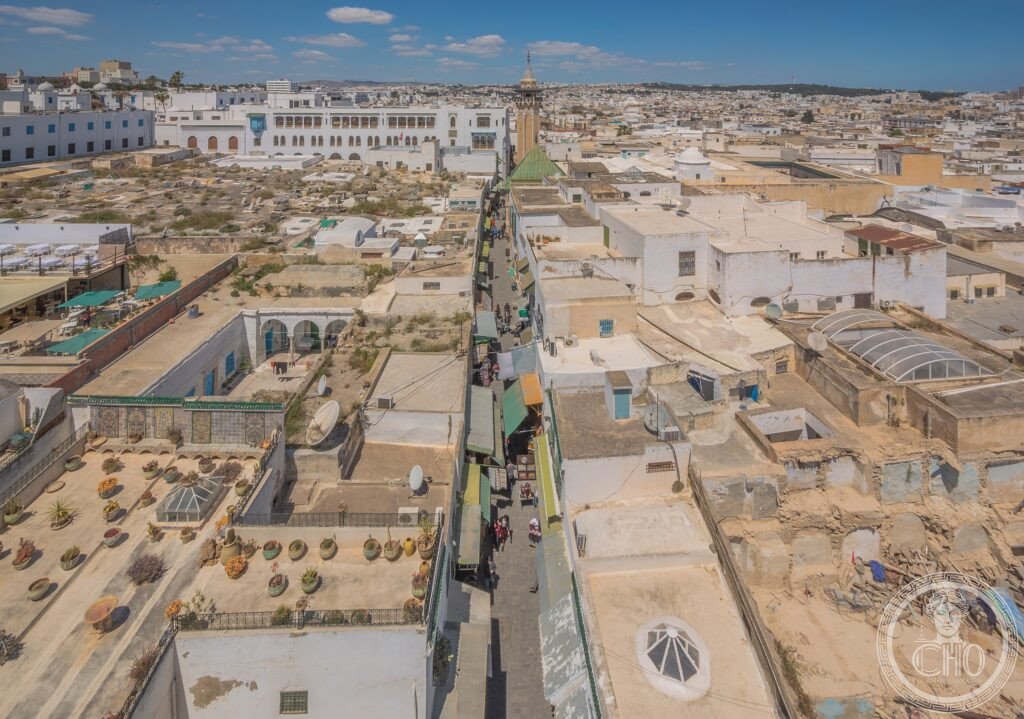
The best-preserved major Islamic medina in the Maghreb. The Medina of Tunis (the old city, as opposed to the French colonial Ville Nouvelle to the east) covers approximately 270 hectares of the oldest continuously inhabited part of the Tunisian capital, containing more than 700 historic monuments. Mosques, palaces, madrasas, mausoleums, and the most intact network of artisanal souks in North Africa. Laid out in the characteristic Islamic urban pattern of a central mosque (the Ez-Zitouna, built 703 AD) surrounded by concentric rings of commercial and residential quarters.
At a glance
Tunis (population of the metropolitan area approximately 2.8 million) is the capital of Tunisia, on the southwestern shore of the Lake of Tunis, 5 km inland from the Gulf of Tunis. The Medina of Tunis (one of the oldest continuously inhabited parts of the Arab world, with settlement dating to the 7th century CE, though the site had been occupied since antiquity as a Berber and then Roman settlement) was inscribed as a UNESCO World Heritage Site in 1979. One of the first Islamic medinas to receive this recognition. Tunisia was the most prosperous North African Arab state for much of the medieval period, and the Medina reflects successive dynasties: the Aghlabids (800–909), Fatimids (909–972), Zirids (972–1148), Almohads (1148–1229), Hafsids (1229–1574), Ottomans (1574–1881), and the French colonial period (1881–1956).
Key facts
- Ez-Zitouna Mosque (Great Mosque of Tunis, Jami’ al-Zaytūna): the central mosque of the Medina and the heart around which the entire urban structure of Tunis is organised. Founded in 703 AD by Hassan ibn al-Nu’man (the Arab general who conquered Carthage), rebuilt substantially between 856 and 863 AD by the Aghlabid emir Abū Ibrāhīm Aḥmad. The mosque has a 9-aisle prayer hall of 184 columns (largely Roman and Byzantine spoliae from Carthage — the Roman city is less than 20 km to the north-east), a distinctive 19th-century Ottoman minaret (replacing an earlier medieval one), and a courtyard with marble cladding. The mosque is not open to non-Muslims for entry into the prayer hall (the rooftop terrace of the adjacent souk is the best viewpoint). The Ez-Zitouna University (attached to the mosque, founded 737 AD) was one of the oldest universities in the world and the most important centre of Islamic learning in North Africa until the French colonial period. Among its alumni are Ibn Khaldun, the 14th-century Arab historian and philosopher considered one of the founding fathers of modern sociology and historiography.
- The souk system: the most complete surviving Islamic artisanal souk network in North Africa. The Medina’s commercial sector is divided into specialised souks arranged in concentric rings around the Ez-Zitouna, with the most prestigious trades (perfume, luxury textiles, gold, books) closest to the mosque and the less prestigious trades (dyers, coppersmiths, saddlers) further away. The major souks: Souk el-Attarine (perfume and fragrance, adjacent to the mosque), Souk el-Trouk (Turkish merchants’ bazaar, established by Ottoman traders in the 17th century), Souk el-Berka (former slave market, the largest in North Africa, now a jewellery market), Souk el-Leffa (blankets and woollen textiles), and the Souk des Chéchias (the distinctive red felt caps worn throughout North Africa and the Ottoman world — Tunis is still the main centre for chéchia production, with approximately 50 workshops still operating in the Medina).
- Bardo National Museum (outside the Medina): while not within the Medina UNESCO zone, the Bardo (3 km west of the Medina in the former Hafsid/Husainid Bey palace complex) is the essential complement to a Medina visit. It houses the world’s largest collection of Roman mosaics (from the excavations of Carthage, El Djem, Dougga, Bulla Regia, and dozens of other North African Roman sites), including the extraordinary Odyssey mosaic cycle (3rd century AD) and the largest mosaic in the ancient world (the Hunt mosaic from Carthage, 8th century AD, 5 metres × 3 metres). The Bardo building itself (a former harem palace, 13th–17th century) is a fine example of Hafsid and Andalusian architecture with its tiled courtyard and carved stucco ceilings.
- Andalusian heritage: the expulsion of the Moriscos from Spain (1609 — approximately 300,000 Muslims expelled by Philip III from Andalusia, Valencia, and Aragon) brought a massive wave of skilled craftspeople, musicians, and gardeners to Tunis, where they settled in specific neighbourhoods of the Medina (Ras Tabia, Bab Souika) and profoundly influenced the city’s architecture, music (the Malouf classical music tradition of Tunisia derives from Andalusian court music), ceramic tiles (the zellige and faience styles in the Medina’s palatial architecture are of direct Andalusian origin), and food culture. The neighbourhood of M’hamsa (near Bab Souika) still has families who trace their origin to Andalusia and maintain the Spanish-Arabic dialect of their ancestors.
- Husainid dynasty palaces: the Husainid Beys (who ruled Tunisia as Ottoman vassals and then independent sovereigns from 1705 to 1957) built a series of ornate palaces within the Medina that synthesise Andalusian, Ottoman, Italian, and French decorative traditions in a distinctive Tunisian palatial style. The Dar Lasram (1793, a private palace now housing the Association for the Safeguarding of the Medina), the Dar Ben Abdallah (early 19th century, now the Museum of the City of Tunis with its extraordinary collection of Tunisian costume and domestic objects), and the Dar Hussein (mid-18th century, now the national heritage office) are the best examples open to the public.
- Heritage: UNESCO World Heritage Site, Medina of Tunis, inscribed 1979.
- GPS: 36.7992° N, 10.1706° E.
History
The site of Tunis was inhabited before the Arab conquest (the Berber town of Tunes is mentioned by ancient Greek and Roman sources), but the city’s current form dates entirely from the Islamic period: Hassan ibn al-Nu’man established the Arab garrison city of Tunis in 698 AD immediately after destroying the Byzantine city of Carthage (15 km to the north-east), which had been the administrative capital of Roman and Byzantine North Africa for nearly 700 years. The intentional destruction of Carthage and creation of Tunis as its successor city is one of the most deliberate acts of urban replacement in history. The Ez-Zitouna mosque was founded five years later (703 AD).
The Aghlabid dynasty (800–909, nominally Abbasid vassals but effectively independent) made Tunis the capital of the most prosperous Muslim state in the western Mediterranean and rebuilt the Ez-Zitouna mosque in its current form. The subsequent Fatimid, Zirid, Almohad, and Hafsid dynasties each added to the city, with the Hafsid period (1229–1574) being the high point of Tunis as the pre-eminent cultural capital of the Arab West. The Hafsid court attracted theologians, poets, and scholars from Andalusia, Egypt, and the eastern Arab world. Ibn Khaldun (1332–1406). Born in Tunis into an Andalusian family, the most important Arab intellectual of the medieval period. Wrote his Muqaddimah (Prolegomena, 1377) in part while at the Hafsid court. The Ottoman period (1574–1881) maintained Tunis as a major Mediterranean port and corsair base. The French Protectorate (1881–1956) created the Ville Nouvelle (new city) to the east of the Medina, leaving the old city largely intact.
What you see
Entry to the Medina from the Ville Nouvelle is typically through the Bab Bhar (Sea Gate, 19th century replacement of the medieval gate) or the nearby Place de la Victoire. From here the Avenue de la Kasbah leads west into the heart of the Medina, passing the Kasbah Mosque (begun 1231 by the Hafsid sultan Abu Zakariya Yahya, the finest medieval Hafsid mosque, with its distinctive octagonal minaret — the model for all subsequent Tunisian minarets — and its fluted dome over the mihrab) and the Zaytuna minaret. The souk network radiates from the Ez-Zitouna: from the mosque courtyard entrance, the Souk el-Attarine (perfume souk, the most elegant) branches left. The Souk el-Leffa and Souk el-Berka branch right. The Souk des Chéchias is visible from the rooftop terrace overlooking the mosque courtyard (admission approximately 3 TND). The best panoramic view of the Medina’s organic roofscape.
The residential quarter (haara) immediately north of the souks (accessible via the narrow Rue du Tribunal) contains the most intact domestic architecture of the Medina: 18th–19th-century courtyard houses (dar, plural diyar) with blank external walls and ornate internal courtyards of marble columns, carved stucco, and faience tile panels (the characteristic Tunisian “green carpet” tile pattern in deep green, turquoise, and white on the lower walls, with carved plaster arabesque panels above). Several have been converted to restaurants (the most atmospheric is Dar el Jeld, at the former palace of the same name).
Practical information
- Admission: Medina streets free. Ez-Zitouna Mosque non-Muslim access is to the courtyard and rooftop terrace only (approximately 3 TND, about €0.90). Dar Ben Abdallah Museum approximately 5 TND. Bardo National Museum approximately 11 TND (about €3.30). Most souks and zaouias (shrine-mosques) are entered freely. Guided tours of the Medina available from the Tourist Office (ONTT) on Avenue Mohamed V in the Ville Nouvelle. Private guides approximately 50–80 TND for a 2-hour tour.
- Getting there: Tunis-Carthage International Airport (TUN). Direct flights from Paris CDG (2.5h, Air France and Tunisair), Rome FCO (1.5h, Tunisair and ITA Airways), London LGW (3h, Tunisair), Frankfurt (3h, Lufthansa and Tunisair), and many European and Arab cities. The airport is 8 km north-east of the Ville Nouvelle centre. The Metro Line 1 connects the airport to the city (approximately 30 min, 0.7 TND). Taxi from airport to Medina approximately 15–20 TND (about €4.50–6). TGM railway (the Tunis-Goulette-Marsa light rail) from the Tunis Marine station (at the eastern edge of the Ville Nouvelle, adjacent to the Bab Bhar entrance to the Medina) to Carthage (20 min) and Sidi Bou Saïd (30 min). The essential day-trip circuit from Tunis.
- Sidi Bou Saïd: 20 km north-east of Tunis and 15 min by TGM railway. The most photographed village in Tunisia (and one of the most photographed in the world), with its white cubic houses, blue-painted wooden doors and windows, and bougainvillea spilling over the walls above the Gulf of Tunis. The village was “discovered” by the French painter Rodolphe d’Erlanger (1872–1932) who restored and repainted the village in its current white-and-blue colour scheme in the early 20th century and who created the Centre des Musiques Arabes et Méditerranéennes (his villa Ennejma Ezzahra, a masterpiece of the neo-Moorish style, is open to visitors). Paul Klee (1914, the watercolour paintings of his Tunisia visit are his most celebrated works) and August Macke visited in 1914 and were transformed by the light.
Getting there
Tunis-Carthage Airport (TUN): 8 km from Medina. Metro Line 1 to city (30 min). Flights from Paris (2.5h), Rome (1.5h), London (3h). GPS: 36.7992, 10.1706.
Nearby
- Carthage. 20 km north-east of the Medina (TGM railway, 20 min). The site of ancient Carthage (founded by Phoenician settlers from Tyre, traditionally in 814 BC, which grew to become the most powerful city in the western Mediterranean before its systematic destruction by Rome in 146 BC — the city was razed and salted, its population massacred or enslaved; Julius Caesar later refounded the city as Colonia Carthago in 44 BC, and it became one of the most important Roman cities in Africa) was inscribed as a UNESCO World Heritage Site in 1979. The Antonine Baths (2nd century AD, the largest Roman baths outside Rome, with the largest known Roman swimming pool), the Carthage Museum (on Byrsa Hill, with Punic jewellery, grave goods, and terracotta figures from the tophet child sacrifice precinct), and the remains of the Punic ports are the main sites. The Roman Theatre of Carthage hosts the International Festival of Carthage in summer (July–August, the largest music and theatre festival in North Africa).
- El Djem Amphitheatre. 200 km south of Tunis (2.5h by Louage shared taxi or SNCFT train). The best-preserved Roman amphitheatre in the world after the Colosseum in Rome. Built approximately 238–248 AD under the reign of the emperor Gordian I and III, the El Djem amphitheatre could seat approximately 35,000 spectators. Unlike the Colosseum, it was never converted or built over and retains three complete tiers of the outer arcade. It is the only Roman amphitheatre in Africa not built on a natural or artificial slope (its massive elliptical foundation is entirely freestanding). UNESCO WHS 1979.
- Medina of Kairouan. 160 km south of Tunis (2h by bus). The fourth holiest city in Islam (after Mecca, Medina, and Jerusalem) and the founding city of the Arab Maghreb. Kairouan was established in 670 AD as the first Arab garrison city in North Africa (preceding Tunis by 28 years) and became the capital of Ifriqiya (the Arab equivalent of Roman Africa Proconsularis). The Great Mosque of Kairouan (Sidi Oqba, 670 AD, rebuilt multiple times, with the oldest extant minaret in the world — three tiers from 724–728 AD) and the Aghlabid Basins (9th century, the most complex surviving Islamic hydraulic engineering in North Africa) are the primary monuments. UNESCO WHS 1988.
Sources
- Wikipedia, Medina of Tunis. Ez-Zitouna Mosque. Ibn Khaldun, accessed June 2026.
- UNESCO, Medina of Tunis, WHS reference 36, inscribed 1979.
- Ahmed Saadaoui, Tunis, ville ottomane: trois siècles d’urbanisme et d’architecture, CNRS Éditions, 2001.
- Ibn Khaldun, Muqaddimah, trans. Franz Rosenthal (3 vols), Princeton University Press, 1967.
Find it on the map
See this place and what’s around it →📷 Become a Cultural Heritage Online photographer
Share your photos of places: they stay published under your name as the author. The more they're seen, the more you get noticed — and soon a contest will reward the most appreciated photos.
Log in or sign up free to add a photo