

The most intact medieval urban landscape in Central Europe. The historic centre of Prague (Staré Město, Nové Město, Malá Strana, Hradčany, and Josefov) retains an extraordinary density of Gothic, Baroque, Renaissance, and Art Nouveau architecture concentrated in a compact area around the Vltava bend, from the 9th-century castle hill to the 14th-century Charles Bridge and Astronomical Clock, forming one of the highest concentrations of pre-modern architectural heritage anywhere in Europe.
At a glance
Prague (Praha; population approximately 1.4 million) is the capital of the Czech Republic, on the Vltava River in Bohemia, at an altitude of approximately 200 m. The historic centre, encompassing five historic towns (the Old Town, New Town, Lesser Town, Hradčany, and the Jewish Quarter Josefov) covers approximately 866 hectares and was inscribed as a UNESCO World Heritage Site in 1992. Prague was the capital of the Kingdom of Bohemia, the Holy Roman Empire (under Charles IV and Rudolf II), the Habsburg Monarchy, and is now the capital of the Czech Republic. Each period leaving a distinct architectural layer that coexists in the same city without the bombing destruction that erased comparable medieval fabric in cities like Dresden or Warsaw.
Key facts
- Charles Bridge (Karlův most, 1357–1402): the city’s most iconic monument and one of the great medieval bridges of Europe. Commissioned by King Charles IV of Bohemia (Holy Roman Emperor 1355–1378) and built over the Vltava River between 1357 and 1402. The bridge is 516 metres long and 9.5 metres wide, supported by 16 sandstone arches. The 30 Baroque statues (added from 1683 to 1714) lining both sides of the bridge. Saints, angels, and martyrs by the leading sculptors of Central European Baroque (Matthias Braun, Ferdinand Maximilian Brokoff, and Jan Brokoff). Form the most important collection of outdoor Baroque statuary in Bohemia. The bridge is pedestrian-only (since 1978). At dawn (before 7am) it is nearly empty and the Gothic towers are dramatically lit. The statue of Saint John Nepomucene (centre of the south balustrade) has a worn brass plaque polished by centuries of touch (touching it is said to bring a wish to come true).
- The Astronomical Clock (Orloj, 1410): the oldest working astronomical clock in the world, built in 1410 by the clockmaker Mikuláš of Kadaň on the Old Town Hall Tower. The clock has three components: the astronomical dial (showing the position of the sun and moon in the zodiac, the time, and the Bohemian time reckoning), the calendar dial (showing the date and saints’ days), and the “Walk of the Apostles” (a mechanical procession of the twelve apostles that appears in two small windows on the hour, followed by the crowing of a golden rooster). The medieval legend that the clock’s creator Hanuš was blinded after completing it (so that he could not build its equal elsewhere) is almost certainly not true but is universally told. The clock was extensively repaired and renovated in 2018. Best seen at the top of the hour when the apostles appear.
- St Vitus Cathedral (Chrám svatého Víta, begun 1344): the principal church of the Czech lands and the most important Gothic building in Central Europe. Construction began in 1344 under Charles IV (who commissioned the French architect Matthieu d’Arras, replaced by the Swabian Peter Parler in 1356) and the cathedral was not completed until 1929 (the western towers and façade were finished between 1873 and 1929 in the Gothic Revival style). The result is a building that spans six centuries yet reads as a unified whole. The south tower (96 metres) contains the royal treasury (the Bohemian Crown Jewels — on display only once a decade). The Wenceslas Chapel (Peter Parler, 1367) inside the cathedral contains the tomb of Saint Wenceslas (patron saint of Bohemia, murdered 935 AD) and is one of the masterpieces of Gothic interior decoration. The stained glass windows include a cycle by Alfons Mucha (1931 — the Slav Epic painter’s only work in stained glass).
- Old Town Square (Staroměstské náměstí): the heart of medieval Prague and the most photographed square in Central Europe. A large irregular medieval market square formed by the convergence of trade routes at the city centre, surrounded by buildings from the 12th to 20th centuries: the Gothic Týn Church (with its dramatic twin spires, begun 1365, completed 1511), the Baroque St Nicholas Church (Kilián Ignác Dientzenhofer, 1732–1737), the Rococo Kinský Palace (Kilián Ignác Dientzenhofer, 1755–1765, where Franz Kafka’s father had his shop and where the young Kafka had a room), the Romanesque House of the Stone Bell (13th century), and the Old Town Hall (begun 1338) with the Astronomical Clock. The Jan Hus Memorial (1915, by the sculptor Ladislav Šaloun, the largest public monument in Prague) commemorates the Czech religious reformer burned at the Council of Constance in 1415.
- Josefov. The Jewish Quarter: the former Jewish ghetto of Prague (established by compulsory decree in the 12th century, the oldest continuously inhabited Jewish ghetto in Europe). The ghetto was demolished between 1893 and 1913 to build the current Art Nouveau streets (Josefov is now the most concentrated Art Nouveau neighbourhood in Central Europe), but six synagogues (the oldest is the Old-New Synagogue, Altneuschul, a Gothic structure of approximately 1270 — the oldest surviving synagogue in Europe in continuous use) and the Old Jewish Cemetery (with 12,000 tombstones piled in up to 12 layers because expansion of the cemetery was forbidden) were preserved. The Jewish Museum of Prague (incorporating all six synagogues) is the second most visited museum in the Czech Republic after the National Museum.
- Heritage: UNESCO World Heritage Site, Historic Centre of Prague, inscribed 1992.
- GPS: 50.0875° N, 14.4213° E.
History
A Slavic settlement on the Hradčany hill above the Vltava River developed in the 9th century. The Přemyslid dynasty (the ruling dynasty of Bohemia from approximately 900 to 1306) built the first stone castle on the hill (Prague Castle, Pražský hrad) in the 870s. The adjacent merchant settlement (the later Old Town) received its first documented market charter in 1091. Prague grew rapidly under Charles IV (reigned as King of Bohemia 1346–1378, Holy Roman Emperor 1355–1378). The most important ruler in Czech history. Who founded the New Town (Nové Město, 1348, one of the largest planned urban extensions in medieval Europe), Charles University (1348, the first university in Central Europe, the oldest university north of the Alps), and rebuilt St Vitus Cathedral. At Charles IV’s death, Prague was the third largest city in Europe (after Paris and Constantinople) with a population of approximately 40,000.
The Hussite Wars (1419–1436). Following the execution of Jan Hus at the Council of Constance (1415). Devastated much of Bohemia but left Prague’s built fabric largely intact. The Habsburg period (1526–1918) brought the Court of Rudolf II (1576–1612 — the most eccentric and culturally significant of the Habsburg emperors, whose court at Prague Castle attracted Tycho Brahe, Johannes Kepler, and Giuseppe Arcimboldo and created the first great public art collection north of the Alps) and the destructive Thirty Years’ War (1618–1648, which began with the Defenestration of Prague in 1618 — the throwing of three Catholic councillors from the windows of Prague Castle by Protestant nobles — and which left Bohemia’s population reduced by a third). The subsequent “re-Catholicisation” of Bohemia produced the extraordinary Baroque city that overlays the medieval fabric. Prague escaped systematic bombing in World War II because it was declared an “open city” and was not defended militarily.
What you see
The standard Prague circuit covers the five historic districts: Hradčany (Prague Castle + St Vitus Cathedral + Royal Palace + Golden Lane, the narrow alley of tiny houses where alchemists and goldsmiths once lived, and where Franz Kafka briefly rented a room in 1916–17). Across the Charles Bridge. Malá Strana (Lesser Town, beneath the castle — the finest concentration of Baroque palaces in Bohemia, including the Wallenstein Palace and its Mannerist garden, the Baroque church of St Nicholas by Christoph Dientzenhofer and his son Kilián Ignác, and the Lennon Wall, a continuously repainted tribute to John Lennon since his 1980 death). Staré Město (Old Town — Old Town Square, Týn Church, Astronomical Clock, Josefov Jewish Quarter). Nové Město (New Town — Wenceslas Square, the National Museum, and the Art Nouveau Municipal House / Obecní dům by Osvald Polívka and Antonín Balšánek, 1905–1911 — the finest Art Nouveau civic building in Central Europe and the site where Czechoslovakia was proclaimed independent in 1918).
The Vinohrady and Žižkov districts (east of the New Town, outside the UNESCO zone but 15 minutes walk) contain an extraordinary concentration of Czech Art Nouveau and early modernist apartment buildings (1895–1930). The Žižkov Television Tower (1985–1992, with crawling baby sculptures by David Černý on its legs) is the most polarising landmark in Prague. The beer culture: Czech beer (pivo) is the national drink, and Prague has a pub culture of genuine depth. U Fleků (Křemencova 11, a brewery since 1499, the oldest brewing pub in Europe still brewing on site) and U Zlatého Tygra (Husova 17, “At the Golden Tiger”, where Bohumil Hrabal wrote and Václav Havel and Bill Clinton visited in 1994) are the canonical historic pubs.
Practical information
- Admission: Charles Bridge and Old Town Square free. Prague Castle complex tickets CZK 250 (about €10, includes St Vitus Cathedral, Royal Palace, Golden Lane, and St George’s Basilica). Old Town Hall and Astronomical Clock tower CZK 250. Jewish Museum of Prague CZK 500 (about €20, includes all six synagogues). National Museum CZK 200. Wallenstein Garden free (April–October). The City of Prague Museum (Muzeum hlavního města Prahy) free on the first Thursday of the month. Note: Prague is extremely crowded in summer (June–August). The Charles Bridge is best visited at 6am or after 9pm.
- Getting there: Václav Havel Airport Prague (PRG). Direct flights from most European capitals (1.5–3h). From London Heathrow (2h, British Airways, easyJet), Amsterdam (1.5h, KLM, easyJet), Paris CDG (1.5h, Air France, Vueling), Frankfurt (1h, Lufthansa), Vienna (55 min, Austrian). No direct transatlantic flights to Prague. Change at Frankfurt, Amsterdam, or London. The airport is 17 km north-west of the city centre. Bus line 119 to Nádraží Veleslavín metro station (30 min, CZK 40), then metro line A (green) to Old Town (18 min total from airport to Staroměstská). Taxi approximately CZK 500–700 (about €20–28, 30–45 min). By train from Vienna (4h, RegioJet or ÖBB direct), Berlin (4h, Flixtrain or RegioJet direct), Budapest (6.5h).
- Franz Kafka in Prague: Kafka (1883–1924) was born in Prague (at a house on the corner of Maiselova and Kaprova streets in Josefov, now marked by a bust), lived in the city almost his entire life, and set all his work in an unnamed city that is unmistakably Prague. The Franz Kafka Museum (in Malá Strana, at Cihelná 2B) has the best exhibition on his life and manuscripts. The house on Wenceslas Square 36 where Kafka worked as an insurance clerk is marked. The Kafka statue by Jaroslav Rona (a large bronze suit with a man sitting on its shoulders, in Josefov at Vězeňská 3) is a more creative memorial than the standard bust.
Getting there
Václav Havel Airport (PRG): 17 km from centre. Bus 119 + metro A line = 30 min. Train from Vienna (4h), Berlin (4h), Budapest (6.5h). GPS: 50.0875, 14.4213.
Nearby
- Český Krumlov. 180 km south of Prague (2.5h by bus). The best-preserved small historic town in Bohemia. A medieval walled town in a dramatic U-shaped bend of the Vltava River, dominated by the second largest castle complex in Bohemia (the Český Krumlov Castle, UNESCO WHS 1992 jointly with the town), with a remarkable Baroque theatre (1680s) still with its original stage machinery and sets. The old town below the castle is a 15th–17th-century urban fabric of extraordinary integrity. UNESCO inscribed the Historic Centre of Český Krumlov in 1992.
- Kutná Hora. 70 km east of Prague (1.5h by train). The medieval silver mining town whose bullion enriched Bohemia. The Sedlec Ossuary (the “Bone Church”, a Gothic church whose interior is decorated with the bones of approximately 40,000 people, arranged by the woodcarver František Rint in 1870 into chandeliers, garlands, and coats of arms; the chandelier contains every bone in the human body) is the most-visited heritage site near Prague. The Cathedral of St Barbara (begun 1388, in Gothic Flamboyant-Bohemian style — with its tent-like vault by Benedikt Ried, 1495–1499, one of the masterpieces of the Jagiellonian court Gothic) is the finest Gothic church in Bohemia after St Vitus. UNESCO WHS 1995.
- Telč. 155 km south-east of Prague (2.5h by train/bus). The most perfectly preserved Renaissance town in the Czech Republic. The town square (náměstí Zachariáše z Hradce) is lined on three sides by Renaissance arcaded burgher houses (16th–17th century, each with a different gabled façade) around a central fountain. UNESCO WHS 1992. Telč is less visited than Český Krumlov or Kutná Hora and represents the authentic character of a Bohemian provincial market town at its most perfect.
Sources
- Wikipedia, Prague. Charles Bridge. Prague astronomical clock. St. Vitus Cathedral, accessed June 2026.
- UNESCO, Historic Centre of Prague, WHS reference 616, inscribed 1992.
- Ivan Holl (ed.), Prague in Black and Gold: Scenes from the Life of a European City, Hill and Wang, 1997.
- Angelo Ripellino, Magic Prague, Macmillan, 1994 (English translation).
Find it on the map
See this place and what’s around it →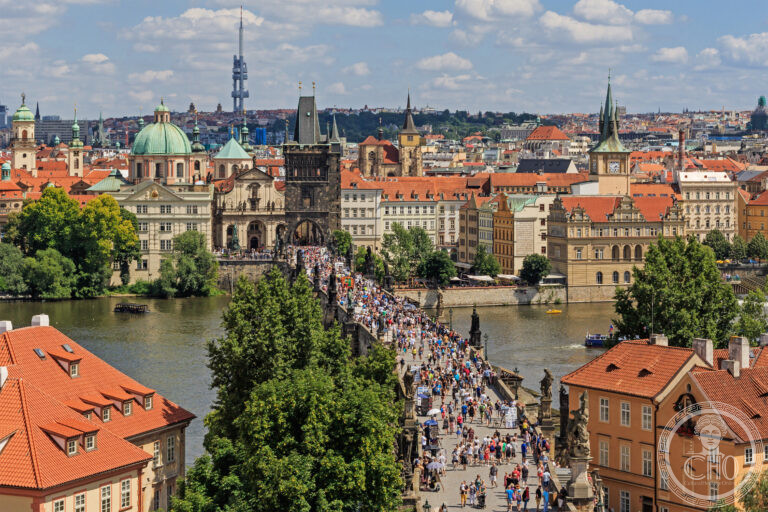
📷 Become a Cultural Heritage Online photographer
Share your photos of places: they stay published under your name as the author. The more they're seen, the more you get noticed — and soon a contest will reward the most appreciated photos.
Log in or sign up free to add a photo