
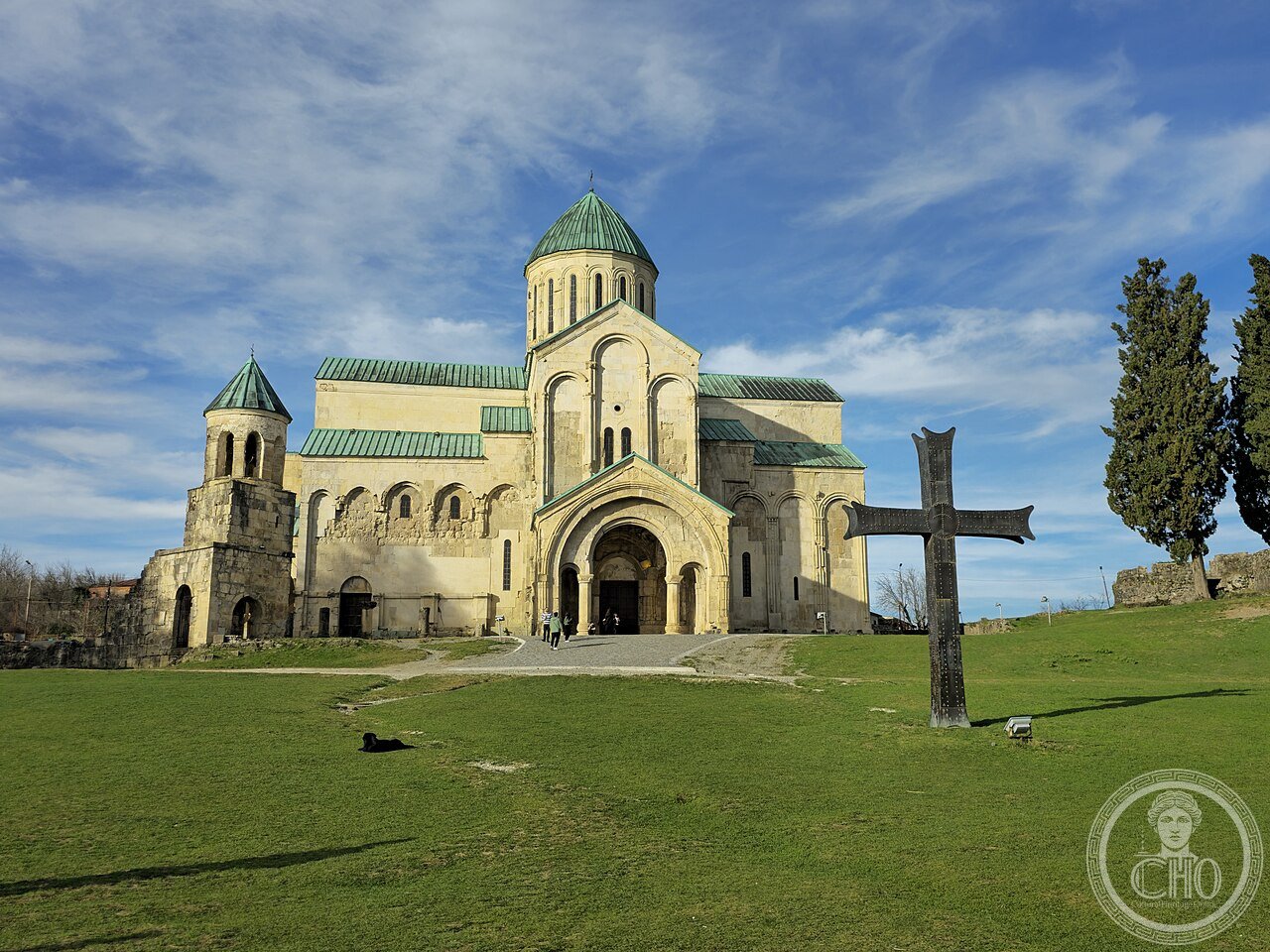
An inscription on the north wall records that the cathedral floor was laid in the year 1003, under the reign of Bagrat III, the first king of a unified Georgia. In 1692, during the Ottoman invasion of the kingdom of Imereti, a cannonball brought down the dome and the roof, leaving the building in ruins for more than three centuries. Restoration work, begun in the 1950s and carried on until 1994, culminated in a complete reconstruction finished in 2012 under President Mikheil Saakashvili: a reinforced concrete dome and new elements in glass and steel that UNESCO judged damaging to the site’s authenticity, to the point of striking it from the World Heritage List in 2017 — one of very few delistings in the organisation’s history.
About Bagrati Cathedral
Bagrati Cathedral in Kutaisi was built in the early years of the 11th century during the reign of King Bagrat III, the first king to rule over a unified Georgian kingdom; an inscription on the cathedral’s north wall records that its floor was laid in the year corresponding to 1003 CE. For nearly seven centuries the cathedral stood as one of the most significant religious and architectural monuments of medieval Georgia, until catastrophe struck in 1692: invading Ottoman troops, who had overrun the Kingdom of Imereti, fired a cannonball into the building that brought down its cupola and ceiling, leaving the cathedral a roofless ruin for the following three centuries. Serious conservation work did not begin until the 1950s, when architect Vakhtang Tsintsadze led a restoration project carried out in six distinct phases and continuing through 1994. That same year, Bagrati Cathedral was inscribed on the UNESCO World Heritage List jointly with the nearby Gelati Monastery, as a single combined heritage site. In the 2000s, however, the Georgian government under President Mikheil Saakashvili pursued a far more ambitious, full-scale reconstruction of the cathedral, rebuilding the collapsed cupola and much of the superstructure using reinforced concrete and incorporating modern glass and steel elements, with the project completed in September 2012. UNESCO’s World Heritage Committee, which had explicitly rejected these reconstruction plans at its 34th session, expressed grave concern that the works — carried out largely without the Committee’s prior approval — irreversibly compromised the cathedral’s authenticity and structural integrity; in July 2010 the combined Bagrati-Gelati site was placed on the List of World Heritage in Danger, and in 2017, in one of the rare delisting decisions in UNESCO’s history, Bagrati Cathedral was formally removed from the World Heritage List altogether, while Gelati Monastery retained its status on its own.
Key facts
- 1003: cathedral floor laid under King Bagrat III, per a surviving wall inscription
- 1692: cupola and ceiling destroyed by an Ottoman cannonball during the invasion of Imereti
- 1950s-1994: conservation and restoration works under architect Vakhtang Tsintsadze
- 1994: inscribed on the UNESCO World Heritage List jointly with Gelati Monastery
- July 2010: placed on the List of World Heritage in Danger over reconstruction concerns
- September 2012: full-scale reconstruction, including a concrete cupola and modern glass and steel elements, completed
- 2017: formally delisted from the UNESCO World Heritage List
History
Built under King Bagrat III at the very moment of Georgia’s medieval unification, the cathedral’s original construction embodied the political and religious consolidation of a newly single Georgian kingdom, making its later three-century ruination by Ottoman cannon fire in 1692 an especially resonant loss within Georgian national memory. The cathedral’s ruined state for so many centuries had itself become part of its identity and its authentic historical fabric, which is precisely what UNESCO’s World Heritage Committee argued was lost through the government’s decision to pursue full reconstruction rather than continued conservation of the existing ruins.
Bagrati Cathedral’s 2017 delisting stands as one of only a small handful of removals in the entire history of the UNESCO World Heritage List, placing it in rare company internationally as a case study in the tension between a heritage site’s continued religious and national symbolic use — the reconstructed cathedral remains an active place of worship — and international conservation standards emphasising material authenticity over functional restoration.
What you see
The reconstructed cathedral today presents a substantially rebuilt cross-in-square structure on its hilltop site overlooking Kutaisi, its new reinforced-concrete cupola and steel-and-glass additions clearly distinguishable from the surviving medieval stonework of the lower walls, which retain original 11th-century carved stone ornamentation. The cathedral’s elevated position continues to offer sweeping views over the city of Kutaisi and the surrounding Imereti region, much as it did in King Bagrat III’s era.
Practical information
- Opening hours: generally open daily; free admission; check current hours before visiting
- Address: Bagrati Street, Kutaisi 4600, Imereti, Georgia
Getting there
Bagrati Cathedral stands on Ukimerioni Hill overlooking Kutaisi, Georgia’s third-largest city, easily reachable on foot from the city centre. GPS: 42.2773° N, 42.7043° E.
Nearby
- Gelati Monastery — UNESCO-listed medieval monastery, a short drive from Kutaisi
- Kutaisi Old Town — historic city centre below the cathedral hill
- Motsameta Monastery — monastery on a river gorge, near Kutaisi
Sources
- Wikipedia — “Bagrati Cathedral” (en.wikipedia.org)
- UNESCO World Heritage Centre — “Bagrati Cathedral and Gelati Monastery” (whc.unesco.org)
- RFE/RL — “Cathedral Restoration Causes Headache For Georgian President” (rferl.org)
Find it on the map
See this place and what’s around it →📷 Become a Cultural Heritage Online photographer
Share your photos of places: they stay published under your name as the author. The more they're seen, the more you get noticed — and soon a contest will reward the most appreciated photos.
Log in or sign up free to add a photo