
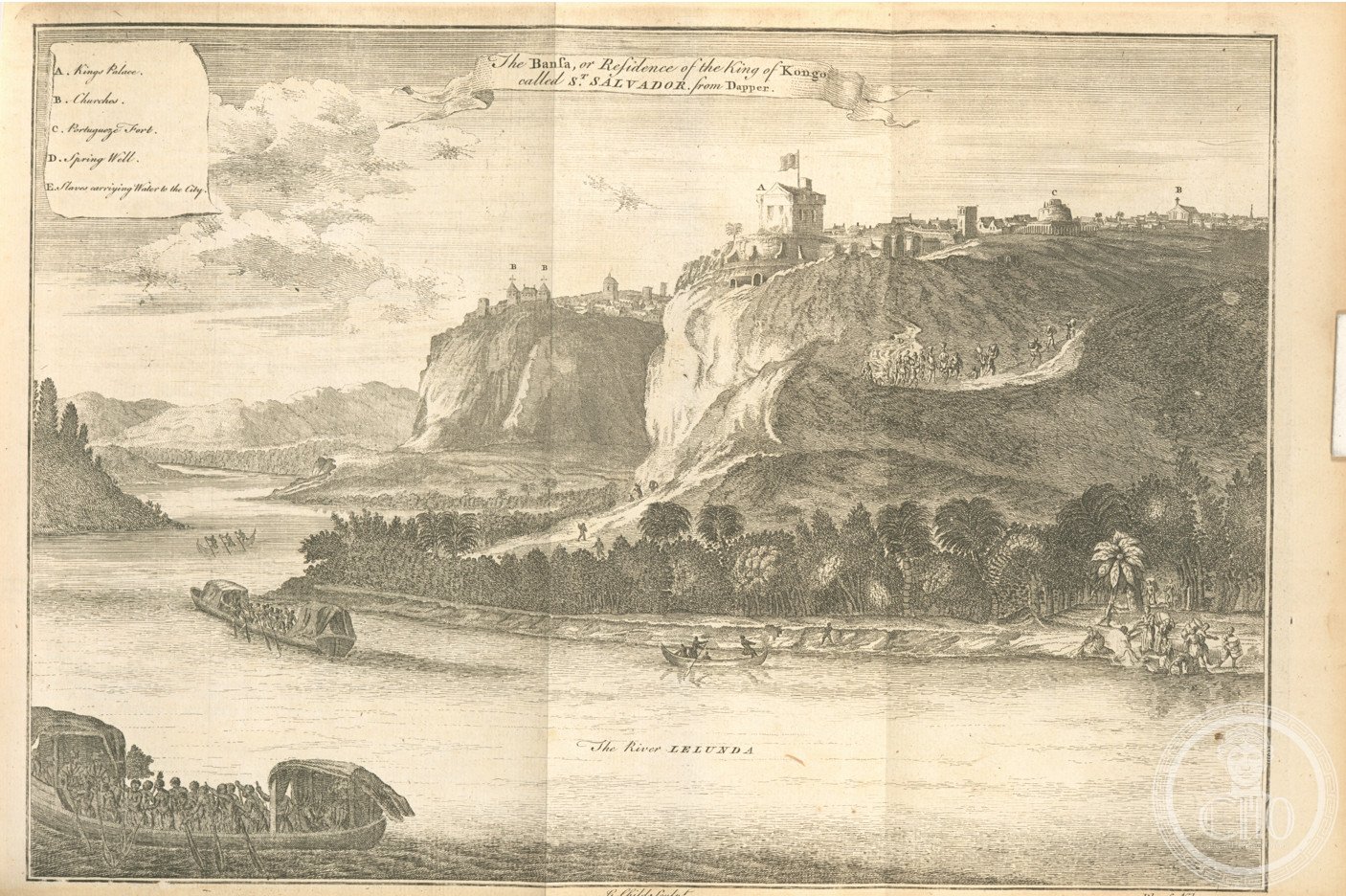
On top of a wooded plateau in north-western Angola, the town of M’banza-Kongo was for five centuries the capital of the Kingdom of Kongo — the most sophisticated and powerful monarchy in sub-Saharan Africa. With a tax system, a hierarchy of nobles, a standing army and a state organisation that astonished the first Portuguese explorers of 1483, the Kingdom of Kongo ruled over millions of subjects from coast to interior, from the Atlantic Ocean to the forests of the Congo. Its capital, home to tens of thousands of people, preserves today unique traces of that legacy. A UNESCO World Heritage site since 2017.
At a glance
M’banza-Kongo (formerly called São Salvador during the colonial period) is a city of about 100,000 people in north-western Angola, capital of the Zaire Province. It sits on a plateau (580 m elevation) and was the capital of the Kongo Kingdom from approximately the 14th century to the 19th century. UNESCO inscribed it in 2017 (ref. 1511) as the testimonial of the Kongo Kingdom — one of the largest and most powerful pre-colonial states in sub-Saharan Africa — and for its exceptional concentration of royal archaeology, sacred sites, old churches and living cultural traditions.
Key facts
- UNESCO: World Heritage since 2017 (M’banza-Kongo, ref. 1511)
- Kingdom of Kongo: one of the most powerful African kingdoms, c. 1390–1914; population estimated at 2–3 million at its peak
- First Portuguese contact: 1483, when Diego Cão reached the Congo River mouth
- Christianity: adopted voluntarily by King Nzinga a Ntinu (João I) in 1491; the Kongo became a Catholic kingdom with its own bishops
- Key monuments: the ruins of the Cathedral of São Salvador (1549), the royal sacred grove (Lumbu), the Nkulumbimbi archaeological complex
- Living heritage: Kongo cultural ceremonies, royal rituals and oral traditions maintained by the Kongo people today
History
The Kingdom of Kongo emerged around 1390 when Lukeni lua Nimi founded the state by conquering the Mbata kingdom. M’banza-Kongo (“city of the Kongo”) was established as the royal capital on a defensible plateau. By the time Portuguese explorer Diogo Cão arrived at the mouth of the Congo River in 1483, the Kongo Kingdom was a sophisticated state with provinces, governors, a tax system, a market economy and a professional army.
King Nzinga a Ntinu (baptised João I) voluntarily adopted Catholicism in 1491, sending his son to be educated in Portugal. The Kongo became a Christian kingdom, building churches and maintaining diplomatic relations with Portugal, Spain and the Vatican. In 1548, the Portuguese began constructing the Cathedral of São Salvador — the first cathedral in sub-Saharan Africa. The kingdom gradually weakened through the 17th–18th centuries due to the slave trade (the Kongo elite sold vast numbers of war captives to European slavers), internal succession conflicts, and Portuguese and Dutch military intervention. The royal family survived in various forms until the formal Portuguese annexation in 1914.
What you see
The historic plateau of M’banza-Kongo contains a concentration of heritage sites unique in Central Africa. The Cathedral of São Salvador (1549, rebuilt repeatedly) stands in ruins beside a modern church — its thick walls and Portuguese-style masonry are the oldest surviving European architecture in sub-Saharan Africa. The Lumbu, the sacred royal enclosure, is a site of living Kongo tradition. The Nkulumbimbi (the ancient sacred tree and royal meeting ground) is still venerated.
The Museu Regional do Zaire in M’banza-Kongo houses royal regalia, carved ivory, and artefacts from the Kongo period. The surrounding landscape retains archaeological traces of the city’s medieval layout.
Practical information
- Access: domestic flights from Luanda (1 hr) to M’banza-Kongo airport; road from Luanda (5–6 hrs on poor roads)
- Tourism: limited tourist infrastructure; Portuguese-speaking guide essential
- Best time: June–August (dry season); avoid January–March (heavy rains, poor road access)
- Museum: Museu Regional do Zaire open weekdays
Getting there
Fly TAAG Angola Airlines from Luanda Quatro de Fevereiro Airport to M’banza-Kongo (1 hr; several flights weekly). By road: N2 highway north from Luanda, 550 km. GPS: 6.27° S, 14.25° E.
Nearby
- Luanda — the Angolan capital, with the Museu Nacional de Angola (colonial history and Kongo artefacts), 550 km south
- Congo River Delta — the mouth of the world’s second-longest river, 150 km west at the border with DRC and ROC
- Mbanza-Kongo Highland — the surrounding plateau with relict gallery forest and Congo Basin watershed
Sources
- UNESCO World Heritage Centre — “M’banza-Kongo, Vestiges of the Capital of the Former Kingdom of Kongo” (ref. 1511)
- Encyclopaedia Britannica — Kingdom of Kongo
- John K. Thornton — “A History of West Central Africa to 1850” (Cambridge University Press, 2012)
Find it on the map
See this place and what’s around it →📷 Become a Cultural Heritage Online photographer
Share your photos of places: they stay published under your name as the author. The more they're seen, the more you get noticed — and soon a contest will reward the most appreciated photos.
Log in or sign up free to add a photo