
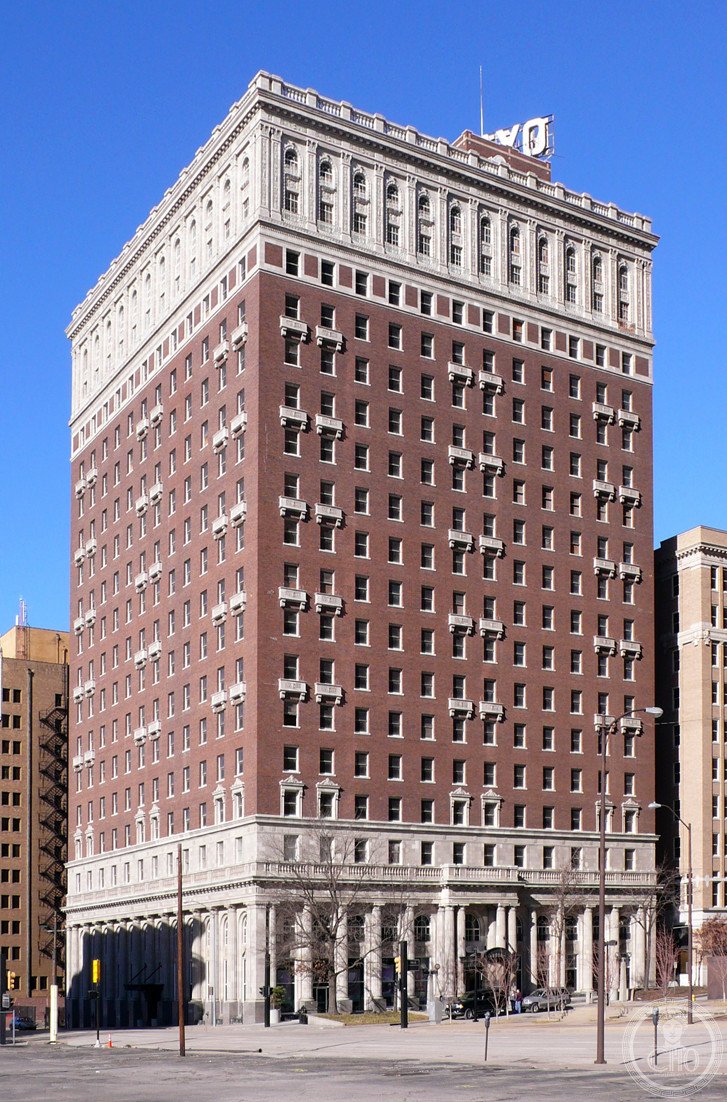
Built in 1925 at the height of Tulsa’s oil boom, the 18-story Mayo Hotel at 115 W 5th Street was the tallest building in Oklahoma at its completion — a terra cotta-clad Art Deco tower that served as the social hub of the oil industry’s golden age and the address of choice for every celebrated name who passed through the city during Oklahoma’s oil era.
At a glance
The Mayo Hotel rises 18 stories above the corner of 5th Street and Cheyenne Avenue in downtown Tulsa, a city that in 1925 was the undisputed capital of the American oil industry. Built by the Mayo family, Tulsa’s most prominent real estate developers, the hotel was designed to serve the oil executives, lawyers, geologists, and financiers who were making and spending enormous fortunes in the fields of northeastern Oklahoma. Its public rooms — ballrooms, restaurants, a rooftop garden, and a mezzanine promenade — became the de facto center of Tulsa’s social and business life through the boom decades. The hotel is listed on the National Register of Historic Places and was fully restored and reopened as a boutique hotel in 2009, reclaiming its position as Tulsa’s most storied address.
Key facts
- Opened: 1925
- Style: Art Deco / Beaux Arts — 18-story brick and terra cotta tower
- Address: 115 W 5th Street, Tulsa, OK 74103 (corner of 5th & Cheyenne)
- GPS: 36.1543°N, 95.9942°W
- Status: National Register of Historic Places; active boutique hotel (reopened 2009)
- Route 66 connection: the Mayo was a landmark address on the original US Route 66 alignment through downtown Tulsa
History
Tulsa in the early 1920s was experiencing one of the most dramatic economic booms in American history. The discovery of vast oil reserves in northeastern Oklahoma — the Glenn Pool in 1905, the Cushing Field in 1912, and dozens of subsequent strikes — had transformed a frontier town of a few thousand into a city of more than 70,000 by 1920, with skyscraper office buildings, grand churches, and cultural institutions that outpaced cities ten times its size in cultural ambition. The Mayo family, who had made their fortune in Tulsa real estate during the boom, commissioned the hotel as the capstone of downtown Tulsa’s built environment: a building tall enough and grand enough to signal that Tulsa was a city of national consequence.
At 18 stories, the Mayo was the tallest building in Oklahoma at the time of its 1925 completion, and it immediately became the social center of the oil industry’s elite. The hotel’s guest register included oil magnates, federal officials, and the touring artists and musicians who played Tulsa’s growing entertainment circuit. The oil industry’s boom-and-bust character meant that the Mayo’s fortunes tracked those of the wider Tulsa economy: prosperous through the 1920s, challenged by the Depression and the oil price collapses of the mid-twentieth century, declining through the urban flight of the 1960s and 70s. The hotel closed in the 1980s and fell into disrepair. Its 2009 restoration — which returned the public rooms, the rooftop ballroom, and the guest accommodation to a standard worthy of the building’s history — was one of the most significant adaptive reuse projects in Tulsa’s recent history.
The Mayo’s place in popular culture extends beyond the oil industry: the building’s connection to the old Route 66 alignment through downtown Tulsa made it a landmark in the romantic geography of the road. Caruso performed in Tulsa and the Mayo was the kind of address where visiting artists were expected to stay when the city’s entertainment calendar brought headline acts through the mid-South.
What you see
The 5th Street and Cheyenne Avenue corner presents two nearly identical facades in brick and cream-colored terra cotta, with the principal ornament concentrated at the base (ground-floor arcade with pilasters and carved capitals) and at the crown (ornamental cornice of terra cotta with Beaux Arts detailing above the seventeenth floor). The building’s overall massing — a simple brick tower without setbacks — reflects the tall commercial building conventions of the early 1920s, before the setback requirements and Art Deco massing innovations of the later decade changed the vocabulary of the American skyscraper.
The lobby and principal public rooms were restored to their original character in the 2009 renovation: marble floors, coffered plaster ceilings, the original ornamental ironwork of the mezzanine balcony railing, and the brass and glass light fixtures that date from the building’s construction. The rooftop ballroom, which served as Tulsa’s most prestigious event space through the mid-twentieth century, was part of the restoration program and continues to offer views over the downtown skyline.
Practical information
- Access: 115 W 5th Street, Tulsa OK 74103; hotel lobby and restaurant open to non-guests
- Highlights: original lobby, mezzanine ironwork, rooftop events space; oil-boom heritage displays
- Transit: Tulsa Transit bus service on 5th Street and Cheyenne; downtown Tulsa PARK&RIDE facilities on 4th Street
- Time needed: 30 minutes for lobby visit and exterior; lunch or dinner for longer stay
Getting there
The Mayo Hotel is in downtown Tulsa at 115 W 5th Street, three blocks west of the BOK Center and two blocks north of the Tulsa Performing Arts Center. Tulsa International Airport (TUL) is approximately 7 miles northeast — 15–20 minutes by car via US-169 south and I-244 west to downtown. There is no public transit connection between TUL and downtown Tulsa; taxi or rideshare are the practical options. By car from I-244 (Tulsa Inner Dispersal Loop), exit at Denver Avenue or Detroit Avenue and proceed south on 5th Street. The BOK Center arena is three blocks east. The Philcade Building (1931) and Philtower (1928) — Tulsa’s other major Art Deco buildings — are two blocks northeast on South Boston Avenue.
Nearby
- Philtower (1928) — Waite Phillips’s 24-story Art Deco office tower at 427 S Boston Avenue, two blocks northeast — the defining silhouette of the Tulsa Art Deco skyline. See the CHO guide.
- Boston Avenue United Methodist Church (1929) — the landmark Art Deco church by Adah Robinson at 1301 S Boston Avenue, eight blocks south. See the CHO guide.
- Gilcrease Museum — the museum of American West art and Native American artifacts at 1400 Gilcrease Museum Road, four miles northwest — one of the most important collections of Western American art in the country.
- Philbrook Museum of Art — the Italian Renaissance villa turned art museum at 2727 S Rockford Road, three miles south — the former home of Waite Phillips, set in formal gardens.
Sources
- National Register of Historic Places nomination, Mayo Hotel, Tulsa
- Tulsa World archives — 1925 opening coverage and 2009 restoration
- Oklahoma Historical Society — Mayo Hotel records
- W. David Baird and Danney Goble, Oklahoma: A History (2008) — oil boom context
- Carol Guilliams Brown, Tulsa Architecture: A Survey of Art Deco Buildings — downtown Tulsa survey
Find it on the map
See this place and what’s around it →📷 Become a Cultural Heritage Online photographer
Share your photos of places: they stay published under your name as the author. The more they're seen, the more you get noticed — and soon a contest will reward the most appreciated photos.
Log in or sign up free to add a photoIs this page about you?
This page is read by travellers and heritage enthusiasts who find it on Google. Tell us how you are connected to this place and we will take it from there.