
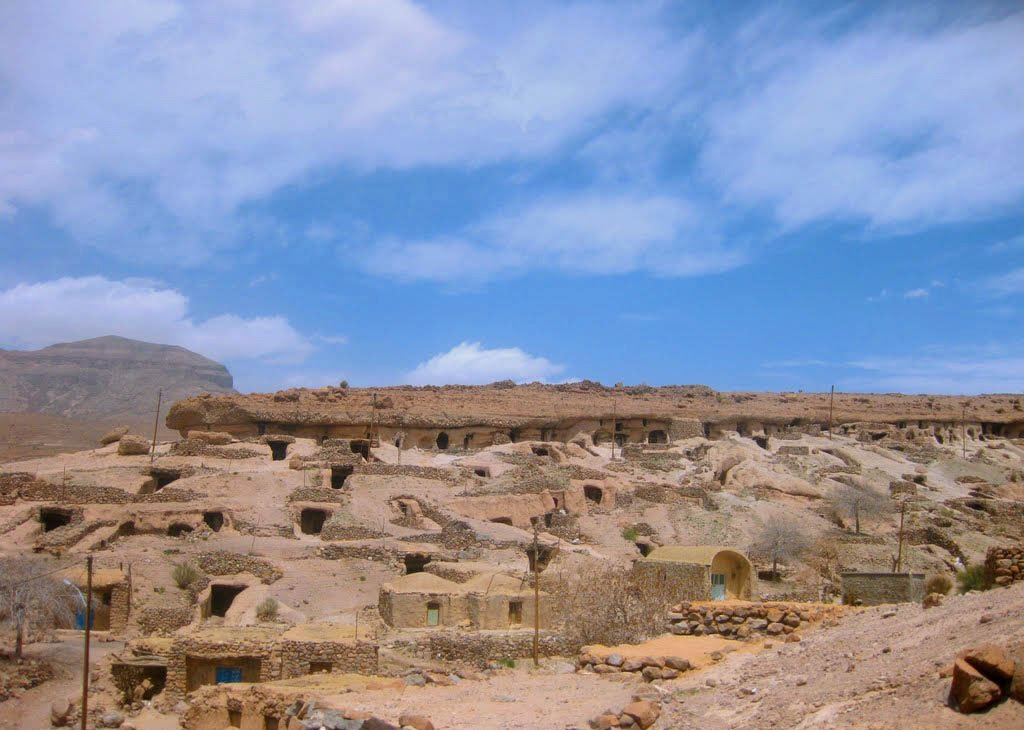
A village carved in living rock: 12,000 years of habitation
In the valley of a seasonal river in the semi-arid highlands of Kerman Province, the village of Maymand presents one of the most ancient continuously inhabited human landscapes on Earth. Its people — the Maymandis — live not in buildings but in kicheh: rooms carved directly into the soft red volcanic tuff of the valley walls, hollowed out, enlarged, and subdivided over 12,000 years of occupation. An estimated 2,500 such rooms survive; several hundred are still seasonally inhabited.
UNESCO inscription: the world’s oldest continuously inhabited cave village
Inscribed in 2015, Maymand was recognised by UNESCO as an outstanding example of human adaptation to a challenging semi-desert environment and as evidence of an unbroken chain of habitation from prehistory to the present day. The inscription emphasises the village’s “cultural landscape” quality: the rock-cut dwellings cannot be understood separately from the semi-nomadic pastoral system that organises life around seasonal migration between highland and lowland pastures.
The kicheh: a room in the cliff
The typical Maymandi dwelling consists of one or several rooms carved into the tuff, their walls smoothed by generations of hands, their floors covered with felt carpets. Niches are cut into the walls for storage; small windows are carved through the rock face for light and ventilation. The rooms maintain a natural temperature of around 15°C year-round — cool in summer’s 40°C heat, warm in winter’s cold. No external structural materials are required; the rock is simultaneously wall, floor, ceiling, and insulation.
Semi-nomadic life: the rhythm of the seasons
The Maymandis maintain a pattern of seasonal migration that archaeologists believe has been practised in this valley for millennia. In summer, families move with their flocks to highland pastures; in winter, they descend to the valley and their rock-cut dwellings. In spring and autumn, they occupy transitional camps at intermediate altitudes. This system — called ahang — reflects a sophisticated understanding of the land’s carrying capacity and a refusal to overexploit any single environment.
The village’s rituals and oral tradition
Maymand retains a living tradition of oral literature, ritual, and craft. The Maymandis are predominantly Zoroastrian in their pre-Islamic cultural substrate, with ceremonies tied to fire, water, and the agricultural calendar. The Nowruz spring festival is celebrated with particular intensity here; the local music tradition uses instruments found nowhere else in Iran; the women’s textile work incorporates geometric patterns of great antiquity. UNESCO has separately inscribed several of these traditions on its Intangible Cultural Heritage list.
Geology: the red tuff that made the village possible
The valley’s geology is central to the Maymand story. The pale-red rock is an ignimbrite — solidified volcanic ash — soft enough to carve with hand tools yet hard enough to maintain structural integrity once exposed to air. The geological formation extends across several hundred metres of valley wall, providing a natural “apartment building” of exceptional size. Generations of carvers have worked outwards and downwards, creating multi-level complexes connected by internal passages.
Conservation: sustaining a living heritage
Maymand faces the paradox common to living heritage sites: the modernisation that threatens the traditional way of life is also the force that keeps the community from abandoning the village entirely. The Iranian Cultural Heritage Organization has supported the restoration of dwellings and the development of ecotourism as an economic alternative to pastoral migration. A small museum in the village documents the history and material culture of the Maymandis.
Visiting Maymand
Maymand lies 45 km northwest of Shahr-e Babak in Kerman Province, accessible by road from the provincial capital Kerman (5 hours). Accommodation is available in renovated rock-cut rooms operated by the village community. The best time to visit is spring (March–April) or autumn (September–October), when the Maymandis are in the valley and the temperature is comfortable. Visitors are expected to engage respectfully with the community; photography of inhabitants requires explicit consent.
Find it on the map
See this place and what’s around it →📷 Become a Cultural Heritage Online photographer
Share your photos of places: they stay published under your name as the author. The more they're seen, the more you get noticed — and soon a contest will reward the most appreciated photos.
Log in or sign up free to add a photo