
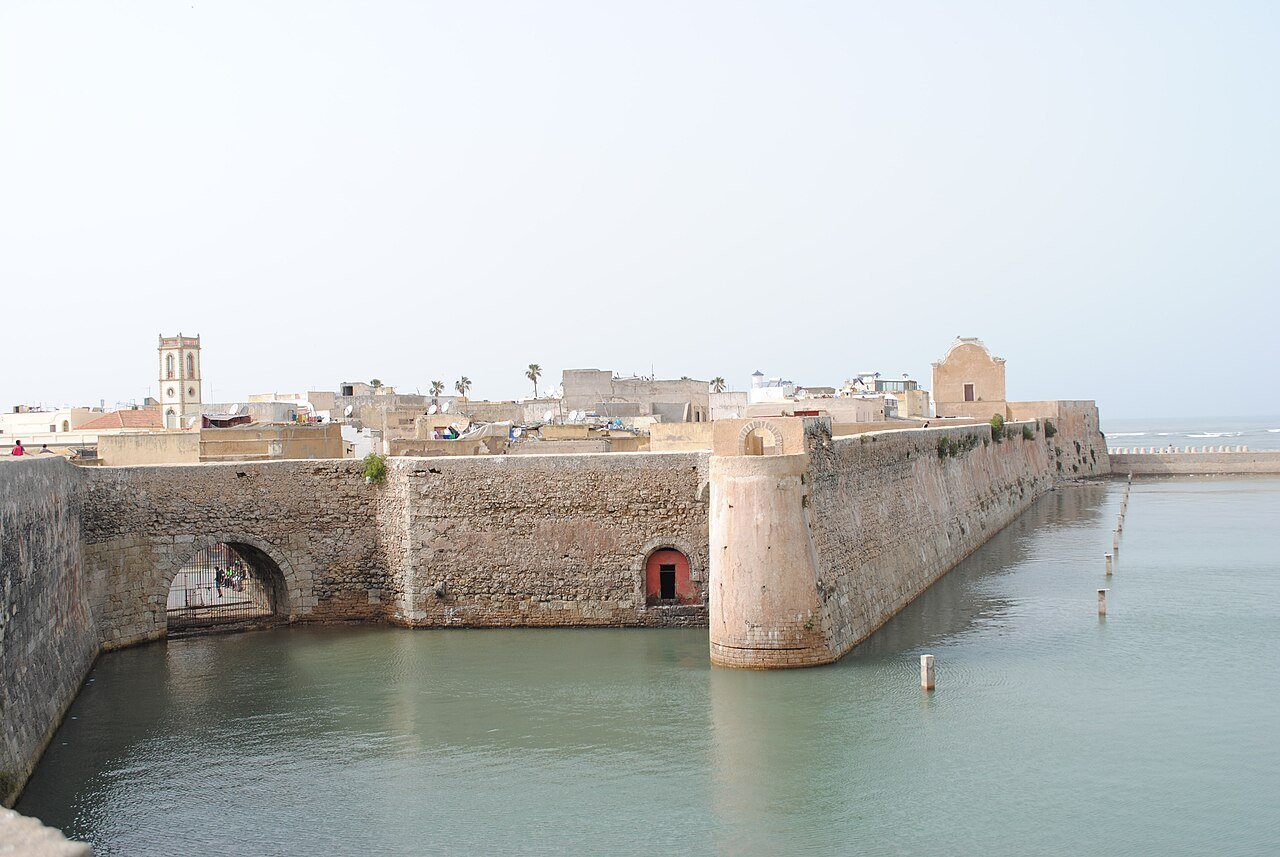
A Portuguese fortress on the Atlantic coast of Morocco
On a promontory overlooking the Atlantic at El Jadida, the fortified city of Mazagan stands as the best-preserved Portuguese colonial settlement on the coast of Africa. Built from 1506 as a trading post and military stronghold, it was held by Portugal for 244 years, then abandoned in 1769, then repopulated by Moroccan settlers who called it El Jadida (The New One). Within its massive bastion walls, the architecture of the Portuguese Golden Age survives almost intact: Gothic vaulting, Manueline stone carvings, and a system of military engineering that represented the cutting edge of Renaissance fortification design.
UNESCO inscription: the encounter between Portugal and Morocco
Inscribed in 2004, Mazagan was recognised by UNESCO as an outstanding example of the cultural interchange between European and Moroccan civilisations in the 16th century, and as an early example of the new style of defensive architecture that the Portuguese and Spanish developed in response to gunpowder artillery. The city represents a unique fusion of Portuguese maritime expansion with North African urban forms.
The Portuguese cistern: Gothic underwater cathedral
The most celebrated interior space in Mazagan is the Portuguese cistern, built in 1514 as a water reservoir and armoury. A rectangular chamber covered by five aisles of cross-ribbed Gothic vaulting, supported by 25 columns, it is now partially flooded with a thin layer of water that reflects the vaulting in a perfect mirror image — one of the most photographed architectural spaces in Morocco. The cistern was discovered accidentally in the early 20th century when a resident broke through a wall.
The fortifications: a masterclass in Renaissance military engineering
The city walls, completed between 1506 and 1541, represent an early example of the trace italienne — the system of angled bastions, low curtain walls, and overlapping fields of fire designed to make fortifications resistant to artillery bombardment. Four massive diamond-shaped bastions project from the corners of the square plan; the sea gate (Bab el-Bhar) faces the ocean with a magnificent Manueline portal in carved stone. The ensemble is remarkably intact after 250 years of post-Portuguese occupation.
The Church of the Assumption: Gothic inside a mosque
The Portuguese Church of the Assumption (Nossa Senhora da Assunção), built 1541–1628, is the only surviving major Catholic building in Mazagan. After the Moroccan reconquest of 1769, it was converted to a mosque, then an arsenal, then a cinema; it is now a museum. Its Gothic nave and side chapels, stripped of Christian imagery but otherwise intact, offer a poignant image of architectural resilience across religious change.
The 1769 evacuation: a city preserved by abandonment
In March 1769, the Sultan Muhammad III of Morocco besieged Mazagan with a force of 100,000. The Portuguese garrison of 1,800, knowing relief was impossible, negotiated a safe evacuation — taking everything movable but leaving the buildings intact. The Moroccans who subsequently resettled the city largely preserved the Portuguese structure because it suited their needs. This act of pragmatic reuse is why Mazagan is so well preserved: unlike most Portuguese colonial forts, it was never razed and rebuilt.
El Jadida today: a beach city with a fortified heart
El Jadida is a thriving Atlantic resort city of 150,000, with a popular beach and a cosmopolitan atmosphere. The Portuguese fortified city occupies a small promontory in the northern part of the modern city — clearly separate, easily walkable in an hour. The medina within the walls has a mixed character: some Portuguese buildings are well maintained; others are in decay. The cistern is the principal tourist attraction and is illuminated at night. Accommodation ranges from riads within the walls to beach hotels.
Visiting Mazagan
El Jadida is 90 km south of Casablanca, easily reached by train (1.5 hours from Casa Port station) or bus. The fortified city entrance is free; the cistern charges a small fee. The site is most atmospheric in morning light or at dusk, when the crowds thin and the Atlantic light illuminates the pale stone. A full visit to the fortified city and cistern takes 2–3 hours; the beach and modern medina are worth additional exploration.
Find it on the map
See this place and what’s around it →📷 Become a Cultural Heritage Online photographer
Share your photos of places: they stay published under your name as the author. The more they're seen, the more you get noticed — and soon a contest will reward the most appreciated photos.
Log in or sign up free to add a photo