
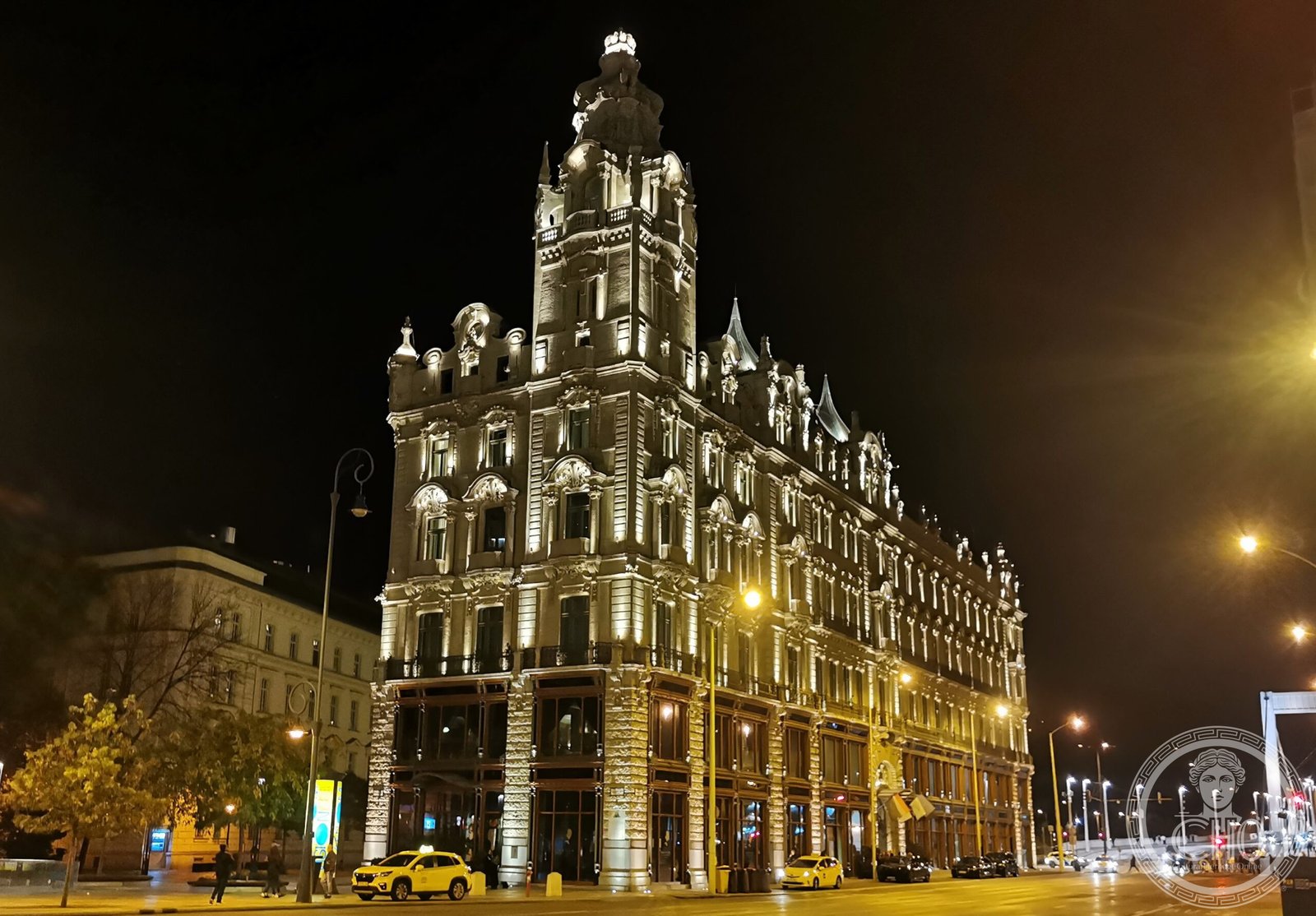
The southern of Budapest’s twin Klotild Palaces, built for a Habsburg archduchess at the Pest gateway to the Elisabeth Bridge, returned to life in 2021 after a five-year restoration.
At a glance
The Matild Palace stands at Váci utca 36, on Ferenciek tere in the heart of Pest. It is one of a matched pair: the twin Klotild Palaces, raised between 1899 and 1902 to the designs of architects Flóris Korb and Kálmán Giergl, frame the avenue that runs from the square down to the Elisabeth Bridge, forming one of the most recognisable urban compositions in Budapest. Commissioned by Archduchess Klotild, wife of Archduke Joseph Karl of Austria, the southern palace spent over a century as offices, apartments and cafés before reopening on 30 June 2021 as a hotel of Marriott’s Luxury Collection, under the name of the archduchess’s daughter Matild. Both palaces have been protected Hungarian monuments since 1977 and stand within the UNESCO World Heritage zone of the banks of the Danube.
Key facts
- Built: 1899–1902, as the southern of the twin Klotild Palaces
- Architects: Flóris Korb and Kálmán Giergl
- Style: Eclectic, with English neo-baroque character
- Commissioned by: Archduchess Klotild, wife of Archduke Joseph Karl of Austria
- Monument protection: declared a Hungarian protected monument in 1977, following an exterior renovation in 1968
- Heritage context: within the UNESCO World Heritage property of the Banks of the Danube
- Hotel opening: 30 June 2021, as a Luxury Collection property with 111 rooms and 19 suites
History
The twin palaces owe their existence to the Elisabeth Bridge. As Budapest prepared to throw a new crossing over the Danube at the turn of the century, the Pest approach needed a dignified frame, and Archduchess Klotild commissioned a matched pair of palaces to provide it. Korb and Giergl, among the busiest architects of turn-of-the-century Budapest, delivered two mirror-image blocks whose towers face each other across Szabad sajtó út, the street funnelling traffic from Ferenciek tere onto the bridge.
The palaces survived the twentieth century in mixed use and mixed fortunes. An exterior renovation in 1968 preceded their formal listing as protected monuments in 1977, which secured the facades and the essential fabric. The southern palace’s most recent chapter began with a restoration lasting five years, which preserved the original cobblestones of the carriage entrance, the staircases, the railings and the internal courtyard. The building reopened on 30 June 2021 as the Matild Palace, a Luxury Collection Hotel — a conversion of the original structure, not a rebuild behind a retained front.
What you see
From Ferenciek tere the two palaces read as a single gateway: symmetrical corner towers, tiers of balconied windows, and richly worked eclectic facades with an English neo-baroque accent, angled to draw the eye down to the Elisabeth Bridge and across the river to Gellért Hill. The Matild Palace is the southern block, on the Váci utca side.
Inside, the restoration kept the bones of the 1902 building legible. The cobbled carriage entrance, the original staircases with their railings, and the courtyard at the core of the block all survive from the archduchess’s palace, threaded through the workings of a modern 130-key hotel rather than replaced by them.
Practical information
- Address: Váci utca 36, 1056 Budapest, at Ferenciek tere
- Access: the facades and the twin-palace composition are visible from Ferenciek tere and the Elisabeth Bridge approach at any time; the interior is accessible to hotel guests and patrons of its restaurants and café
- Best viewed: from the middle of Szabad sajtó út’s pedestrian crossings or from the Elisabeth Bridge, where both towers align
Getting there
Ferenciek tere station on metro line M3 is directly in front of the building, and the Váci utca pedestrian street begins at its door. The Elisabeth Bridge carries road traffic to Buda in minutes, and Deák Ferenc tér, where all three original metro lines meet, is a ten-minute walk north.
Nearby
- The northern Klotild Palace — its twin, directly across Szabad sajtó út
- Inner City Parish Church — the oldest church in Pest, two minutes toward the river
- Elisabeth Bridge and the Danube embankment — part of the UNESCO World Heritage riverside
- Váci utca — Pest’s principal pedestrian street, starting at the palace
Sources
- PestBuda, “Elegant hotel opened in the renovated southern Klotild Palace” — pestbuda.hu
- MaNDA database, “Klotild Palaces” — mandadb.hu
- Építészfórum, “Klotild és Matild — Korb és Giergl ikonikus alkotásai” — epiteszforum.hu
- We Love Budapest, “The Matild Palace now shines in her original splendour” — welovebudapest.com
Find it on the map
See this place and what’s around it →
📷 Become a Cultural Heritage Online photographer
Share your photos of places: they stay published under your name as the author. The more they're seen, the more you get noticed — and soon a contest will reward the most appreciated photos.
Log in or sign up free to add a photoIs this page about you?
This page is read by travellers and heritage enthusiasts who find it on Google. Tell us how you are connected to this place and we will take it from there.