
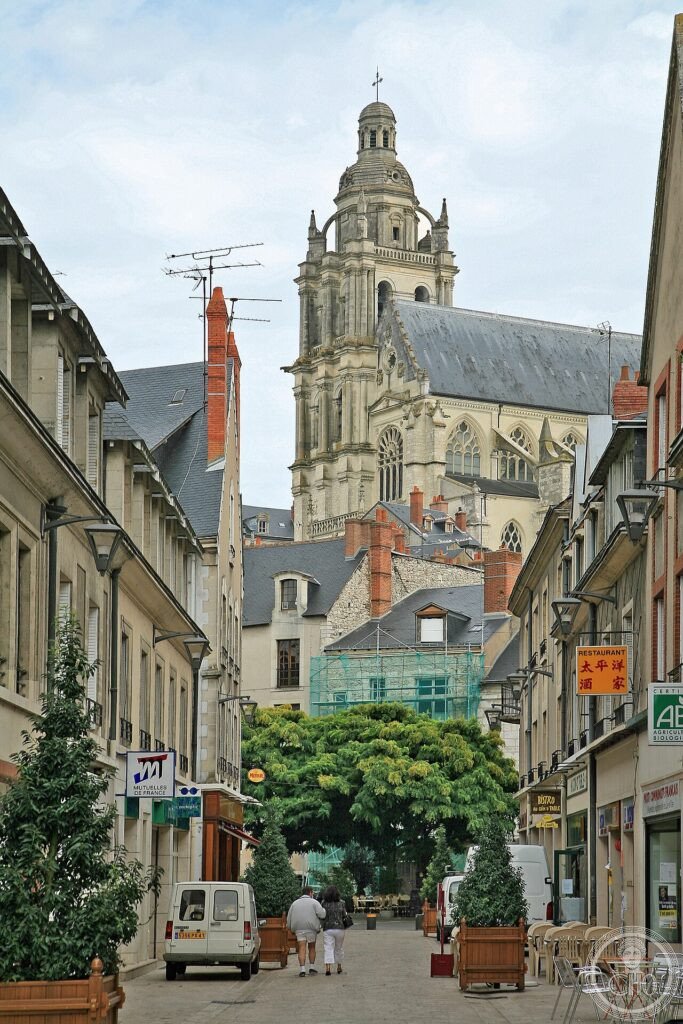
On the night of 6–7 June 1678 a hurricane brought down the vault and the piers of the church of Saint-Solenne, leaving only the facade and the bell tower standing. The rebuilding came about only because a local official managed to get the request as far as Louis XIV, through the minister Colbert’s wife, who was from Blois.
At a glance
Blois Cathedral (Cathédrale Saint-Louis) stands on a site with a documented history of religious use stretching back to a Saint Peter’s chapel attested in the 6th century, making the present building the fifth church to occupy the location following four earlier reconstruction campaigns. Its immediate predecessor, the church of Saint-Solenne, was devastated on the night of 6-7 June 1678 by a violent hurricane that shattered the windows, collapsed the vault, and destroyed the pillars, leaving only the facade and bell tower standing. The rebuilding that followed, in Gothic style between 1680 and 1702 under architect Arnoult-Séraphin Poictevin, happened specifically because Jacques II Belot, lieutenant-general of the bailliage of Blois, managed to get the project brought to the attention of King Louis XIV through Colbert, the influential royal minister, whose wife happened to be from Blois — a connection that secured full royal financing for the reconstruction. The building became the seat of the Diocese of Blois, newly created in 1697 by a papal bull of Innocent XII specifically timed to the reconstruction.
Key facts
- Site history: a Saint Peter’s chapel attested from the 6th century; the present cathedral is the fifth church to stand on the site, following four earlier reconstruction campaigns
- 1678 hurricane: night of 6-7 June 1678, a violent storm shattered the windows and collapsed the vault and pillars of the earlier church of Saint-Solenne, leaving only the facade and bell tower standing
- Reconstruction: 1680-1702, Gothic style, architect Arnoult-Séraphin Poictevin (died 1720); master masons Jean Habert and Jean Jacquet, both from Blois
- Royal financing: secured through Jacques II Belot, lieutenant-general of the bailliage of Blois, who reached King Louis XIV via minister Colbert, whose wife was from Blois
- Diocese of Blois: created 1697 by papal bull of Innocent XII, coinciding with the reconstruction; the cathedral has been a listed historic monument since 9 August 1906
History
Blois’s long sequence of religious buildings on the same site, from a 6th-century Saint Peter’s chapel through four subsequent reconstructions to the present cathedral, reflects the kind of continuous, layered building history common to many French cathedral sites, where successive generations rebuilt in response to fire, structural failure, or simply changing architectural ambition rather than relocating to new ground. What makes Blois’s specific 17th-century rebuilding notable is both the dramatic, well-documented cause — a violent hurricane destroying the previous church’s structural core in a single night — and the equally well-documented, almost anecdotal mechanism by which royal funding was secured: rather than proceeding through routine diocesan or municipal channels, the project’s advancement depended on a specific personal connection between the local lieutenant-general, Jacques II Belot, and Louis XIV’s powerful minister Jean-Baptiste Colbert, whose wife’s Blésoise origins gave Belot’s appeal a personal channel to royal attention it might not otherwise have received.
The timing of the Diocese of Blois’s creation in 1697, via a papal bull specifically coinciding with the reconstruction’s near-completion, reflects a broader pattern in which French dioceses were periodically created or reorganised to align administrative church geography with political and demographic realities — Blois had grown into a significant regional centre without possessing its own bishopric, and the rebuilding of its principal church into a structure of genuinely cathedral scale and ambition provided a natural occasion to formalise that administrative gap. The choice to rebuild in Gothic style as late as 1680-1702, well after Gothic architecture had given way to Baroque and classical styles in most contemporary French religious building, is itself notable, suggesting a deliberate continuity with the earlier church’s architectural character rather than a wholesale stylistic modernisation.
What you see
The cathedral’s late Gothic construction, unusual for its 1680-1702 date well into an era when Baroque and classical architecture dominated French religious building elsewhere, gives the building a deliberately historicist character reflecting continuity with its storm-destroyed predecessor rather than contemporary architectural fashion. The crypt, open to visitors only on Sunday mornings after the 10:30 mass, preserves earlier structural elements connecting the present building to its long sequence of predecessor churches on the same site. The cathedral’s setting on Place Saint-Louis, within Blois’s historic centre near the Loire river and the city’s celebrated Renaissance château, situates it within one of the Loire Valley’s most visited historic towns.
Practical information
- Opening hours: daily, 9:00-19:00, free admission
- Crypt: open Sunday mornings only, after the 10:30 mass
- Address: 7 Place Saint-Louis, 41000 Blois
Getting there
Blois has direct rail connections from Paris (approximately 1.5 hours) and Nantes (approximately 2 hours 20 minutes). From Blois train station, the cathedral is reachable on foot in approximately 16 minutes, or by bus lines B, C, or F (République stop) in around 11 minutes. By car, Blois sits on the A10 motorway (Paris-Bordeaux). GPS: 47.5885° N, 1.3365° E.
Nearby
- Château Royal de Blois — a short walk from the cathedral; a major royal residence combining Gothic, Renaissance, and Classical wings built across several French reigns
- Blois historic centre — surrounding the cathedral; a well-preserved townscape overlooking the Loire
- Château de Chambord — approximately 30-40 minutes by car; the largest and most famous of the Loire Valley châteaux
Sources
- Blois Chambord Loire Valley Tourist Office — official visitor information (bloischambord.com)
- Diocèse de Blois — parish and historical information (catholique-blois.net)
- Wikipedia — “Cathédrale Saint-Louis de Blois” and “Blois Cathedral” (fr.wikipedia.org, en.wikipedia.org)
- Monumentum — heritage listing PA00098336 (monumentum.fr)
Find it on the map
See this place and what’s around it →📷 Become a Cultural Heritage Online photographer
Share your photos of places: they stay published under your name as the author. The more they're seen, the more you get noticed — and soon a contest will reward the most appreciated photos.
Log in or sign up free to add a photoIs this page about you?
This page is read by travellers and heritage enthusiasts who find it on Google. Tell us how you are connected to this place and we will take it from there.