Mantova e Sabbioneta

Mantova Gonzaga Renaissance city lakes Virgil birthplace Palazzo Ducale Camera degli Sposi Mantegna UNESCO 2008
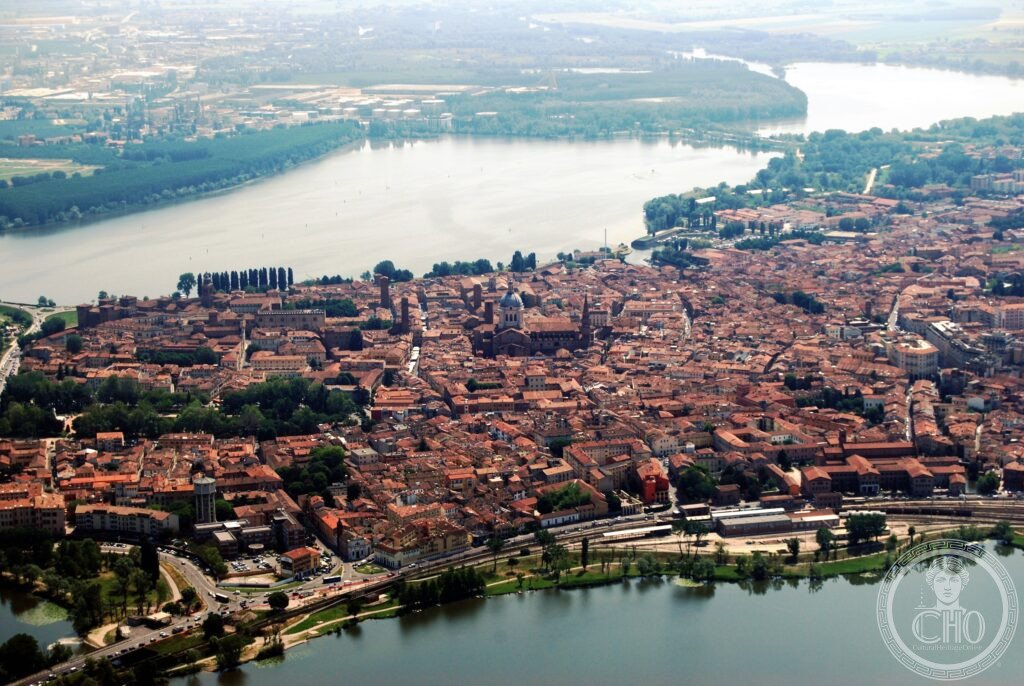
Mantova from the north lake (Lago di Mezzo; the middle of the 3 artificial lakes that surround the historic city on 3 sides; the city profile: from left, the Torre della Gabbia (the medieval cage-tower where criminals were exposed), the tower of Sant’Andrea, the dome of Sant’Andrea (Alberti, begun 1472 CE), the bell tower of the Palazzo della Ragione (13th century), and the towers of the Palazzo Ducale (the Gonzaga palace complex; 500 rooms; begun 13th century); the lakes were created in the 12th century by blocking the Mincio river and are the reason Mantova could resist sieges — the city was besieged 14 times and conquered only once (by Napoleon in 1797 CE)), Province of Mantova, Lombardia, Italy. UNESCO World Heritage Site 2008 (reference 1287). Photo via Wikimedia Commons.
Mantova (+ Sabbioneta 35 km), Lombardia, Italy · Gonzaga dynasty 1328–1708 CE; Virgil birthplace; Mantegna Camera degli Sposi (1465–74 CE); Alberti Sant’Andrea (1472 CE); Giulio Romano Palazzo Te (1525–35 CE); UNESCO WHS 2008 (reference 1287)

Mantova e Sabbioneta

Mantova (UNESCO 2008) is the most concentrated Renaissance art and architecture city in northern Italy — a walled city on an artificial lake where the Gonzaga dynasty (1328–1708) employed Mantegna, Alberti, Pisanello, Giulio Romano, and Rubens in continuous succession for 400 years, producing a density of Renaissance masterworks per square metre that exceeds Florence and Rome — paired with Sabbioneta, the ideal city built from scratch by Vespasiano Gonzaga in the 1550s–1590s as a living textbook of Renaissance urbanism.

At a glance

Mantova e Sabbioneta (the most precisely MantovaeSabbioneta serial Mantova Lombardia Italy 45.1564 N 10.7921 E UNESCO WHS 2008 reference 1287 serial 2 cities: the serial inscription covers Mantova (the major city; 65 sq km; 50,000 inhabitants) and Sabbioneta (the planned ideal city; 18 km southeast of Mantova; the smallest of the Italian UNESCO serial inscriptions; population 4,000; the town is 400m × 300m within its hexagonal walls); the Gonzaga (the ruling family of Mantova from 1328 to 1708 CE; the Gonzaga were not the original lords of Mantova (the Bonacolsi preceded them until the 1328 coup) but they created the identity of the city through their cultural patronage; the Gonzaga began as mercenary captains (condottieri) and accumulated sufficient wealth and prestige to become Marquesses (1433 CE) and later Dukes (1530 CE) of Mantova; the Gonzaga cultural programme: the family employed a continuous sequence of the greatest artists of each generation over 4 centuries — Pisanello (court painter 1422–1448 CE; the most important Gonzaga-commissioned artist before Mantegna; the Tournament fresco in the Palazzo Ducale is his masterwork and the last major work in the International Gothic style before the Italian Renaissance superseded it); Mantegna (court painter 1460–1506 CE; the most important; the Camera degli Sposi; the Dead Christ; the Triumphs of Caesar (now at Hampton Court Palace)); Alberti (architect 1460s–1472 CE; the design of Sant’Andrea; the single most influential church design of the 15th century); Giulio Romano (architect and painter 1524–1546 CE; the Palazzo Te; the most important Mannerist building in Italy); Rubens (court painter 1600–1608 CE; 3 triptychs for the Gonzaga family chapel, now dispersed between Mantova, Brussels, and the Uffizi)).

Key facts

  • The Camera degli Sposi and why it is the most important painted room in the Italian Renaissance: the Camera degli Sposi (the “Bridal Chamber” or “Chamber of the Spouses”; in the northeastern tower of the Palazzo Ducale (the Castle of San Giorgio; 1395–1406 CE); the fresco cycle by Andrea Mantegna (1465–1474 CE; 9 years of work for one room (6m × 8m); the most precisely documented fresco campaign in the entire Italian Renaissance — the preparatory drawings, the correspondence between Mantegna and Marquess Ludovico Gonzaga, and the payment records all survive in the Archivio di Stato di Mantova); the specific innovation of the Camera: it is the first room in Western art history where the entire ceiling and walls are painted with a unified illusionistic architectural system that eliminates the visual boundary between the room and an imaginary exterior space; the north wall (the Court Scene): Ludovico Gonzaga receives a message while surrounded by his court (the fresco depicts an actual historical event — probably the news of the appointment of Francesco Gonzaga as Cardinal in 1461 CE; the figures in the court are identifiable portraits (Ludovico himself; his wife Barbara of Brandenburg; the dwarf Rodolfo who appears in the far left; the dog Rubino visible beneath Ludovico’s bench; the dog Rubino is the most famous dog in Italian Renaissance painting)); the east wall (the Meeting Scene): Ludovico Gonzaga meets his son Cardinal Francesco with the Holy Roman Emperor Frederick III and the Crown Prince of Denmark — a scene from 1462 CE when Mantova was briefly host to both the Emperor and the Danish heir simultaneously; the ceiling tondo (the most famous element; the oculus — a painted round window in the ceiling center showing the sky, putti, and women looking down from above the “opening”; this is the first di sotto in su (from below upward) ceiling painting in history; the technique Mantegna invented in 1465 CE became the standard for Baroque ceiling painting from Corregio to Tiepolo 200 years later)
  • GPS Palazzo Ducale: 45.1600° N, 10.7945° E
  • GPS Sabbioneta: 44.9980° N, 10.4869° E

History

From Virgil to the Gonzaga to Napoleon to UNESCO (the most precisely MantovaeSabbioneta serial Virgil (Publius Vergilius Maro; 70–19 BCE; born at Andes, the ancient village now identified with Pietole di Virgilio 6 km from Mantova; the birthplace has been disputed since the 3rd century CE; the current scholarly consensus places it at the location of the modern Pietole village; the Mantovans have claimed Virgil as their civic symbol since the Roman period — the Piazza Virgiliana in Mantova has a statue of Virgil (19th century); Dante identified Virgil as the Mantovan poet in Inferno I, line 68: “fui poeta, e cantai di quel giusto figliuol d’Anchise che venne di Troia” (I was a poet and I sang of that just son of Anchises who came from Troy) — Virgil is both the Roman poet and the Mantovan civic hero in the medieval imagination); the Gonzaga cultural programme (summary of key dates; see above): Pisanello 1422–1448; Mantegna 1460–1506 (the Camera degli Sposi painted 1465–1474 CE); Alberti (Sant’Andrea design 1470 CE; construction begun 1472 CE after Alberti’s death; the facade completed 1488 CE; the interior vaulted nave completed 1732 CE by Filippo Juvara); Giulio Romano 1524–1546 CE (Palazzo Te; the Sala dei Giganti is the most technically extreme room in Mannerist architecture: the falling giants are painted on every surface including the floor and the ceiling in a continuous circular narrative; the room is 15m × 15m × 12m; the figures scale upward from human size at the base to titanic scale at the ceiling so that the room feels like it is collapsing); Rubens 1600–1608; 1628 CE sack of Mantova: Charles I of England purchased the Gonzaga collection of paintings (including Mantegna’s Triumphs of Caesar and numerous Rubens) in 1627–1628 CE; most of the purchased works are now in the British Royal Collection (Hampton Court Palace) or in British museums; 1797 CE Napoleon conquered Mantova (the only military conquest in the city’s history; defended for 8 months before surrender; the fortifications that delayed Napoleon (the Gonzaga walls and the lake system) are the same defensive system visible today); 2008 CE UNESCO inscription reference 1287; Sabbioneta: built by Vespasiano Gonzaga 1550s–1590s CE as a planned city from scratch (the hexagonal walls; the single orthogonal street grid; the Teatro Olimpico (1588–1590 CE; the most complete surviving example of a Renaissance theatre; it has 20 seats arranged in a D-shape at 1:1 scale and was used for theatrical performances for 400 years; the theatre ceiling is original 1590 CE painted wood)).

What you see

Mantova: the Palazzo Ducale, the Camera degli Sposi, Sant’Andrea, and the Palazzo Te (the most precisely MantovaeSabbioneta single visit Mantova (1 full day): 1) Palazzo Ducale (Piazza Sordello; the most complex visit; the complex (500 rooms; total floor area 34,000 sq m; built over 4 centuries) is open as a museum with a specific timed-entry route through the state apartments (2 hours minimum); book the Camera degli Sposi slot online (Coopculture; cameramagnacoopculture.it) at least 4 weeks in advance in summer (the Camera has a maximum of 15 visitors every 20 minutes; the morning slots 8:45–9:30 AM are the least crowded); the palace visit: the Sala del Pisanello (the unfinished tournament fresco by Pisanello, c.1447 CE; the largest unfinished fresco in Italian art; the underdrawing (sinopia) is visible through the thin first layer of plaster in the unfinished areas — the preparatory drawing style is visible as brown oxide outlines showing the horses and knights in full tournament action); the Camera degli Sposi (the 20-minute slot is not enough — 45 min is the minimum; binoculars for the ceiling oculus are essential)); 2) Sant’Andrea (Piazza Andrea Mantegna; free; the most influential church interior in the Italian Renaissance — the single-aisle barrel-vaulted nave (24m wide) was the model for St Peter’s (Bramante’s original nave design follows Alberti’s proportional system); the tomb of Andrea Mantegna is in the first left chapel); 3) Palazzo Te (Viale Te; 20 min walk or bicycle from the city centre; €12; the Sala dei Giganti (the most important room); the Sala di Psiche (the mythological fresco cycle); 1.5 hours); Sabbioneta (35 km from Mantova; 30 min by car; the entire town circuit (walls, Palazzo Ducale, Teatro Olimpico, Galleria degli Antichi) takes 1.5–2 hours; guided tour from the tourism office (Via Gonzaga 31; +39 0375 221044)).

Practical information

  • Mantova by train from Milan, Verona, and Bologna and the practical visit circuit: transport: Mantova is on the Verona–Mantova rail line (35 min from Verona; €4.50; hourly); from Milan: change at Verona or Brescia (total 1h45min–2h); from Bologna: change at Modena (2h30min); the city centre (Piazza Sordello to Sant’Andrea) is 15 min walk from the station; bicycle rental available at the station (€10/day); the Palazzo Ducale ticket (€10 + Camera degli Sposi supplement €2.50; combined ticket with Palazzo Te €15); advance booking Camera degli Sposi: mandatory in summer (cameramagnacoopculture.it; book 4 weeks in advance; the 8:45 AM English language slot is the best for lighting conditions in the Camera); Mantua Chambers Music Festival (the Festival Internazionale della Camera di Mantova; September; one of the best chamber music festivals in Italy; performances in the Camera degli Sposi (closed to normal visitors during the festival) and the Palazzo Ducale state apartments; program at camusa.it); the mantovana food circuit (the traditional Mantovano cuisine is the most distinct in Lombardia: tortelli di zucca (pasta filled with pumpkin, mostarda, and Parmigiano — a sweet-savory combination unique to Mantova; the dish is documented in the Gonzaga court kitchen records of 1455 CE); sbrisolona (the local almond-flour crumble cake; the name means “crumbly” in Lombard dialect; served with Moscato passito or grappa)); accommodation: the Hotel San Lorenzo (near Piazza Sordello; the best hotel for walking access; from €95/night))

Getting there

Train from Verona (35 min, €4.50; hourly). From Milan: change at Verona/Brescia (1h45-2h). Palazzo Ducale: €10 (+€2.50 Camera degli Sposi; book ahead: cameramagnacoopculture.it). Palazzo Te: €12. Sabbioneta: 35 km by car (30 min). GPS: 45.1564, 10.7921.

Nearby

  • Verona — 35 min by train (UNESCO WHS 2000; the Arena di Verona (Roman amphitheater; the summer opera season; the best-preserved Roman arena in Italy); the Romeo and Juliet sites; Casa di Giulietta; the Castelvecchio Scarpa museum)
  • Cremona — 50 km northwest (the violin-making capital of the world; Stradivari, Amati, Guarneri workshops; the Museo del Violino (Piazza Marconi; €15; the most complete collection of antique violins in existence; includes a Stradivarius acoustic testing room where you can hear the difference between a 1700 CE and a 1720 CE instrument))

Sources

  • Wikipedia, Mantua; Camera degli Sposi; Palazzo Te; Sabbioneta; House of Gonzaga, accessed June 2026
  • UNESCO, Mantua and Sabbioneta, WHS reference 1287, inscribed 2008
  • Chambers, D.S. A Renaissance Cardinal and his Worldly Goods: The Will and Inventory of Francesco Gonzaga (1444–1483). London: Warburg Institute, 1992

Hero image: Mantova, Lombardia, Italy, Wikimedia Commons. Editorial text © Cultural Heritage Online, 2026.

📷 Diventa un fotografo di Cultural Heritage Online

Condividi le tue foto dei luoghi: restano pubblicate con la tua firma come autore. Più vengono viste, più ti fai conoscere — e presto un concorso premierà le foto più apprezzate.

Accedi o registrati gratis per aggiungere una foto
📋 Copy & share on social
Scroll to Top