

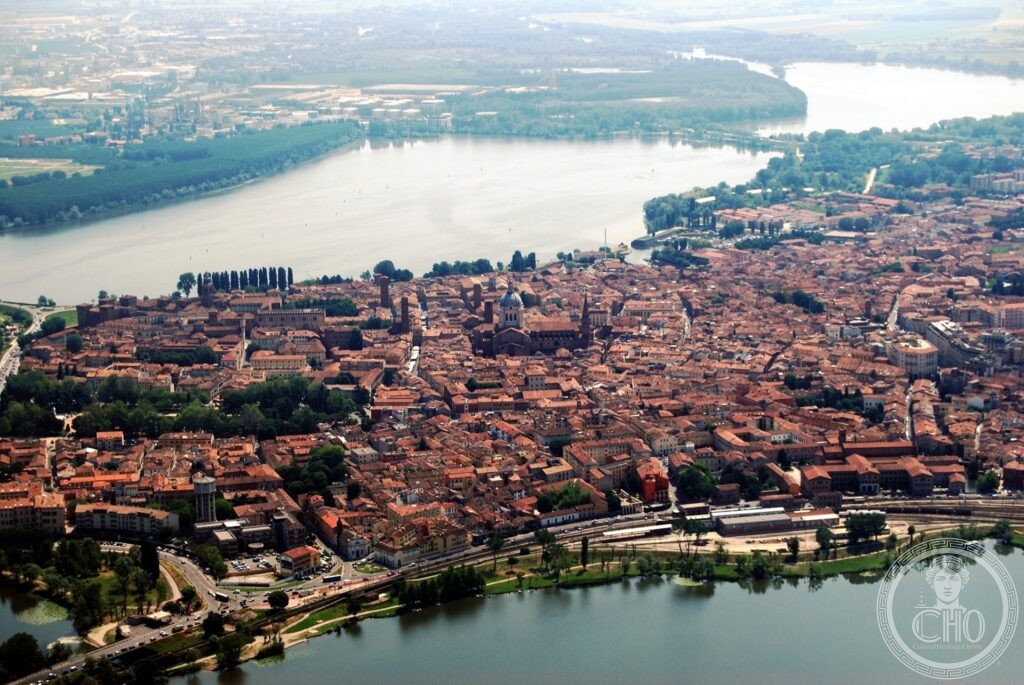
Mantova and Sabbioneta. Two Gonzaga cities 30 kilometres apart in the Po plain. Represent two different answers to the Renaissance question of the ideal city: Mantova is the accumulated architectural achievement of a dynasty (the Gonzaga ruled from 1328 to 1708, commissioning over 14 major building projects in the city, including the largest palace complex in Italy), while Sabbioneta was built from scratch in 30 years (1556-1591) by Vespasiano Gonzaga as a single, self-contained, theoretical ideal city. Planned with straight streets, a circuit of walls, a theatre, and a gallery, all at a single historical moment, making it the most complete surviving example of Renaissance urban theory built in practice.
At a glance
Mantova (province of Mantova, Lombardia) and Sabbioneta (province of Mantova, Lombardia, 30 km south-west) are jointly inscribed as a UNESCO World Heritage Site in 2008 (ref. 1287) as “Mantua and Sabbioneta.” The inscription recognises the two cities as complementary examples of Renaissance urban planning: Mantova as the accumulated achievement of 380 years of Gonzaga patronage (the Palazzo Ducale, Palazzo Te, Basilica di Sant’Andrea by Alberti, Camera degli Sposi by Mantegna) and Sabbioneta as the most complete surviving purpose-built Renaissance planned city, created by Vespasiano Gonzaga (1531-1591) as a working military, commercial, and cultural capital for his tiny duchy.
Key facts
- Palazzo Ducale dei Gonzaga: The largest palace complex in Italy by area (34,000 m² of floor space, 500 rooms, 15 courtyards). Built in progressive campaigns by the Gonzaga from 1328 to 1708. The three principal buildings (Palazzo del Capitano + Magna Domus, the main residential block; Castello di San Giorgio; Domus Nova/Palazzina Paleo-gonzaghesca) are connected by covered passages and form an irregular complex covering the entire north-east quarter of the medieval city. The Gonzaga collection (dispersed in 1627-1628 by Charles I of England and the Duke of Nevers) included, at its peak, works by Raphael, Titian, and Rubens.
- Camera degli Sposi / Camera Picta (1474, Andrea Mantegna): The room in the Castello di San Giorgio of the Palazzo Ducale, decorated entirely in fresco by Andrea Mantegna over nine years (1465-1474) for the Marquis Ludovico II Gonzaga. The frescoes cover all four walls and the ceiling, depicting members of the Gonzaga court (Ludovico, his wife Barbara of Brandenburg, their children and courtiers, dwarves, dogs) in a continuous painted space that dissolves the wall into a fictive outdoor loggia. The painted oculus at the ceiling centre. A circular “hole” through which cherubs and ladies look down from above. Is the first illusionistic ceiling painting in Western art (a full 50 years before Raphael’s Stanza della Segnatura and 80 years before Correggio’s Cathedral of Parma).
- Palazzo Te (1524-1534, Giulio Romano): The summer palace built by Federico II Gonzaga on the island of Te (1.5 km south of the Palazzo Ducale, reachable on foot via Via Acerbi). Designed by Giulio Romano (Raphael’s principal student, who came to Mantova in 1524). The building is a single-storey square building with a central courtyard. The interior frescoes are the masterpiece of Mannerist illusionism: the Sala dei Giganti (Room of the Giants, 1532-1534) depicts the mythological battle of the Giants against Jupiter’s thunderbolts, with the entire room (floor to ceiling, ceiling to floor, covering all surfaces including the fireplace and door frames) painted as if the room is collapsing under the giant’s assault. Visitors standing in the centre of the room experience a total visual environment that has no parallel in 16th-century painting.
- Sabbioneta (1556-1591, Vespasiano Gonzaga): A planned city built ex novo by Vespasiano Gonzaga on an empty plain 30 km south-west of Mantova. Hexagonal walls (1556-1588), a regular grid of streets, the Teatro Olimpico (Teatro all’Antica, 1588-1590, Vincenzo Scamozzi — the second indoor theatre in Italy after Vicenza, built to be used, not as a monument), the Galleria degli Antichi (1584 — a 97-metre gallery for Vespasiano’s collection of antiquities, the first purpose-built art gallery in Italy), and the Palazzo Ducale (with the Sala degli Elefanti, the main reception room).
- UNESCO: 2008, ref. 1287.
- GPS: 45.1564, 10.7942. Google Maps.
History
The Gonzaga family. Originally a family of minor landowners from Gonzaga, a village near Mantova. Seized power in Mantova in 1328 in a coup against the Bonacolsi family, and held it (as captains, then marquises, then dukes) until the male line died out in 1707. Under the Gonzaga, Mantova became one of the most important artistic centres in northern Italy: Andrea Mantegna was court painter from 1460 to his death in 1506. Leon Battista Alberti designed the Basilica di Sant’Andrea (begun 1472) and the church of San Sebastiano (begun 1460). Giulio Romano redesigned much of the city and built the Palazzo Te after his arrival in 1524. And the court musicians and poets included Claudio Monteverdi (court musician 1591-1612, who composed the first surviving opera, L’Orfeo, for the Gonzaga court in Mantova in 1607).
The dispersal of the Gonzaga collection in 1627-1628 (when Duke Vincenzo II Gonzaga, facing bankruptcy, sold the entire collection — including the Gonzaga Cartoons of Raphael’s Acts of the Apostles, now in the Victoria and Albert Museum in London; the Gonzaga Mantegna series; and works by Titian, Caravaggio, and Rubens) to Charles I of England and other buyers was one of the most significant single sales in the history of art collecting, and removed most of the major portable artworks from Mantova at one moment.
What you see
The Palazzo Ducale complex requires a guided visit for the Camera degli Sposi (the principal attraction), which is available on timed entry (20-minute timed slots, maximum 30 visitors per slot). The Camera degli Sposi is the most important single painted room in northern Italy: the Gonzaga family portrayed on the south wall (Ludovico Gonzaga with his courtiers receiving a letter, the first naturalistic group portrait in Italian art) and the Meeting Scene on the west wall (Ludovico meeting his son Cardinal Francesco Gonzaga returning from Rome, in an outdoor setting with a precise landscape background — the background showing the imaginary Renaissance city that Mantegna constructed as the ideal architectural environment of the meeting) are the two key images. The ceiling with the oculus and the cherubs is the technical miracle.
The Palazzo Te (admission ~€12) is a 30-minute walk from the Palazzo Ducale. The Sala dei Giganti is the final room of the visit sequence and requires at least 10 minutes of still observation to register the full effect of the total-environment illusionism: standing still in the centre of the room, looking at the ceiling (which shows Jupiter’s thunderbolt and the falling giants) and then slowly rotating to take in all four walls (which show the earth crumbling, columns falling, architectural fragments tumbling toward the floor level) creates an experience of intentional disorientation that has no parallel in contemporary painting.
Gallery
Practical information
- Palazzo Ducale / Camera degli Sposi: Piazza Sordello 40. Open Tuesday-Sunday 9:00-19:00. Closed Monday. Admission ~€13 (reduced ~€2 for EU citizens 18-25). The Camera degli Sposi requires mandatory timed-entry booking (€1 supplement). Book at least 2-3 days in advance from April to October at mantovaducale.beniculturali.it. Arrive 15 min early for security scanning.
- Palazzo Te: Viale Te 13. Open Monday 13:00-19:00, Tuesday-Sunday 9:00-19:00. Admission ~€12 (reduced ~€5).
- Sabbioneta: 30 km south-west of Mantova (bus from Mantova, 45 min; car via SS10 Padana Inferiore). Combined ticket for Palazzo Ducale + Palazzo del Giardino + Teatro all’Antica + Galleria degli Antichi ~€12. Guided tours available (booking required for Teatro all’Antica).
- Duration: Mantova historic centre (Palazzo Ducale + Palazzo Te + Sant’Andrea): 5-6 hours. Adding Sabbioneta: full day (12 hours from Mantova).
Getting there
Piazza Sordello, Mantova (MN), Lombardia. By train: Trenitalia from Milano Centrale (160 km; 1h55 via Brescia, regional). From Verona Porta Nuova (45 km; 35 min regional — the most convenient connection). From Bologna (130 km; 2h with change at Modena). Mantova station is 1 km south of the historic centre (15 min walk via Corso Vittorio Emanuele II). By car: from Verona, A22 south to Mantova Nord exit (45 km, 30 min). From Milano, A4 east to Brescia then SP11 south (160 km, 1h45). Paid parking near Piazza Sordello (Parking Virgiliana) and outside the walls.
Nearby
- Sabbioneta. 30 km south-west (UNESCO same inscription). The only complete surviving purpose-built Renaissance planned city. Teatro all’Antica (Scamozzi, 1588-1590). Galleria degli Antichi (1584 — first purpose-built art gallery in Italy). Palazzo Ducale Sala degli Elefanti.
- Verona. 45 km east. UNESCO 2000 (ref.797 — Centro storico di Verona). The Arena (1st century BCE amphitheatre, summer opera festival). Casa di Giulietta (Via Cappello). Basilica di San Zeno (Romanesque, 12th century). Piazza delle Erbe.
- Cremona. 50 km west. Not UNESCO but the center of Italian violin-making: the Museo del Violino (Palazzo dell’Arte, with instruments by Stradivarius, Guarneri del Gesù, and Amati families). The Cathedral complex (Piazza del Comune) with its Torrazzo (112 m bell-tower, tallest Romanesque campanile in Italy).
Sources
- UNESCO: whc.unesco.org/en/list/1287.
- Wikipedia EN: Mantua.
- Chambers, D.S.: Patrons and Artists in the Italian Renaissance, Macmillan, 1970.
- Palazzo Ducale di Mantova: mantovaducale.beniculturali.it.
- Palazzo Te: palazzote.it.
Find it on the map
See this place and what’s around it →📷 Become a Cultural Heritage Online photographer
Share your photos of places: they stay published under your name as the author. The more they're seen, the more you get noticed — and soon a contest will reward the most appreciated photos.
Log in or sign up free to add a photo