

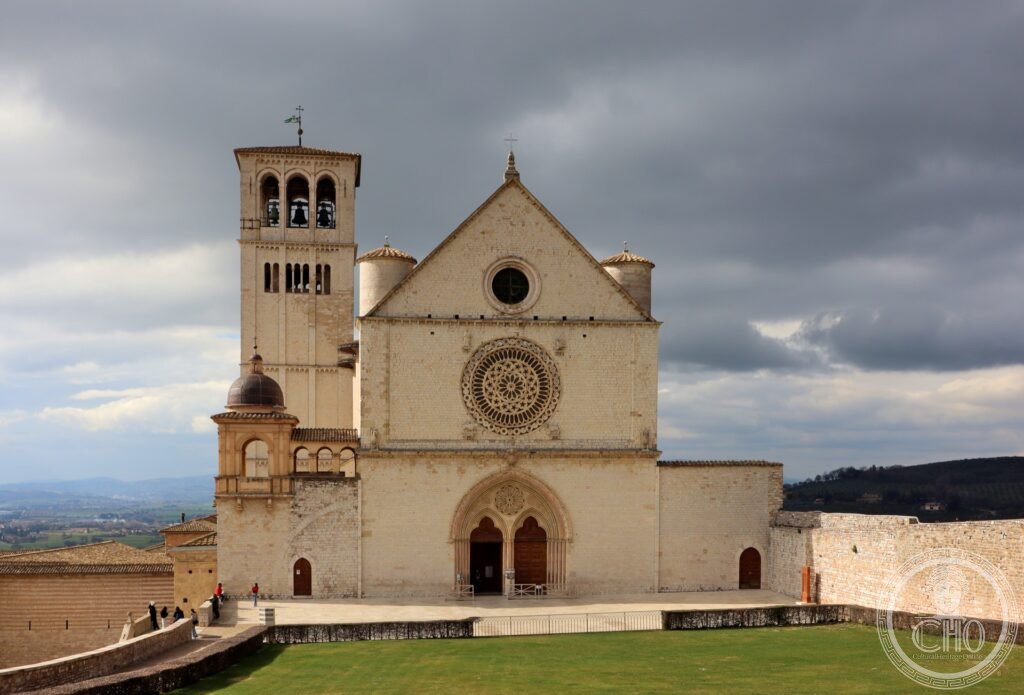
Assisi is the city where Francis of Assisi (1181/2-1226) founded the Franciscan order, lived, preached, and died, and where the Basilica built over his tomb in 1228-1239 contains the fresco cycles by Cimabue and Giotto that mark the beginning of naturalistic painting in the western world — the 28 scenes of the life of St Francis painted by Giotto on the walls of the Upper Church (1296-1304) are the earliest surviving paintings in which faces express individual emotions, landscapes reflect actual light, and figures cast shadows.
At a glance
Assisi (province of Perugia, Umbria) is a UNESCO World Heritage Site inscribed in 2000 (ref. 990) as “Assisi, the Basilica of San Francesco and Other Franciscan Sites.” The inscription covers the Basilica di San Francesco (the double church built 1228-1239, containing the tomb of St Francis in the crypt, the Cimabue frescoes in the Lower Church, and the Giotto fresco cycle in the Upper Church), the Sacro Convento di San Francesco (the Franciscan friary adjacent to the basilica), the Basilica di Santa Chiara (the church of the female Franciscan order, built 1257-1265, containing the cross that spoke to Francis at San Damiano), and the medieval town of Assisi as a whole (the Rocca Maggiore castle, the Temple of Minerva in Piazza del Comune, the churches of San Damiano and Santa Maria degli Angeli).
Key facts
- Francis of Assisi (1181/2-1226): Born Giovanni di Pietro di Bernardone in Assisi, the son of the cloth merchant Pietro di Bernardone. Francis underwent a conversion experience after a serious illness and military captivity (1203-1205). In 1206 he renounced his wealth publicly in the piazza of Assisi in front of the Bishop of Assisi, dressed in a peasant’s robe, and began living among lepers and repairing ruined churches. The Franciscan order (Friars Minor) was approved by Pope Innocent III in 1209: the first mendicant order in the Church, living by manual labour and begging, not by fixed property. Francis received the stigmata, the five wounds of Christ, on La Verna mountain (Tuscany) in September 1224, the first documented case of stigmatization in Christian history. He died in Assisi on October 3, 1226, and was canonized by Pope Gregory IX on July 16, 1228 — only 2 years after his death, one of the fastest canonizations in history
- Basilica di San Francesco: Two superimposed churches on the same building: the Lower Church (Basilica Inferiore, 1228-1230, Romanesque, single nave with painted vault; contains the tomb of St Francis in the crypt and frescoes by Cimabue, Pietro Lorenzetti, and Simone Martini) and the Upper Church (Basilica Superiore, 1228-1239, Gothic, with pointed arches and large clerestory windows; contains the Giotto fresco cycle); the two churches share a single facade (Romanesque with Gothic elements, the facing in alternating pink and white Subasio stone), visible from the Piazza Inferiore di San Francesco below
- Giotto’s life of St Francis (Upper Church, c. 1296-1304): 28 scenes of the life of Francis, arranged as 14 images per side wall, in two rows, with each scene framed by a painted Gothic architectural border. The scenes include the most celebrated images: “St Francis Preaching to the Birds” (Scene 15), “The Miracle of the Spring” (Scene 14), and “The Appearance at Arles” (Scene 18). These are the first paintings in European art in which landscape, architecture, and human figures are rendered in consistent pictorial space with natural lighting — the foundation of the entire tradition of naturalistic western painting from Masaccio to Raphael to Rembrandt. The frescoes were severely damaged by the 1997 Umbria earthquake, when the vault of the left transept collapsed, killing 4 people and destroying the Cimabue frescoes in that section; the surviving frescoes were restored 1997-2002
- Piazza del Comune: The central piazza of Assisi, on the site of the ancient Roman forum; the Temple of Minerva (1st century BCE — the only Roman temple facade from the imperial period to survive complete in situ in central Italy; the six Corinthian columns and the pediment of the original temple are intact; the interior was converted into a church in 1539) is on the north side of the piazza; the Palazzo dei Priori (13th century, municipal government building) and the Torre del Popolo (bell tower, 1305) are on the west side
- UNESCO: 2000, ref. 990
- GPS: 43.0754, 12.6079 — Google Maps
History
The Franciscan movement transformed medieval Christianity more quickly and more thoroughly than any other movement of the 13th century: by the time Francis died in 1226, there were already approximately 3,000 Franciscan friars across Europe; by 1300, there were approximately 30,000 in 1,400 friaries. The speed and scale of Franciscan expansion (to England, France, Germany, Portugal, Hungary, and the Holy Land within Francis’s own lifetime) was driven by the novelty of the mendicant model — friars who lived without fixed property, worked for their food, and preached to the urban poor in the vernacular — and by the personal charisma of Francis himself, who was reported to have communicated with animals, preached to birds (a tradition documented in the Fioretti di San Francesco, the early 14th-century collection of Franciscan legends that remained the most widely read Italian vernacular text for 200 years), and appeared to his followers in levitation during prayer.
The basilica was begun 2 years after Francis’s death and 2 days after his canonization (the foundation stone was laid by Pope Gregory IX on July 17, 1228 — one day after the canonization). The speed of construction and the architectural ambition of the building (the Upper Church is one of the earliest Gothic structures in central Italy, a style previously confined to France and northern Italy) were a deliberate political statement: the papacy’s formal adoption of the Franciscan movement as an instrument of its reform programme required a building that would establish Assisi as a major pilgrimage centre.
What you see
The Basilica di San Francesco is entered from the Piazza Inferiore di San Francesco (the lower piazza, to the south of the basilica complex): the entrance to the Lower Church is through the Gothic doorway on the right of the facade. The Lower Church has a mystical quality — the low vaulted nave with its painted interlacing ribs (the earliest painted vault decoration in the building, c. 1250-1260), the frescoes by Pietro Lorenzetti on the left transept (Deposition of Christ, 1315, the most important Lorenzetti fresco outside Siena), and the Cimabue Madonna and the Simone Martini chapel frescoes on the right side. The crypt (entered from the left side of the Lower Church nave) contains the stone tomb of St Francis, rediscovered in 1818 (it had been deliberately hidden in 1442, under threat of invasion, and not found for 376 years).
The Upper Church, entered from the outside through the main facade (street level), is a single Gothic nave 50 metres long. The Giotto fresco cycle is on the lower half of the north and south walls (14 scenes per wall), below the larger Old Testament and New Testament scenes in the upper zone (attributed to the “Isaac Master,” a painter in Giotto’s circle, or possibly Giotto himself in an earlier period). The best light for the Giotto cycle is in the morning on the south wall and in the afternoon on the north wall. Photography is now allowed in the Upper Church but not the Lower Church.
Gallery
Practical information
- Basilica di San Francesco (Lower and Upper Churches): Free entry; open Monday-Saturday 6:00-20:00, Sunday 6:00-18:15; dress code enforced (shoulders and knees covered; free scarves at the entrance). The crypt (tomb of St Francis): open Monday-Saturday 6:00-19:00, Sunday 7:00-17:40; free. Groups (10+ people) must book in advance.
- Sacro Convento and Lapidary Museum: Part of the Franciscan friary, adjacent to the basilica; open daily for visits to the cloister and the museum.
- San Damiano (2 km south-east of Assisi): The small rural church where Francis heard the voice of the cross commanding him to “rebuild the Church”; free entry; open daily 10:00-12:00 and 14:00-18:00.
- Duration: Basilica and crypt: 1.5-2 hours. Adding Piazza del Comune, Santa Chiara, Rocca Maggiore, San Damiano: full day. The medieval streets of Assisi between the Basilica and the Piazza del Comune (Via San Francesco, Via Portica) are worth the 15-minute walk.
Getting there
Piazza Inferiore di San Francesco, Assisi (PG), Umbria. By train: Trenitalia to Assisi station (3 km below the hill; bus shuttles every 30 min to Piazza Matteotti in the town, then 10 min walk to the basilica); direct trains from Perugia (25 km; 20 min); from Foligno (20 km; 15 min); from Florence (change at Terontola or Foligno, 2h30); from Rome (change at Foligno, 2h30). By car: from Perugia, SS75 east then SS147 (25 km, 30 min); from Rome, A1 to Orte then SS204 north (190 km, 2h); from Florence, A1 to Valdichiana then SS75 south (160 km, 1h45). No cars in the historic centre; park at Piazzale Europa (buses to centre, included in parking ticket) or at the lower Porta San Giacomo car park.
Nearby
- Perugia — 25 km west; the capital of Umbria; the Galleria Nazionale dell’Umbria (Palazzo dei Priori, largest collection of Umbrian painting 13th-18th century, including Perugino and Pinturicchio); the Fontana Maggiore (1278, Nicola and Giovanni Pisano, the finest medieval public fountain in Italy); the Piazza IV Novembre medieval centre; the Etruscan arch (Arco d’Augusto, 3rd century BCE) and underground Etruscan archaeology
- Spello — 10 km south; a beautifully preserved Roman/medieval hilltop town; the Baglioni Chapel of the church of Santa Maria Maggiore (Pinturicchio frescoes, 1501 — the finest Pinturicchio programme outside Rome, including the “Annunciation with the Artist’s Self-Portrait as a Shadow”)
- Spoleto — 50 km south; the Cathedral of Santa Maria Assunta (Filippo Lippi fresco cycle of the life of the Virgin, 1467-1469, in the apse — Lippi’s last work, completed by his student Fra Diamante after Lippi’s death in Spoleto in 1469); the Roman Theatre (1st century BCE); the Festival dei Due Mondi (international arts festival, July)
Sources
- UNESCO: whc.unesco.org/en/list/990
- Wikipedia EN: Assisi
- Smart, Alastair: The Assisi Problem and the Art of Giotto, Oxford University Press, 1971
- Basilica di San Francesco: sanfrancescoassisi.org
Find it on the map
See this place and what’s around it →📷 Become a Cultural Heritage Online photographer
Share your photos of places: they stay published under your name as the author. The more they're seen, the more you get noticed — and soon a contest will reward the most appreciated photos.
Log in or sign up free to add a photoIs this page about you?
This page is read by travellers and heritage enthusiasts who find it on Google. Tell us how you are connected to this place and we will take it from there.