
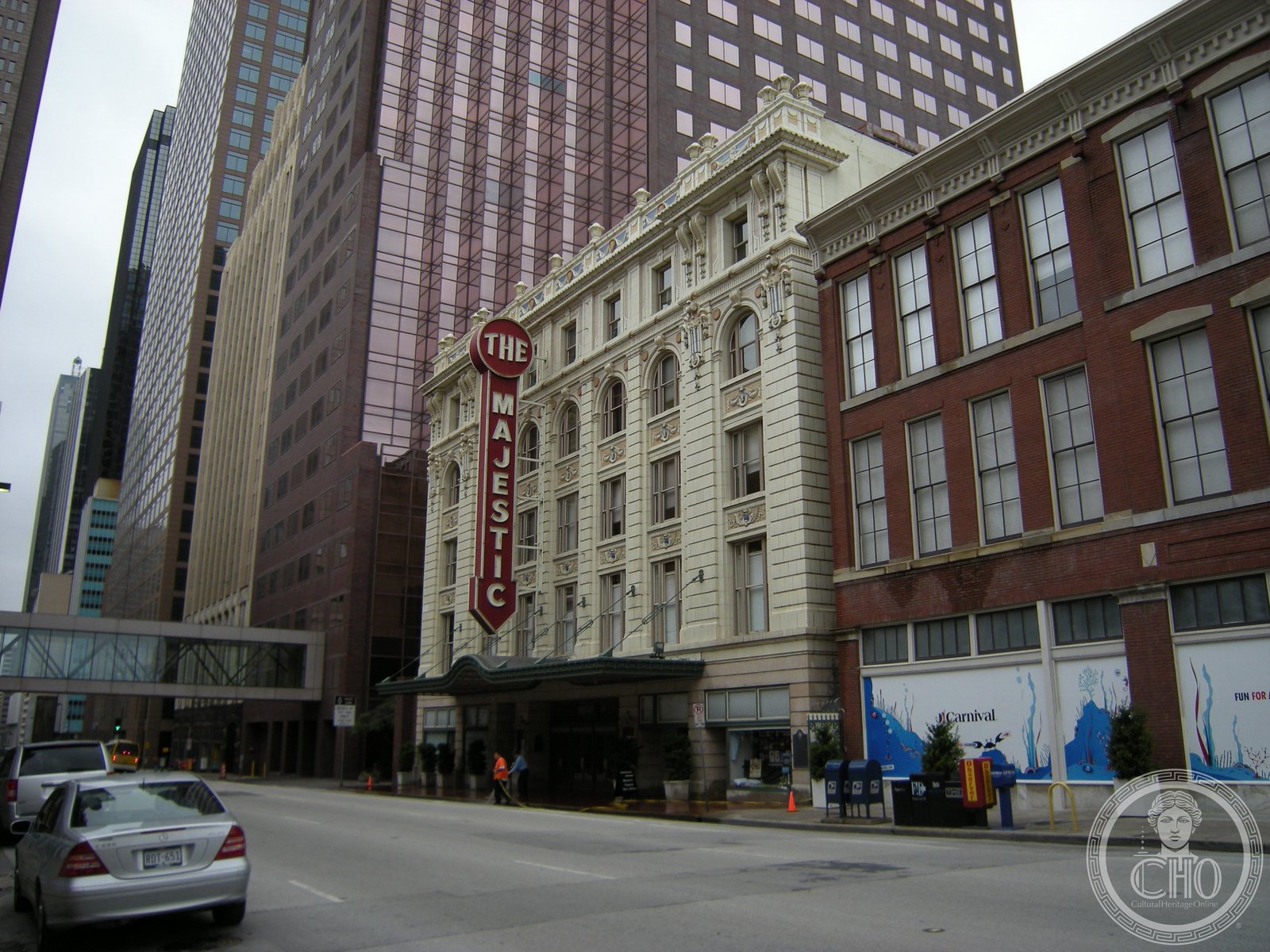
The Majestic Theatre opened in 1921 on Elm Street in downtown Dallas as a vaudeville and film palace designed by John Eberson, the Austrian-born architect who invented the atmospheric theater genre, and remains among the finest surviving examples of his early work in the American South.
At a glance
John Eberson’s atmospheric theaters — interiors designed to evoke outdoor Italian or Spanish courtyards beneath a starlit sky, complete with a projected celestial dome — transformed American picture palace design in the 1920s. The Majestic in Dallas was among his early projects in Texas and stands as a significant example of the atmospheric idiom applied to a major Southwestern city. Dallas in 1921 was a booming cotton and oil brokerage center, and the Majestic’s scale and ambition reflected the city’s self-image as a commercial metropolis. The building has been preserved as a live entertainment venue in the Dallas Arts District and continues to operate for concerts and theatrical events.
Key facts
- Address: 1925 Elm Street, Dallas, TX 75201.
- Opened: 1921.
- Architect: John Eberson (1875–1954).
- Style: Atmospheric (Italian Baroque interior).
- Listed: National Register of Historic Places; Recorded Texas Historic Landmark.
- Current operator: Live entertainment venue, downtown Dallas Arts District.
History
John Eberson arrived in the United States from Austria in the early twentieth century and developed his signature atmospheric theater concept by the mid-1910s: an interior that would make audiences feel they were seated in an outdoor courtyard of an Italian or Spanish palace, with a ceiling projecting a night sky of stars and clouds drifting across a blue field. The effect was achieved with plaster architecture built up against the walls, statuary in niches, climbing vines, and above all the Brenograph projector casting atmospheric effects on the domed ceiling.
The Dallas Majestic opened in 1921 as a vaudeville and film house on Elm Street in the heart of downtown, where the commercial activity of a prosperous cotton and oil brokerage city supported a demand for premium entertainment. Dallas in the early 1920s was competing with Fort Worth for regional dominance in the cattle and grain trades, and its downtown theaters reflected this competitive civic energy — the Majestic was intended to be the finest such venue in the city.
The theater operated as a vaudeville and film venue through the decades of the picture palace era, eventually transitioning to live entertainment as cinema migrated to suburban multiplexes. Preservation efforts have maintained the building as an active venue in what has developed into the Dallas Arts District, one of the largest contiguous urban arts districts in the United States.
What you see
The Elm Street facade is a Renaissance Revival composition in terra cotta and brick: arched openings at street level, paired pilasters framing the upper stories, and an ornate cornice that marks the building as something distinct from its commercial neighbors. The decorative vocabulary draws on the Italian Renaissance sources that Eberson’s atmospheric interiors referenced, so the exterior previews the architectural language awaiting inside.
The auditorium interior — though modified through the theater’s operational history — retains traces of the atmospheric concept: the plaster architecture of the side walls, the trompe-l’oeil sky effect, and the baroque ornamental detail that Eberson applied with characteristic density. The Majestic is a theater that rewards close attention; the surfaces are layered with figures, moldings, and theatrical devices that no single visit exhausts.
Practical information
- Access: 1925 Elm Street, downtown Dallas, adjacent to the DART rail corridor.
- Hours: Open for scheduled performances; check the Majestic Theatre Dallas website for current programming.
- Best for: Atmospheric theater architecture, John Eberson heritage, Dallas Arts District.
- Tip: The nearby AT&T Performing Arts Center (2009) includes the Dee and Charles Wyly Theatre and Margot and Bill Winspear Opera House, contrasting the Majestic’s historic character with contemporary arts architecture.
Getting there
The Majestic is on Elm Street in downtown Dallas, within walking distance of several Dallas Area Rapid Transit (DART) light rail stops including St. Paul Station and Akard Station on the Red and Blue Lines. Dallas/Fort Worth International Airport (DFW) is approximately 20 miles northwest, with DART Orange Line service connecting to downtown Dallas. Dallas Love Field (DAL) is approximately 7 miles northwest. Interstate 30 (Thornton Freeway) provides direct downtown access from the east and west.
Nearby
- Sixth Floor Museum at Dealey Plaza — 10 minutes walk, the museum occupying the former Texas School Book Depository where President Kennedy was assassinated in 1963, one of the most visited historic sites in Texas.
- AT&T Performing Arts Center — 10 minutes walk, the 2009 performing arts campus designed by Rem Koolhaas (Wyly Theatre) and Foster + Partners (Winspear Opera House).
- Nasher Sculpture Center — in the Dallas Arts District, a world-class outdoor and indoor sculpture museum in a Renzo Piano building opened in 2003.
- Dallas Museum of Art — the major encyclopedic art museum of the Dallas Arts District, in a Edward Larrabee Barnes building from 1984.
Sources
- National Register of Historic Places — Majestic Theatre, Dallas, Texas.
- Texas Historical Commission — Recorded Texas Historic Landmark documentation.
- Headley, Robert K. Motion Picture Exhibition in Washington, DC — reference for Eberson atmospheric theater genre development.
Find it on the map
See this place and what’s around it →Record researched and written by Luigi De Marchi for Cultural Heritage Online, 2026.
📷 Become a Cultural Heritage Online photographer
Share your photos of places: they stay published under your name as the author. The more they're seen, the more you get noticed — and soon a contest will reward the most appreciated photos.
Log in or sign up free to add a photoIs this page about you?
This page is read by travellers and heritage enthusiasts who find it on Google. Tell us how you are connected to this place and we will take it from there.