
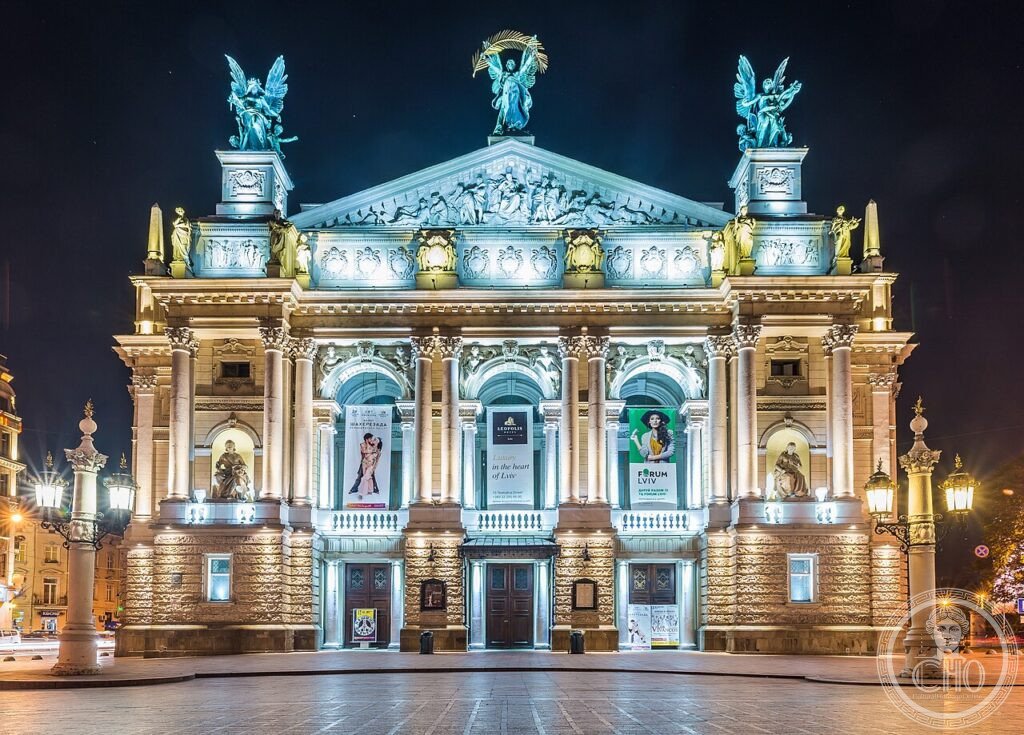
On Svobody Avenue at the heart of Lviv, Zygmunt Gorgolewski’s 1900 opera house brought the full ambition of the Austro-Hungarian cultural programme to the capital of Galicia — a building that matched Vienna and Kraków as a statement of civic prestige, and has since become inseparable from the identity of the city.
At a glance
The Lviv National Academic Theatre of Opera and Ballet — known to residents simply as the Lviv Opera — stands at the western end of Svobody Avenue (Freedom Avenue), the ceremonial axis of Lviv’s UNESCO-listed old city. Built between 1897 and 1900 by the Polish architect Zygmunt Gorgolewski, it replaced an earlier municipal theatre and was designed to give Galicia’s capital a building commensurate with its status as one of the Austro-Hungarian Empire’s most important cities. Since 1999 it has carried the full name of Solomiya Krushelnytska — the Lviv-born soprano (1872–1952) who became one of the great voices of the Belle Époque and who premièred the role of Butterfly in several of Puccini’s productions. The theatre continues to offer opera and ballet performances throughout the season.
Key facts
- Architect: Zygmunt Gorgolewski
- Built: 1897–1900
- Style: Neo-Renaissance / Neo-Baroque with Art Nouveau ornament
- Named after: Solomiya Krushelnytska (1872–1952), Ukrainian soprano (name added 1999)
- Location: Svobody Avenue 28, Lviv, Ukraine
- GPS: 49.84417, 24.02639 — Google Maps
- Status: Operating theatre (opera + ballet season year-round)
History
Lviv — known as Lwów in Polish and Lemberg in German — had been the capital of Galicia under Austro-Hungarian administration since 1773. By the late nineteenth century it was a city of some 150,000 people, with a university, polytechnic, multiple newspapers, and an active cultural life conducted in Polish, Ukrainian, and German. The need to replace the aging municipal theatre on the same site had been apparent for decades, and in 1895 the city administration finally opened the commission.
Zygmunt Gorgolewski — a Lwów-educated architect who had spent years working in Vienna and Dresden — won the competition with a design that combined the Neo-Renaissance plan logic of the great nineteenth-century opera houses (Vienna, Paris, Dresden) with the ornamental elaboration that the emerging Art Nouveau movement was bringing to surface decoration. Construction began in 1897 and the building opened in 1900 to considerable celebration, the timing coinciding with a moment of peak Galician confidence in Austro-Hungarian cultural life.
The twentieth century treated the theatre roughly: the building was occupied and used by successive administrations — Austrian, Polish, Soviet, and German — through two world wars and Soviet collectivisation. But it survived, and after Ukrainian independence in 1991 became a cultural symbol of the city’s Polish-Ukrainian heritage. In 1999, during the theatre’s centenary, it was renamed after Solomiya Krushelnytska — the soprano who had trained in Lviv before becoming internationally famous, and who had returned to the city in her old age.
What you see
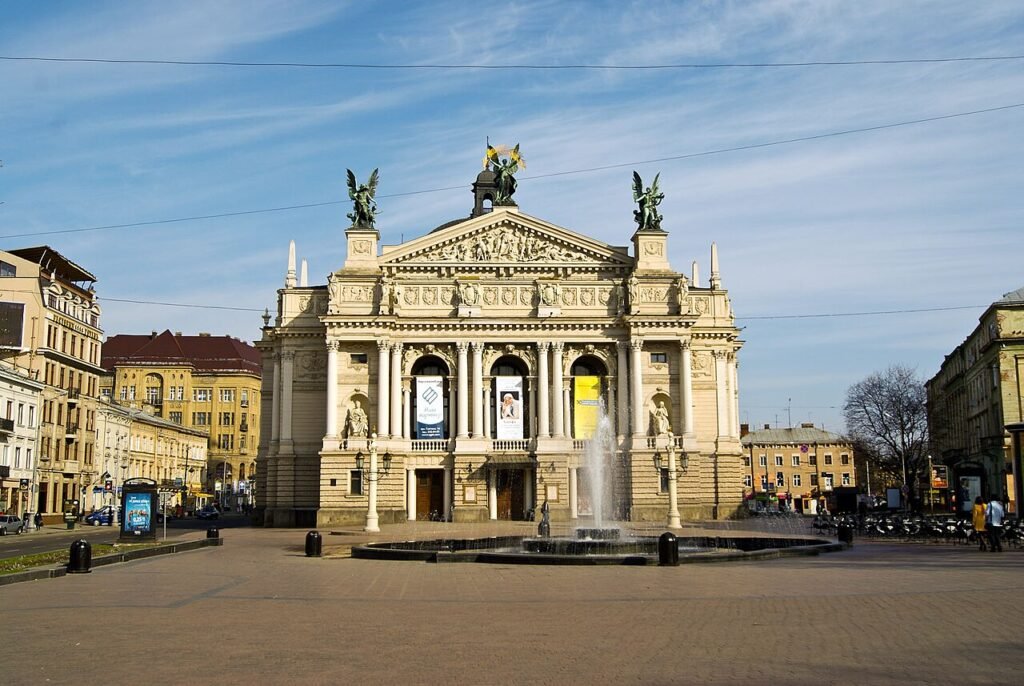
The façade presents a symmetrical composition of dressed stone animated by sculptural groups, allegorical relief panels, and a continuous programme of ornamental detail that reads as Art Nouveau in its surface treatment even as its massing follows nineteenth-century Neo-Baroque conventions. The central colonnade with its arched loggia and the attic storey surmounted by a sculptural group — Glory with a laurel wreath, flanked by allegorical figures of Comedy and Tragedy — give the street front a monumental formality that the side elevations soften with more decorative detail.
The interior carries the ornamental programme from the entrance vestibule through the foyers and staircase to the main auditorium, whose ceiling painting and plasterwork were executed to Gorgolewski’s decorative programme. The horseshoe plan of the auditorium — standard for nineteenth-century opera houses, with its four tiers of boxes — seats roughly a thousand spectators, and the acoustic qualities that the space was designed for remain intact.
Practical information
- The theatre offers opera and ballet performances year-round; check the schedule at the official website.
- Tickets are available at the box office (Svobody Ave. entrance) and online.
- The exterior is freely visible at all hours from Svobody Avenue and the surrounding park.
- Guided tours of the interior may be arranged; inquire at the box office.
- Lviv’s old city is a UNESCO World Heritage Site; the opera house is a short walk from the market square.
Getting there
The opera house is on Svobody Avenue at the western end of Lviv’s historic core, 10 minutes’ walk from the Rynok (market square). From Lviv Holovnyi (main railway station), trams 1, 6, 9 run along Svobody Avenue and stop directly in front of the building. From Lviv Danylo Halytskyi International Airport (LWO, 6 km west), take bus route 48 to the city centre (30–40 minutes).
Nearby
- Lviv old city (Rynok Square) — UNESCO World Heritage Site, 10-minute walk east
- Lviv Holovnyi (Main Railway Station) — 1904 Art Nouveau terminal, 1.5 km west
- High Castle Hill — panoramic viewpoint over Lviv’s UNESCO skyline, 30-minute walk northeast
- Potocki Palace — 1880 Neoclassical palace, 5-minute walk south
More photographs
Sources
- Wikipedia (EN): Lviv Theatre of Opera and Ballet — architect, dates, style, naming for Krushelnytska
- Wikipedia (EN): Solomiya Krushelnytska — biography of the soprano (1872–1952), Lviv training, career
- UNESCO World Heritage: Historic Centre of L’viv — context for the building’s urban setting
- Wikidata Q5895 (approx.) — GPS coordinates 49.84417, 24.02639
Find it on the map
See this place and what’s around it →Historical events at this place (1)
📷 Become a Cultural Heritage Online photographer
Share your photos of places: they stay published under your name as the author. The more they're seen, the more you get noticed — and soon a contest will reward the most appreciated photos.
Log in or sign up free to add a photoIs this page about you?
This page is read by travellers and heritage enthusiasts who find it on Google. Tell us how you are connected to this place and we will take it from there.