
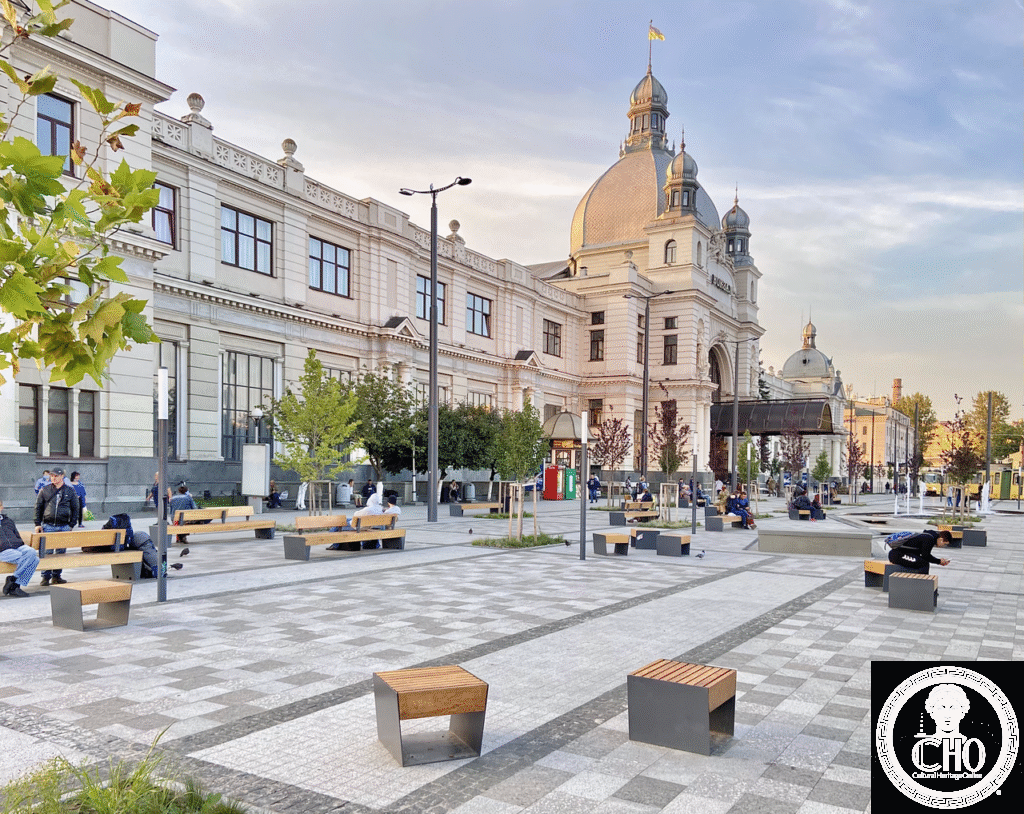
Wikipedia calls Lviv’s main station “one of the most notable pieces of Art Nouveau architecture in former Galicia” — and the steel-and-stained-glass entrance dome, Tuscan colonnade, and mythological sculpture programme that Władysław Sadłowski designed in 1888 still justify that judgment.
At a glance
Lviv Holovnyi — the Holovnyi (main) station of Lviv, known during the Austro-Hungarian period as the Lemberg Hauptbahnhof — is the principal railway terminal of western Ukraine. Selected by competition in 1888 and opened to the public on 26 March 1904, the station was designed by the Polish architect Władysław Sadłowski as the representative entrance to the Galician capital: a building that would meet the traveller with the full decorative ambition of the Arts and Crafts movement — translated into the Austro-Hungarian context of railway architecture. The terminal currently handles over 1.2 million passengers per month and operates services connecting Lviv to Kyiv, Warsaw, Budapest, Vienna, and other European cities.
Key facts
- Architect: Władysław Sadłowski (project); Alfred Zachariewicz (waiting-hall designs)
- Competition won: 1888
- Opened: 26 March 1904
- Style: Art Nouveau / Arts and Crafts
- Notable features: Steel-and-stained-glass entrance dome; mythological sculptures (Hypnos); three themed waiting halls
- Location: Pryvokzalna Square 1, Lviv, Ukraine
- GPS: 49.83972, 23.99444 — Google Maps
- Status: Operating railway terminal (intercity + international)
History
Lemberg’s first railway station had opened in 1861–62 as the terminus of the Galician Railway of Archduke Charles Louis — a neo-Gothic building that matched the ambitions of mid-century railway optimism but quickly proved inadequate for a city growing as fast as Galicia’s capital. By 1888, the Austro-Hungarian administration had determined that a new, representative station was required: one that would occupy a site near the edge of the old city, handle the increasing traffic on the Lviv–Kraków–Vienna and Lviv–Kyiv routes, and announce itself architecturally as a gateway to one of the empire’s most important provincial centres.
Władysław Sadłowski, a Lwów-born architect and graduate of the Lwów Technical Academy, was selected by competition in 1888. Sadłowski was the leading figure of the Arts and Crafts movement in Galicia — in the tradition of William Morris, his design for the station included not only the architectural shell but the complete programme of internal decoration: the ornamental ironwork, the sculptural groups, the materials and finishes of each waiting hall. He worked in collaboration with Alfred Zachariewicz for the three-class waiting rooms. The building opened in March 1904, celebrating its centenary exactly a hundred years later in 2004.
The station has operated continuously through the turbulent twentieth-century history of Lviv, changing its official language from German to Polish to Soviet Russian to Ukrainian across the decades. Since Ukraine’s independence in 1991 it has become an increasingly important node in central European rail connections, and with the 2022 invasion of Russia, it became a major transit point for civilian displacement and international humanitarian logistics.
What you see
The main façade presents a horizontally-oriented composition in which the central entrance block — topped by the steel-and-stained-glass dome — is flanked by two symmetrical wings, each terminating in a smaller cupola. The entrance is framed by Tuscan columns and large mythological sculptures; the figure of Hypnos (god of sleep) is the most noted, positioned above the entrance as a metaphor for the restfulness of arrival. The sinuous ornamental detail that runs through the ironwork, the plasterwork friezes, and the window surrounds places the building firmly within the Art Nouveau vocabulary of the 1890s–1900s, even as its plan-logic follows the conservative horizontality of the great railway terminals.
The three waiting halls inside were designed by Sadłowski and Zachariewicz as three distinct worlds: the first-class hall modelled after the interior of an English gentleman’s club, with dark Viennese-style furniture that evoked the Wiener Werkstätte; the second-class room after the domestic interiors of nineteenth-century Galician bourgeois houses; and the third-class space in a more vernacular tradition. Each hall carried through the ornamental programme of the exterior in adapted forms suited to its social register.
Practical information
- The station is freely accessible as an operating railway terminal. Main hall open 24 hours.
- Train services: Ukrainian Railways (Ukrzaliznytsia) intercity to Kyiv, Odesa, Kharkiv; international to Warsaw, Budapest, Vienna, Prague, Berlin (subject to current service conditions).
- The dome and main hall are accessible from the concourse level; the three-class waiting-hall divisions are still partially visible in the restored interior.
- Trams 1, 6, 9 connect the station to Svobody Avenue and the opera house (10 minutes).
Getting there
Lviv Holovnyi is on Pryvokzalna Square, 1.5 km west of the historic centre and the opera house. From Lviv Danylo Halytskyi Airport (LWO, 5 km south), bus route 48 stops outside the station (20 minutes). Trams connect the station to the city centre and UNESCO old town.
Nearby
- Lviv National Opera House — 1.5 km east, Gorgolewski’s 1900 Art Nouveau opera house
- Lviv Polytechnic University — Neo-Renaissance campus, 5-minute walk south
- Ivan Franko Park — Lviv’s central park, 10-minute walk east toward the opera house
Sources
- Wikipedia (EN): Lviv railway station — “one of the most notable pieces of Art Nouveau architecture in former Galicia”; opened 26 March 1904; centenary 2004; 1.2 million passengers/month; architect Władysław Sadłowski; Alfred Zachariewicz (waiting halls)
- Wikipedia (EN): Lviv railway station History section — 1888 competition; neo-Gothic predecessor 1861–62; Sadłowski Arts and Crafts approach; Hypnos sculpture; three-class hall descriptions; first-class hall compared to English gentleman’s club + Wiener Werkstätte
- Wikidata (GPS) — 49.83972°N, 23.99444°E
Find it on the map
See this place and what’s around it →📷 Become a Cultural Heritage Online photographer
Share your photos of places: they stay published under your name as the author. The more they're seen, the more you get noticed — and soon a contest will reward the most appreciated photos.
Log in or sign up free to add a photoIs this page about you?
This page is read by travellers and heritage enthusiasts who find it on Google. Tell us how you are connected to this place and we will take it from there.