
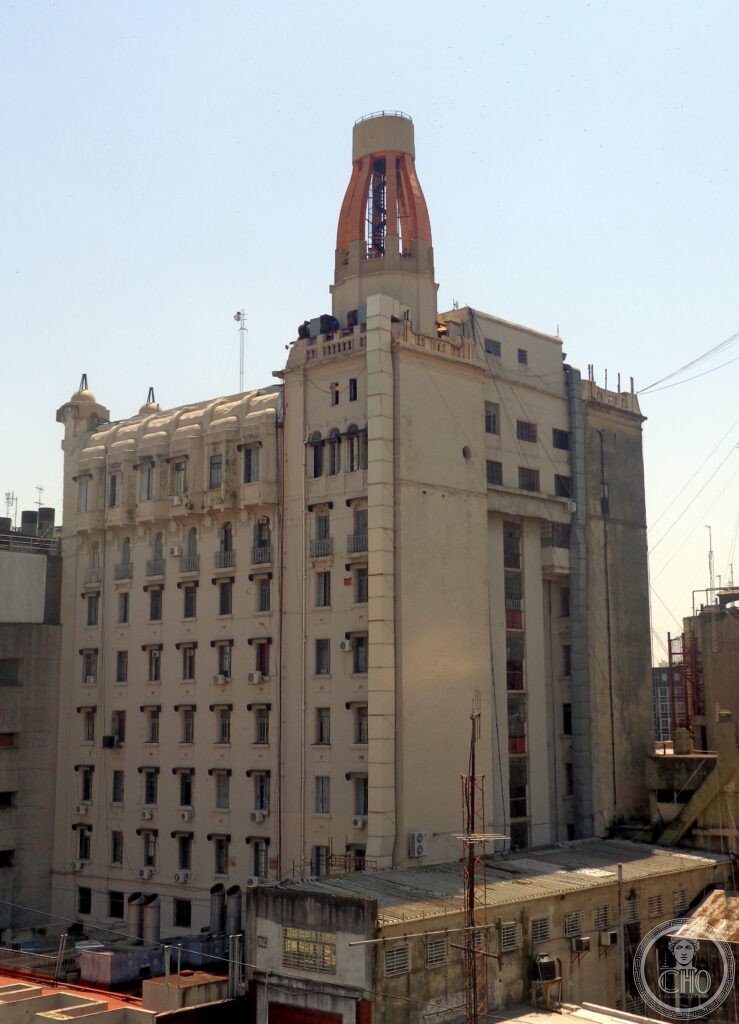
Francesco Gianotti’s 1913 commercial gallery on Florida Street gave Buenos Aires its answer to the covered passages of Paris — a vertical composition of Art Nouveau ironwork, stained glass, and ornamental plasterwork that became one of the city’s most storied literary addresses.
At a glance
Galería Güemes stands on Florida 165, the pedestrian spine of Buenos Aires’ city centre, and is widely regarded as the finest Art Nouveau galleria in South America. Designed in 1913 by the Italian-Argentine architect Francesco Gianotti — who three years later would give the city the Confitería del Molino — the building combines a street-level covered arcade with upper floors containing offices, studios, and apartments. Its glass-and-iron dome and decorative corner tower define the skyline above Florida Street’s pedestrian promenade. The gallery has attracted a remarkable literary biography: Antoine de Saint-Exupéry lived here in 1931 while completing what would become Night Flight, and Julio Cortázar made the Güemes and Paris’s Galerie Vivienne share the same imaginary air in his story El otro cielo.
Key facts
- Architect: Francesco Gianotti (Italian-Argentine)
- Completed: 1913
- Style: Art Nouveau
- Address: Florida 165, San Nicolás, Buenos Aires
- GPS: −34.606128, −58.374953 — Google Maps
- Notable resident: Antoine de Saint-Exupéry (1931); literary references by Julio Cortázar
- Status: Operating commercial and residential building
History
When Galería Güemes opened in 1913, Florida Street was already the commercial and social axis of Buenos Aires — the street where the city’s professional and mercantile class promenaded, shopped, and conducted the informal business of a rapidly industrialising society. The commission fell to Francesco Gianotti, an Italian-born architect who had settled in Argentina and was developing the Art Nouveau approach to mixed-use urban architecture that would reach its apex three years later with the Confitería del Molino.
The building’s programme was designed around the galleria model established in the nineteenth century by Paris and Milan: a covered pedestrian arcade at street level, generating rent from commercial tenants, while upper floors provided more private accommodation for offices, studios, and apartments. The Art Nouveau idiom — with its promise of beauty as a commodity available to the urban middle class — was the natural architectural language for a building that sold the idea of shopping as an aesthetic experience.
The gallery’s literary associations came later. In 1931, the French author Antoine de Saint-Exupéry was living in the building — working in Buenos Aires for the airline Aeroposta Argentina — and is reported to have completed the manuscript of what would be published that year as Vol de nuit (Night Flight) in a room at the Güemes. A generation later, the Argentine writer Julio Cortázar used the gallery’s atmosphere as a fictional bridge to Paris in his story El otro cielo, imagining the Güemes and the Galerie Vivienne as spaces that breathe the same air between two cities.
What you see
From Florida Street, the gallery presents its principal entrance under an elaborate Art Nouveau portal of wrought iron and ornamental glass. The covered arcade within — narrow, high-vaulted, and lit from above by the glass roof — has the compressed vertical drama of a European passage couvert, amplified by the Buenos Aires taste for ornamental excess: moulded plasterwork friezes, sinuous iron column capitals, and coloured glazing that filters the southern light into warm tones even at midday.
Above the street level, the building rises through several storeys to a corner tower and glass dome — the Güemes’ most distinctive external feature, visible from several blocks along Florida Street. The dome’s ironwork tracery and the stained glass panels that ring the lantern level place it firmly in the tradition of the great European covered markets and department stores of the Belle Époque, translated into the subtropical context of the Río de la Plata.
Practical information
- The ground-floor arcade is open during business hours; free to enter.
- Commercial tenants include shops, offices, and a basement tango cabaret.
- Best exterior viewing: from across Florida Street, looking northwest, mid-morning before the pedestrian crowds build.
- The building’s architectural tour begins at the entrance portal and proceeds through the arcade to the central dome space.
Getting there
Galería Güemes is at Florida 165, between Av. Corrientes and Av. de Mayo in central Buenos Aires. Subte Line B stops at Florida, one block away. Line C serves San Martín, 300 m west. The building is a 20-minute walk from the Confitería del Molino and 10 minutes from the Casa Rosada and Plaza de Mayo.
Nearby
- Confitería del Molino — 2 km west, Gianotti’s other Art Nouveau masterpiece, opposite the National Congress
- Teatro Colón — 300 m north, among the world’s greatest opera houses (1908)
- Casa Rosada and Plaza de Mayo — 600 m south, the presidential palace and city’s founding square
- Librería El Ateneo Grand Splendid — 700 m north, Belle Époque theatre converted to bookshop
Sources
- Wikipedia (EN): Galería Güemes — architect Francesco Gianotti, 1913, Art Nouveau, Florida Street; Saint-Exupéry 1931 residency and Night Flight; Cortázar El otro cielo reference
- Wikidata Q11682033 — GPS (-34.606128,-58.374953), architect (P84: Francesco Gianotti)
- English Wikipedia: Confitería del Molino — confirms Galería Güemes as one of Gianotti’s two greatest Buenos Aires works
Find it on the map
See this place and what’s around it →📷 Become a Cultural Heritage Online photographer
Share your photos of places: they stay published under your name as the author. The more they're seen, the more you get noticed — and soon a contest will reward the most appreciated photos.
Log in or sign up free to add a photoIs this page about you?
This page is read by travellers and heritage enthusiasts who find it on Google. Tell us how you are connected to this place and we will take it from there.