

Ancient Thebes with its Necropolis — Luxor and Karnak

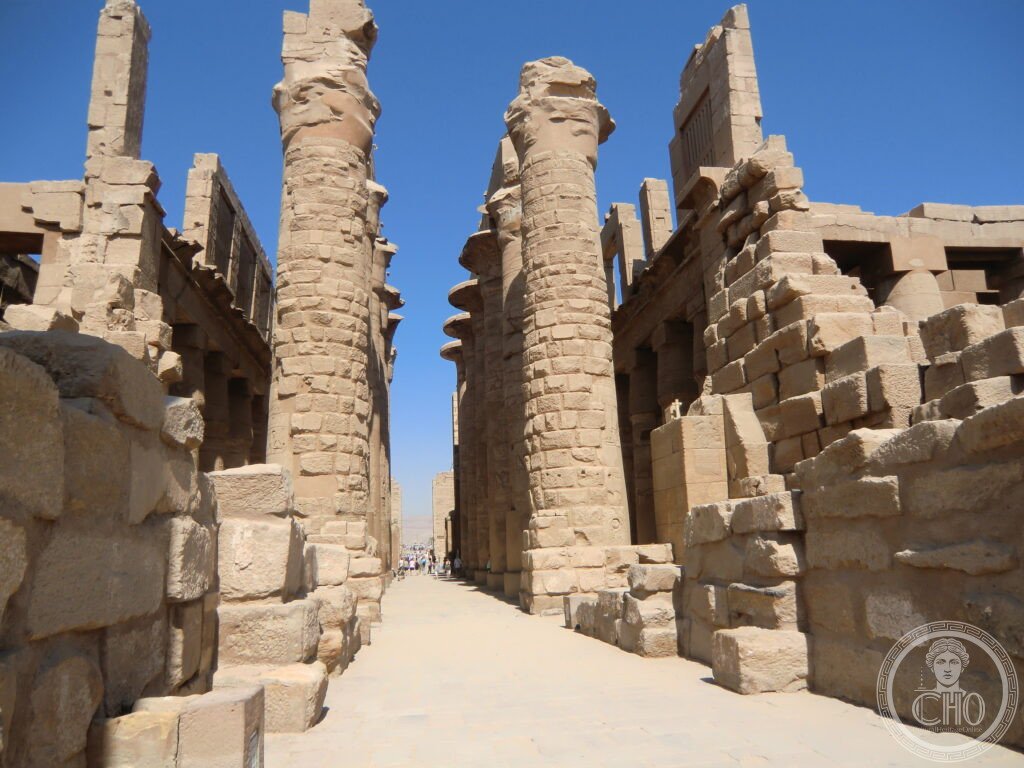
Karnak temple Hypostyle Hall Luxor Egypt Ramesses UNESCO World Heritage
The Great Hypostyle Hall (العمودية الكبرى; the Hypostyle Hall of Karnak; the greatest single interior space of ancient Egyptian temple architecture; 134 papyrus-form columns in 16 rows (the dimensions: 102 m wide × 53 m deep; the 12 central columns (the Great Row; each 21 m high and 3.6 m in diameter — the most massive stone columns in any ancient building; the shaft circumference (each central column is so large that 10 people linking hands can barely encircle it); the papyrus-bud capitals (the closed bud capitals on the 12 great columns represent papyrus plants before flowering; the open papyrus capitals on the 122 smaller columns represent papyrus in bloom; the most sophisticated symbolic botanical programme in any ancient Egyptian architectural element); the original paint (traces of the original polychrome painting (the columns were painted in blue, green, red, yellow, and white; the scenes carved into the columns were painted in bright mineral pigments; the most important reminder that the grey stone columns we see today were originally as colourful as an illuminated manuscript)), Great Hypostyle Hall, Karnak Temple Complex, Luxor (ancient Thebes), Egypt — UNESCO World Heritage Site 1979. Photo via Wikimedia Commons.
Luxor, Upper Egypt · Karnak Temple Complex (the largest religious building ever constructed; 200 ha; built by 30+ pharaohs 2055–343 BCE; Great Hypostyle Hall 134 columns 21m high; Luxor Temple (1390 BCE; the Avenue of Sphinxes 3km connecting both temples; the Colossi of Memnon (both fallen; 18m high each); Valley of the Kings (63 royal tombs including Tutankhamun; KV62 found intact 1922)); Luxor: the world’s greatest open-air museum (UNESCO 1979); East Bank (temples) + West Bank (tombs + mortuary temples) · UNESCO World Heritage 1979

Ancient Thebes with its Necropolis — Luxor and Karnak

The greatest concentration of ancient Egyptian monuments on Earth and the capital of the most powerful empire of the second millennium BCE — Luxor (ancient Thebes; Waset; “the City of a Hundred Gates” as Homer described it) preserves the largest religious complex in the world (Karnak) alongside the finest royal tombs in existence (the Valley of the Kings), across a single bend of the River Nile 700 km south of Cairo.

At a glance

Ancient Thebes with its Necropolis (UNESCO WHS 1979; Luxor is a city of approximately 500,000 people on the east bank of the Nile in Upper Egypt (Upper Egypt: the upstream part of the Nile; confusingly located in the south of Egypt; “upper” refers to elevation, not latitude; the confusion has persisted in English usage since the first European explorers)); the two banks (the east bank (the living city; the temples of Karnak and Luxor; the Nile corniche; the souks; the east = the rising sun = life in ancient Egyptian cosmology); the west bank (the necropolis; the Valley of the Kings; the Valley of the Queens; the Mortuary Temples; the workers’ village of Deir el-Medina; the west = the setting sun = death in ancient Egyptian cosmology; the most logically organised sacred geography in any ancient culture)); the history as capital of Egypt (Thebes became the capital of a unified Egypt during the Middle Kingdom (c.2055 BCE) under the 11th Dynasty pharaohs who drove out the Hyksos invaders and reunified Egypt; the New Kingdom (c.1550–1070 BCE) was the period of Thebes’s greatest power (the period of Tutankhamun, Ramesses II, Akhenaten, and Hatshepsut — the most famous pharaohs in the public imagination are almost all New Kingdom rulers whose monuments are preserved at Luxor); Thebes remained Egypt’s most important religious centre even after the administrative capital moved north to Memphis (under the New Kingdom) and later to Alexandria (under the Ptolemies); the Greek and Roman city (Thebes was a major city in the Ptolemaic period; the Luxor Temple was converted into a Roman fort; the Avenue of Sphinxes (the most important recent archaeological discovery in Luxor: the 3-km avenue connecting the Luxor and Karnak temples, lined with 1,350 sphinx statues; excavated and restored between 2004 and 2021; the most ambitious single archaeological restoration project in modern Egypt)

Key facts

  • Karnak Temple Complex: the largest religious building in the history of the world — Karnak (the most important single fact about Karnak: it is not one temple but a complex of temples, pylons, obelisks, avenues, and sacred lakes that was built, extended, and modified by more than 30 pharaohs over approximately 1,700 years (c.2055–343 BCE); the total area: approximately 200 ha — equivalent to 4 times the area of the Vatican City; the most important modern test of scale: if Paris’s Notre-Dame Cathedral were placed inside the Hypostyle Hall, it would fit); the Great Hypostyle Hall (the most important single space in Karnak; built by Seti I (c.1290–1278 BCE) and completed by Ramesses II (c.1279–1213 BCE); 134 columns in 16 rows; the total weight of stone: approximately 40,000 tonnes; the 12 great central columns (21 m high × 3.6 m diameter; the shaft of each column = a mass of individual stone discs (column drums) stacked without mortar; the sheer weight and the precision of the fit holds them vertical; the most impressive stone stacking in ancient Egypt)); the pylons (the entrance gateways; Karnak has 10 pylons in the Amun precinct alone (the most pylons of any single temple in Egypt; each pylon (a pair of tapering towers) was originally painted and covered in gilded electrum tips on the flag poles; the Pylon of Ramesses II (Pylon 2; the most intact of the great Karnak pylons; the reliefs showing the Battle of Kadesh (c.1274 BCE; the most extensively documented battle in ancient Egyptian history; the first recorded peace treaty in world history; the Egyptian–Hittite peace treaty (c.1259 BCE) — the most important diplomatic document of the Late Bronze Age))); the Sacred Lake (the most important ritual element of the Karnak complex; 120 m × 77 m; the lake was used for ritual purification; the Khepri scarab (the giant granite scarab beside the Sacred Lake; the tradition that walking clockwise around the scarab 7 times brings good luck — the most popular tourist ritual in Luxor; the most-touched single monument in Egypt)
  • Luxor Temple: the temple that became a Roman fort, a mosque, and an archaeological site — Luxor Temple (the southern temple; built primarily by Amenhotep III (c.1390–1353 BCE) and completed by Ramesses II (c.1279–1213 BCE); the entrance court (the original entrance had two 25-m obelisks of red Aswan granite; only one survives (the west obelisk, still in Luxor); the other is the Luxor Obelisk (one of the two pink granite obelisks given to France by Mohammed Ali Pasha in 1830 (the most famous gift of an ancient Egyptian monument to a European power; now standing in the Place de la Concorde in Paris — the most visited Egyptian obelisk in Europe))); the Avenue of Sphinxes (the 3-km avenue from Luxor Temple to Karnak; originally lined with 1,350 ram-headed sphinxes (in the Karnak section) and human-headed sphinxes (in the Luxor section); the avenue was used for the annual Opet Festival (the most important annual religious festival in the New Kingdom; the ritual procession of the barque of Amun from Karnak to Luxor Temple and back; a festival of 11 days (in the 18th Dynasty) extended to 27 days (in the Ramesside period)))); the Roman fort (in the 3rd century CE, the Romans built a fort inside the Luxor Temple court; the Romans painted over the Egyptian reliefs with their own scenes; the most important recent discovery: the removal of the Roman plaster in 2021–2022 revealed perfectly preserved original Egyptian coloured reliefs beneath (the most important conservation discovery in Luxor in recent memory)); the Abu Haggag Mosque (the 12th-century mosque built on top of the east pylon of the Luxor Temple (the floor of the mosque is at the same level as the top of the ancient temple colonnade — the most striking illustration of the multi-layer archaeology of Luxor))
  • Valley of the Kings: the most famous royal cemetery in the world — the Valley of the Kings (the burial site of the pharaohs of the 18th, 19th, and 20th dynasties (c.1539–1075 BCE; the New Kingdom); 63 known tombs (the most important tombs: KV62 — Tutankhamun (discovered by Howard Carter, 4 November 1922; the most important single archaeological discovery of the 20th century; the only pharaonic tomb found substantially intact; the treasures (approximately 5,000 objects; the solid gold inner coffin (110.4 kg of 22-carat gold; the most valuable single funerary object in any museum collection; now in the Grand Egyptian Museum (the new museum in Giza opened 2023)); the golden mask (the most recognisable single object of ancient Egypt; 11 kg of gold; 50 cm high)); KV17 — Seti I (the most elaborately decorated tomb in the Valley; the walls painted in extraordinary detail from top to bottom; 137 m long — the longest royal tomb in the Valley; the Astronomical Ceiling (the earliest known complete astronomical ceiling in Egypt; the first accurate depiction of the Egyptian sky divided into decans (10-day periods) used for night-time time-keeping))
  • Heritage: UNESCO World Heritage Site, Ancient Thebes with its Necropolis, inscribed 1979
  • GPS: 25.7188° N, 32.6573° E (Karnak Temple)

History

Pre-dynastic Thebes (occupation of the site from at least c.3200 BCE; the Theban nome (administrative district) was an important local power even before the unification of Egypt); the Middle Kingdom rise (c.2055 BCE; the Theban kings of the 11th Dynasty drove out the Hyksos and reunified Egypt; Mentuhotep II (r. c.2055–2004 BCE; the pharaoh who reunified Egypt after the First Intermediate Period; his mortuary temple at Deir el-Bahari (directly opposite Luxor on the west bank) was the architectural model for the more famous Mortuary Temple of Hatshepsut built beside it 500 years later)); the New Kingdom (c.1550–1070 BCE; the period of Thebes’s greatest power; the key rulers: Hatshepsut (r. c.1473–1458 BCE; the most powerful female pharaoh in Egyptian history; her mortuary temple at Deir el-Bahari (the finest example of ancient Egyptian architectural design; the three-tiered colonnaded approach ramp; the most sophisticated sight-line planning in any New Kingdom temple)); Thutmose III (r. c.1479–1425 BCE; the pharaoh who expanded the Egyptian empire to its greatest extent); Akhenaten (r. c.1353–1336 BCE; the pharaoh who moved the capital from Thebes to Amarna; abolished the Egyptian polytheistic pantheon in favour of a monotheistic solar cult of the Aten — the most radical religious reform in Egyptian history; Tutankhamun (r. c.1332–1323 BCE; the most famous pharaoh; died at approximately 19 years of age; the smallest reigning pharaoh in the New Kingdom; famous only because his tomb was the only one found intact); Ramesses II (r. c.1279–1213 BCE; the most prolific builder in Egyptian history; the pharaoh who completed the Karnak Hypostyle Hall; added the Great Colonnade to Luxor Temple; built the mortuary temple of the Ramesseum)); the Late Period (c.1070–332 BCE; Thebes lost political power but retained religious importance); the Ptolemaic and Roman periods; UNESCO WHS 1979.

What you see

The Luxor visit: the essential itinerary (3 days minimum for the full experience; Day 1 East Bank (Karnak in the morning (2–3h; enter at the 1st Pylon; walk straight through to the Sacred Lake; the Hypostyle Hall is unmissable; allow 90 min inside the Hall alone; leave 30 min for the open-air museum (the 7th Pylon area; reassembled blocks from the destroyed temples of Hatshepsut and Akhenaten)); Luxor Temple in the late afternoon (the 1h before closing is the best light; the entrance colossi of Ramesses II are at their most dramatic in low golden light; the Abu Haggag Mosque visible above the pylon)); Day 2 West Bank (Valley of the Kings in the morning (the only time before the heat becomes prohibitive; the standard ticket covers 3 tombs (not including KV62 which requires a separate ticket); the most important 3 for a first visit: KV9 (Ramesses VI; the finest painted ceiling in the Valley; the astronomical ceiling; the most complete); KV11 (Ramesses III; the longest of the commonly accessible tombs; the side chambers with painted boats and musicians); KV62 (Tutankhamun; the smallest royal tomb; requires a separate ticket; the mummy of Tutankhamun remains in the tomb (the only pharaoh still in his original tomb))); the Mortuary Temple of Hatshepsut (Deir el-Bahari; the afternoon; the most elegant New Kingdom temple); the Colossi of Memnon (the two 18-m statues of Amenhotep III standing alone in the fields; formerly the guardians of the now-vanished mortuary temple; the most photogenic sunset view in Luxor)); Day 3 (Dendera — 60 km north; the most completely preserved temple in Egypt; the zodiac ceiling (the original in the Louvre; the copy in situ is still the finest astronomical ceiling in any Egyptian temple))

Practical information

  • Getting there: Luxor Airport (LXR; direct flights from London Heathrow, Frankfurt, Paris CDG, and many European cities; approximately 4–5h flight from western Europe; the most convenient air access to Upper Egypt); or by overnight train from Cairo (Cairo Ramses to Luxor; approximately 10h; the best overnight sleeper option in Egypt; the ticket price varies (Egyptian Railways sleeper: the most important point for international travellers: the first-class sleeper tickets must be purchased in person at the Cairo station on the day of travel or through travel agencies; online booking is unreliable); Nile cruise (the Luxor–Aswan Nile cruise; the most atmospheric way to see Upper Egypt; 4–7 night cruises from Luxor to Aswan (or reverse) stop at the temples of Edfu, Kom Ombo, Esna, and Aswan; the most recommended single experience in Egypt after Cairo); the Grand Egyptian Museum (the new museum at Giza; opened 2023; the permanent home of all the Tutankhamun treasures (the solid gold coffin; the golden mask; the chariot; the canopic shrine; the 5,000 objects); the most important single museum opening in the world in the 21st century; easily combined with Cairo and Luxor in a single 7-day Egypt itinerary)
  • The Egyptian table: food in Luxor and the Nile Valley — Egyptian cuisine (the most important food context for Luxor visitors: the Nile Valley cuisine is distinct from the coastal and Delta cuisine; the key dishes: ful medames (فول مدمس; slow-cooked fava beans with olive oil, lemon, and cumin; the most important breakfast dish in Egypt; eaten by peasants and pharaohs alike for 5,000 years (fava bean seeds have been found in New Kingdom tomb offerings at Luxor)); koshary (كشري; the street food of Egypt; a mixture of lentils, rice, macaroni, chickpeas, and crispy fried onions topped with tomato sauce and chilli vinegar; the most complex simple dish in the world; sold from street carts and specialist koshary restaurants (the best koshary in Luxor is from the simple restaurants on the street behind the Luxor Temple, not from the hotels)); ta’amiya (Egyptian falafel; made from fava beans rather than chickpeas (the most important distinction between Egyptian and Levantine falafel); the best: the small deep-fried patties sold from carts near the west bank ferry landing at dawn, when the workers cross for the day; the most authentic food moment in Luxor))
  • Aswan and Abu Simbel: the natural extension of the Luxor itinerary — Aswan (215 km south of Luxor; 2h 30min by the Nile cruise boat or 2h by train; the most important sites: Philae Temple (the Temple of Isis; moved from its original island to Agilkia Island to avoid the Aswan High Dam flooding (1960–1980; the most important international cultural rescue operation in UNESCO history; 22 temples moved or reassembled); the Aswan High Dam (1970; the most important 20th-century engineering project in Africa; created Lake Nasser (5,248 km²; the most important artificial lake in Africa)); Abu Simbel (280 km south of Aswan (1h by plane or 3.5h by bus); the most remote major monument in Egypt; the Great Temple of Ramesses II (the four 20-m seated colossi of Ramesses II; the solar alignment (on 22 February and 22 October each year, the rising sun penetrates the entrance corridor and illuminates the four statues in the inner sanctuary — the most precise solar alignment in any Egyptian temple; the two dates are believed to correspond to the anniversary of Ramesses II’s coronation and birthday)); the UNESCO Save Abu Simbel campaign (both temples were cut into 1,036 blocks and raised 65 m above their original position to avoid the Aswan dam floodwaters (1964–1968; the most complex archaeological relocation in history))

Getting there

Luxor Airport (LXR; direct flights from Europe 4–5h). Overnight sleeper train from Cairo 10h. Nile cruises Luxor–Aswan 4–7 days. GPS Karnak: 25.7188, 32.6573. GPS Luxor Temple: 25.6994, 32.6390.

Nearby

  • Temple of Dendera — 60 km north of Luxor (1h by car); the best-preserved temple complex in Egypt and the finest painted ceilings of the Ptolemaic period — Dendera (the Temple of Hathor (the complete temple complex of Hathor, goddess of beauty, music, and love; built in the Late Period and Ptolemaic period (c.380 BCE–68 CE) on the site of an earlier New Kingdom temple; the best preserved of all Egyptian temple complexes (the roof is largely intact; the Pronaos (the great columned hall) with Hathor-headed columns is the finest columned interior in any Ptolemaic temple; the Zodiac ceiling (the most important single ceiling in Egyptian art; the original Zodiac ceiling is in the Louvre (Napoleon’s engineers removed it in 1820 and it was purchased by the French state for 150,000 francs in 1821; the most expensive Egyptian antiquity in French possession); the high-quality copy in the inner sanctuary is the finest astronomical ceiling still in situ in Egypt; the crypt (the underground passages accessible by ladder; the most disorienting heritage experience in Egypt; the original scenes in the crypts have never been repainted and the pigments are as vivid as on the day they were applied (c.50 BCE — the finest surviving ancient Egyptian paint in any crypt))
  • Abydos — 130 km north of Luxor (2h by car); the most sacred site in ancient Egypt and home to the most important list of pharaohs ever compiled — Abydos (the cult centre of Osiris (the god of the dead and the resurrection; the most important god in the ancient Egyptian funerary religion (the most important religious concept in Egyptian culture was the guarantee of a life after death, and Osiris was its divine guarantor)); the Temple of Seti I (c.1279 BCE; the most complete New Kingdom temple still standing in Egypt; the Abydos King List (the list of 76 pharaoh cartouches inscribed on the wall of the Seti I temple; the most important historical document in Egyptian archaeology (it was used by Egyptologists to establish the sequence of pharaohs for the first time; the most significant fact about the list: it deliberately omits Akhenaten, Neferneferuaten, Smenkhkare, and Tutankhamun — the pharaohs associated with the “Amarna heresy”; the most politically motivated gap in any ancient historical record))
  • Cairo and the Pyramids of Giza (UNESCO WHS 1979) — 700 km north of Luxor (1h by plane; 10h overnight train); the most famous ancient monuments in the world — the Pyramids of Giza (the Great Pyramid of Khufu (c.2560 BCE; the only surviving Wonder of the Ancient World; 146.6 m original height (138.8 m today after the loss of the casing stones and the apex); 2.3 million stone blocks averaging 2.5 tonnes each; the King’s Chamber (the central chamber; lined with Aswan granite; the most precisely hewn stone room in the ancient world; the corners are perfectly square to within 1–2 cm over a 10 m span — the most precise right angles in any building of the ancient world); the internal passages (the most studied passages in world archaeology; the two ascending passages (each approximately 100 m long) leading to the Grand Gallery (the corbelled vault; 8.5 m high; the most impressive single architectural element inside the Great Pyramid) and the King’s Chamber; the Grand Egyptian Museum (the new museum adjacent to the Giza plateau; the definitive collection of Tutankhamun’s treasures (the most important single collection in Egyptian archaeology)

Sources

  • Wikipedia, Karnak; Luxor Temple; Valley of the Kings; Ancient Thebes, accessed June 2026
  • UNESCO, Ancient Thebes with its Necropolis, WHS reference 87, inscribed 1979
  • Nicholas Reeves and Richard Wilkinson, The Complete Valley of the Kings, Thames and Hudson, 1996

Hero image: Karnak Temple Hypostyle Hall, Luxor, Wikimedia Commons. Editorial text © Cultural Heritage Online, 2026.

📷 Diventa un fotografo di Cultural Heritage Online

Condividi le tue foto dei luoghi: restano pubblicate con la tua firma come autore. Più vengono viste, più ti fai conoscere — e presto un concorso premierà le foto più apprezzate.

Accedi o registrati gratis per aggiungere una foto
📋 Copy & share on social
Scroll to Top