

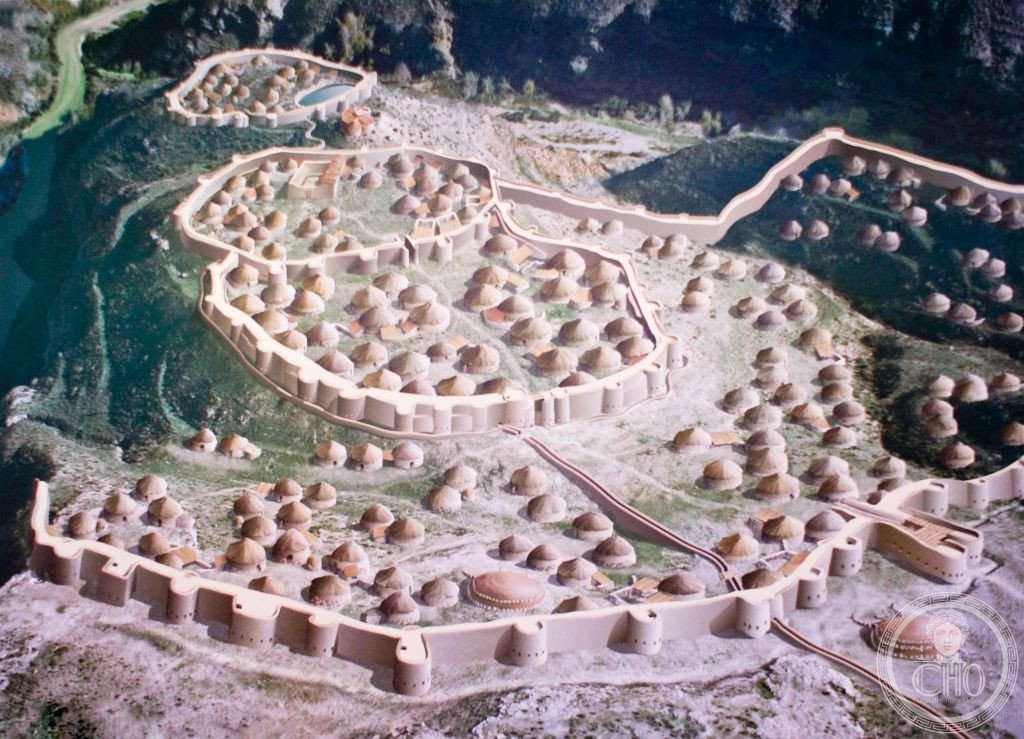
On a triangular promontory above the Andarax River in southeastern Spain, a Copper Age community built between 3200 and 2200 BC the most formidable fortified settlement in Bronze Age Europe: four concentric lines of walls with semicircular bastions, a water supply system, satellite forts on the surrounding hills, and a necropolis of eighty megalithic passage tombs — the largest known concentration of tholos tombs in the world.
At a glance
Los Millares is the largest and most complex Chalcolithic (Copper Age) fortified settlement in Europe, occupied from approximately 3200 to 2200 BC on a promontory formed by the confluence of two ravines in Almería Province, southeastern Spain. A community of approximately 1,000–1,500 people was protected by at least four successive lines of defensive walls, the outermost over 300 metres long and studded with semicircular bastions. The necropolis of approximately 80 megalithic tholos (corbelled-vault) passage tombs to the north is the largest known concentration of this tomb type in Europe. The settlement was served by a sophisticated water supply system and surrounded by satellite forts on the commanding hills. Los Millares is managed by the Junta de Andalucía and lies 17 km north of Almería city.
Key facts
- Location: Santa Fe de Mondújar, Almería Province, Andalusia, southeastern Spain; 17 km north of Almería city.
- Period: c. 3200–2200 BC (Chalcolithic / Copper Age).
- Defences: At least four concentric wall lines; outermost over 300 m long; semicircular bastions throughout; satellite forts on surrounding hills.
- Population: Estimated 1,000–1,500 inhabitants at peak.
- Necropolis: Approximately 80 megalithic tholos (corbelled-vault) passage tombs — largest known concentration in Europe.
- Metal use: Among the earliest users of copper tools on a significant scale in Europe (copper axes, awls, saws).
- Abandoned: c. 2200 BC, possibly as Bell Beaker culture arrived and Copper Age trade networks collapsed.
History
Los Millares was occupied during the height of European Copper Age culture, a period when communities across the Iberian Peninsula, Atlantic Europe, and the Aegean developed independently sophisticated social structures, long-distance trade networks, and monumental architecture without access to bronze. The inhabitants of Los Millares derived their copper ore from the rich deposits of the Sierra Alhamilla to the north and traded finished copper tools, ivory (from North Africa), ostrich eggs, and decorated ceramics across a network that extended to the Atlantic coast and the British Isles. The appearance of copper tools at Los Millares is among the earliest evidence of metal use on any significant scale in western Europe.
The settlement layout reveals remarkable planning for its period. A main residential area occupied the innermost walled enclosure; a suburb developed between the first and second wall lines; satellite forts on the surrounding hills controlled approach routes. The necropolis to the north grew over centuries as successive chambers were added to existing tholos tombs, accommodating family or clan burials. Many of the tholos tombs contain decorated stone slabs, beaker-style pottery, idols (abstract human figures carved in bone, ivory, or stone), copper tools, and personal ornaments of jet, amber, and exotic stone — all indicative of long-distance connections and a stratified society with a specialist ritual class.
The tholos tomb architecture of Los Millares — corbelled stone chambers beneath earthen mounds, approached through a long stone-lined entrance passage — is formally similar to Irish passage tombs (Newgrange, Knowth) and the Aegean tholos tradition (Treasury of Atreus at Mycenae). Whether these similarities reflect contact, shared ancestry, or independent invention remains one of the most debated questions in European prehistory. Los Millares was abandoned c. 2200 BC, possibly following the collapse of Copper Age trading networks and the rapid expansion of the Bell Beaker culture, which superseded the Los Millares culture across the Iberian Peninsula.
What you see
The site is accessible along a marked path from the visitor car park. The four wall lines are partially reconstructed and clearly visible, with the semicircular bastion towers at intervals along the outermost wall particularly impressive. The satellite fort on the hill above the main site gives a panoramic view over the entire settlement and the Andarax valley. The water channel system, cut into the rock, is traceable in places. A reconstructed tholos tomb near the visitor area demonstrates the corbelled-vault construction technique.
The necropolis itself, with its dozens of mounds spread across the promontory to the north, is the most atmospheric part of the site. Several tombs are open for inspection, showing the typical long entrance passage leading to the corbelled chamber. The interpretive panels (Spanish and English) at the site explain the excavation history and social structure. For the finest objects found at Los Millares (copper tools, idols, beaker pottery), visit the Archaeological Museum of Almería in the city.
Practical information
- Address: Los Millares archaeological site, near Santa Fe de Mondújar, Almería Province, Spain.
- Opening: Tuesday–Sunday, approximately 09:00–14:00 (times vary; confirm via Junta de Andalucía or Almería tourism); closed Mondays.
- Admission: Free; guided tours available in Spanish (advance booking recommended for groups).
- Facilities: Car park, visitor information panels; no on-site café.
- Allow: 1.5–2.5 hours for the full site walk.
Getting there
Los Millares is 17 km north of Almería city, near the village of Santa Fe de Mondújar on the A-348 road along the Andarax valley. By car: follow the A-348 northwest from Almería toward Gador; signs for Los Millares are marked from the main road (approximately 20 minutes). Public transport: take the bus from Almería towards Beró, disembarking at the turn-off; services are infrequent — verify schedules locally. Almería city is accessible by train from Granada (2 hours) and Madrid (7 hours) or by bus from major Andalusian cities.
Nearby
- Archaeological Museum of Almería: Holds the finest collection of Los Millares artefacts, including copper tools, idols, and decorated pottery; free entry on Sundays.
- Almizaraque: A smaller Copper Age settlement in the same region, for specialist interest.
- Almería city: The Alcazaba (Moorish fortress, the largest in Spain after the Alhambra) and the Cathedral-Fortress are within 20 km.
- Cabo de Gata: Europe's driest region and the volcanic natural park, 30 km southeast.
Sources
- Chapman, Robert, Emerging Complexity: The Later Prehistory of South-East Spain, Iberia and the West Mediterranean, Cambridge University Press, 1990.
- Gilman, Antonio & Thornes, John, Land-use and Prehistory in South-East Spain, Allen & Unwin, 1985.
- Molina González, Fernando, 'Los Millares y la periodización de la prehistoria reciente del sudeste'.
- Wikipedia: Los Millares.
- Junta de Andalucía, Los Millares visitor information (official site).
Find it on the map
See this place and what’s around it →📷 Become a Cultural Heritage Online photographer
Share your photos of places: they stay published under your name as the author. The more they're seen, the more you get noticed — and soon a contest will reward the most appreciated photos.
Log in or sign up free to add a photo