
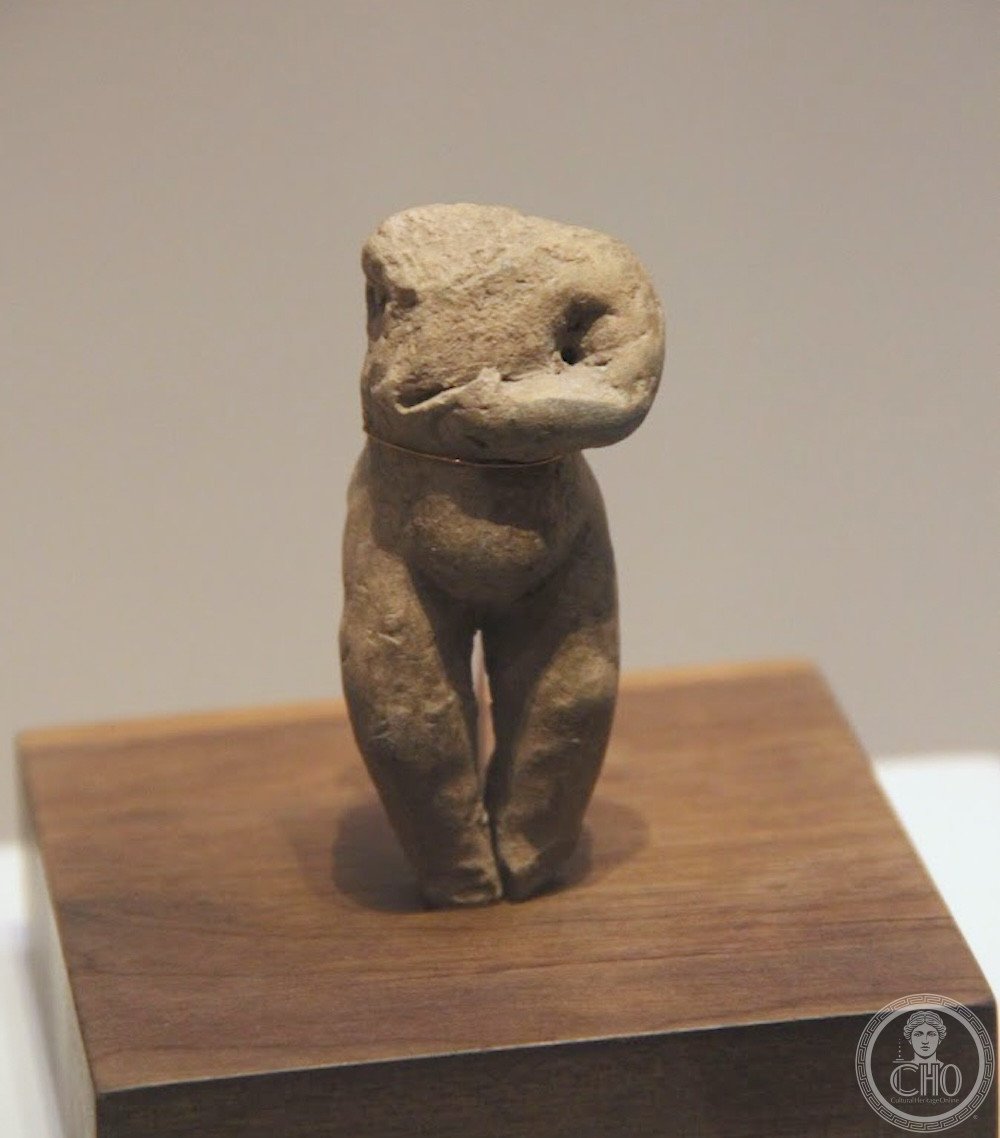
In the mountains of western Liaoning Province, a Neolithic ritual complex built 5,500 years ago on a remote ridgeline has overturned everything that was thought about the origins of Chinese civilisation: Niuheliang contains the oldest known purpose-built temple in East Asia, life-sized clay goddess figures, and more than twenty burial mounds filled with extraordinary jade objects.
At a glance
Niuheliang is a Hongshan culture ceremonial complex in the mountains of western Liaoning Province, northeastern China, built between approximately 3,500 and 3,000 BC — contemporary with the earliest phases of Stonehenge, and more than a century before the Egyptian Old Kingdom. The site was discovered in 1981 and has completely reassessed our understanding of Neolithic society in East Asia. Its key structures are the semi-subterranean Goddess Temple (Nüshen Miao), with life-sized painted clay figures and jade-inlaid eyes, and more than twenty stone cairn burial mounds on surrounding ridges containing the finest Hongshan jade ever found. Niuheliang is 50 km from Chaoyang city in Liaoning and accessible as a day trip from either Chaoyang or Shenyang.
Key facts
- Location: Western Liaoning Province, northeastern China; 50 km from Chaoyang
- Period: c. 3500–3000 BC (Hongshan culture, Late Neolithic)
- Discovered: 1981; systematic excavation by the Liaoning Provincial Institute of Archaeology
- Key structure: The Goddess Temple (Nüshen Miao) — oldest known purpose-built temple in East Asia
- Burial mounds: More than 20 stone cairn mounds on surrounding ridges; each containing jade objects of exceptional quality
- Key jade types: Jade pig-dragons (zhulong), jade tortoise, jade human masks, jade cloud pendants
- Significance: Oldest known institutionalised shamanism in East Asia; Hongshan jade tradition directly influenced later Chinese Bronze Age jade
History and discovery
The Hongshan culture flourished in the Liao River Valley of northeastern China between approximately 4700 and 2900 BC, a thousand years before the first Chinese dynasty. Before the discovery of Niuheliang in 1981, the Hongshan were known primarily from painted pottery and jade pig-dragon pendants found scattered across the region. Niuheliang revealed something no one had expected: a sophisticated ceremonial complex of monumental scale, built by people who organised large-scale collective labour for ritual purposes, maintained an elite class with specialised religious functions, and developed a jade tradition of extraordinary refinement — all without bronze tools, writing, or urban settlement in the conventional sense.
The site covers a ridgeline of approximately 50 km² in the Daling River headwaters. The Goddess Temple, the centrepiece, is a semi-subterranean complex of connected rooms — at least three linked chambers — whose interior walls were plastered and painted in geometric patterns, and whose floors were covered with fine pottery fragments. The main chamber contained a life-sized clay face with jade inlaid eyes (the 'Goddess of Niuheliang'), remnants of several life-sized and larger-than-life-sized clay figures including apparent animal forms (bear jaw, bird's claws), and what appear to be the remains of sustained ritual fire. The temple is interpreted as a centre for ancestor veneration or goddess worship, the oldest known purpose-built ritual architecture in East Asia.
On the ridges surrounding the temple, twenty-plus stone cairn burial mounds have been excavated. Each mound contained between one and several dozen individuals, accompanied by jade objects of high quality — pig-dragons, tortoises, human masks, and abstract cloud shapes. These burials clearly indicate a social elite with specialised religious roles. The Hongshan jade tradition — using nephrite from distant sources, worked with extraordinary technical skill — directly influenced later Chinese Bronze Age jade aesthetics and may represent the origin point of Chinese jade cosmology. Some scholars see in Niuheliang the earliest known evidence of institutionalised shamanism in East Asia.
What you see
The Goddess Temple (Nüshen Miao) has been covered by a protective structure for preservation, with display panels explaining the excavation. Visitors can see the outline of the connected chamber plan and the stratigraphy of the plastered walls. Nearby, several of the burial cairns are partially reconstructed and interpreted, showing the typical Hongshan mound-over-stone-chamber arrangement. The remoteness and natural setting of the ridgeline — with views over the Daling River valley — give the site a distinctive atmosphere that larger excavated sites lack.
The finest objects from Niuheliang, including the jade pig-dragons, the jade tortoise, and reconstructed fragments of the clay goddess figures, are held at the Liaoning Provincial Museum in Shenyang and the National Museum of China in Beijing. A site museum at Niuheliang itself provides introductory context; the provincial museum collection is essential viewing for a full understanding of the Hongshan world.
Practical information
- Location: Jianping County, Chaoyang, Liaoning Province, China
- Site museum: Niuheliang Ruins Museum, open daily (check hours locally, typically 08:30–17:00)
- Admission: Entrance fee applies; pricing may vary by season
- Best combined with: Liaoning Provincial Museum (Shenyang) for the jade collection
- Allow: 2–3 hours at the site; half-day if combining with Chaoyang city
Getting there
Niuheliang is approximately 50 km from Chaoyang city. From Chaoyang, hire a taxi or private car (about 1 hour; public transport is limited). Chaoyang is connected by high-speed rail to Shenyang (approximately 2 hours) and Beijing (approximately 4 hours). The nearest major hub is Shenyang, 3–4 hours by road from the site. Guided tours from Chaoyang or Shenyang are available through local operators.
Nearby
- Chaoyang: Contains the Chaoyang North Pagoda (a Tang Dynasty Buddhist stupa) and a museum with local Hongshan material
- Liaoning Provincial Museum, Shenyang: Holds the finest Hongshan jade collection, including pig-dragons and human masks from Niuheliang
- National Museum of China, Beijing: Significant Hongshan collection with comparative material from across northeastern China
Sources
- Barnes, Gina, Archaeology of East Asia, Oxbow Books, 2015
- Nelson, Sarah M., 'Hongshan: An Early Complex Society in Northeastern China', Journal of World Prehistory
- Sun Shoudao & Guo Dashun, 'Niuheliang Hongshan Culture Goddess Temple and Cairn Sites', Wenwu, 1984
- Wikipedia: Niuheliang
- Wikipedia: Hongshan culture
Find it on the map
See this place and what’s around it →📷 Become a Cultural Heritage Online photographer
Share your photos of places: they stay published under your name as the author. The more they're seen, the more you get noticed — and soon a contest will reward the most appreciated photos.
Log in or sign up free to add a photo