

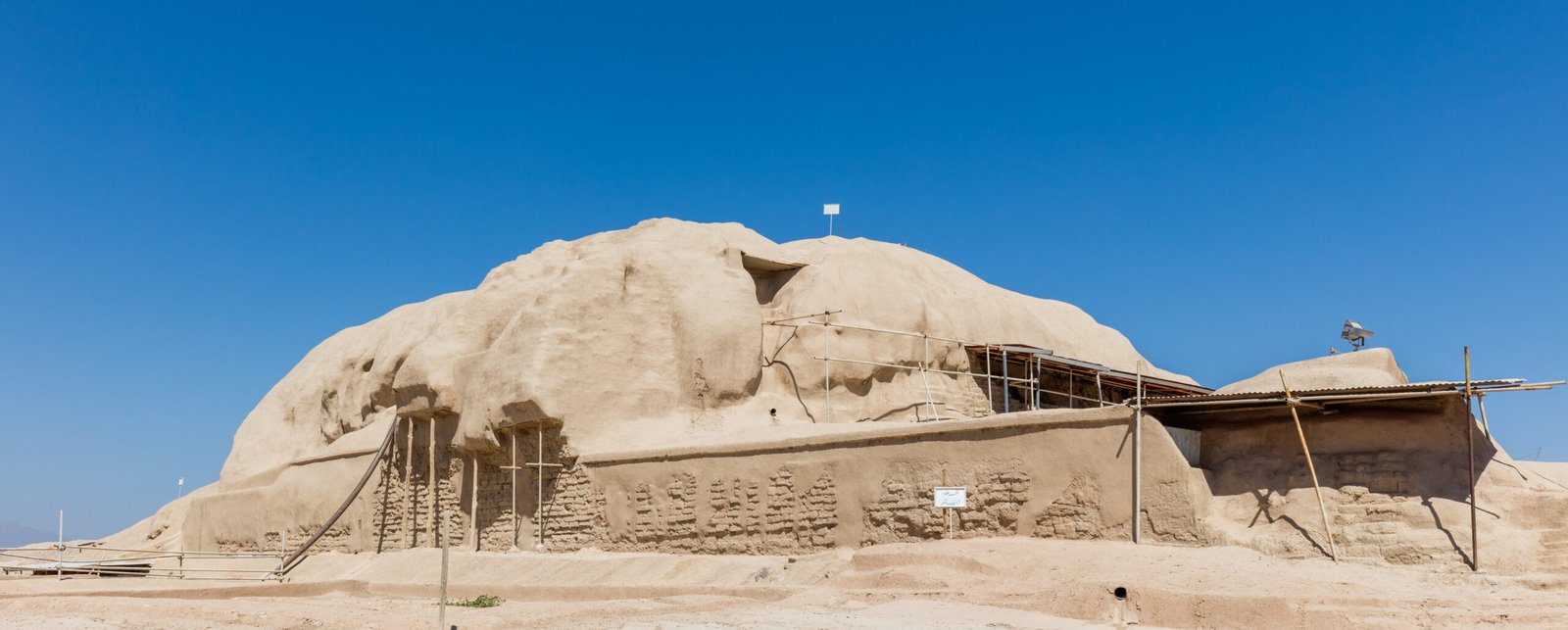
Two earthen mounds on the edge of Kashan preserve 4,500 years of unbroken human settlement, the Iranian plateau's oldest known ziggurat, and some of the earliest decorated ceramics and proto-writing signs anywhere in the world.
At a glance
Tepe Sialk sits at the edge of the modern city of Kashan in Isfahan Province, its northern mound rising approximately 8 metres above the plain. The site preserves 28 or more occupation phases spanning from roughly 5500 BC to around 1000 BC — a stratigraphic sequence of extraordinary depth that documents the full arc of Iranian civilisation from the earliest Neolithic through the Bronze and Iron Ages. The southern mound bears a heavily eroded but recognisable mudbrick ziggurat, built around 3000 BC and considered the oldest known stepped pyramid temple on the Iranian plateau, predating the great ziggurats of Mesopotamia by roughly nine centuries. UNESCO placed Sialk on its 2002 list of the 100 most endangered heritage sites following severe looting in the 1990s.
Key facts
- Location: Kashan, Isfahan Province, Iran (33.9794°N, 51.3939°E)
- Occupation: c. 5500–1000 BC, 28+ identified phases
- Type: Multi-period archaeological tell (two mounds: North and South)
- Key monument: Earliest known ziggurat on the Iranian plateau (c. 3000 BC)
- Excavated by: Roman Ghirshman, French Archaeological Mission, 1930s
- UNESCO status: Listed among 100 most endangered heritage sites (2002)
- Significance: Among the oldest known permanent human settlements in the world
History
The lowest deposits at Tepe Sialk — designated Sialk I (c. 5500–4500 BC) — preserve among the earliest evidence of permanent human settlement on the Iranian plateau. The inhabitants of this phase were producing hand-formed pottery painted with geometric designs, some of the earliest known decorated ceramics in the region, and living in rectangular mud-brick structures rather than temporary shelters. This foundational step from mobile to settled life makes Sialk a critical reference point for understanding the origins of complex society in Southwest Asia.
By the Sialk III phase (c. 3700–3200 BC) the settlement had undergone a technological revolution: the potter's wheel had been adopted, copper was being worked regularly, and clay tablets bearing incised proto-writing symbols were in use. French archaeologist Roman Ghirshman led the foundational excavations in 1933–34 and 1937–38, establishing the stratigraphic sequence still used by researchers today. The southern mound's mudbrick ziggurat, built around 3000 BC, is the site's most visible legacy: predating the great ziggurats of Ur and Ur-Nammu by roughly nine centuries, it supports the contested but significant hypothesis that the stepped pyramid temple form originated in Iran rather than in Mesopotamia.
The 1990s brought devastating looting, particularly of the Iron Age cemetery levels, which yielded spectacular painted pottery that flooded the international antiquities market. UNESCO's 2002 endangered listing prompted stronger Iranian government protection. The National Museum of Iran in Tehran holds the primary collection, including the famous 'Sialk goblets' — tall painted ceramic vessels whose distinctive style influenced pottery traditions across a vast region.
What you see today
The two mounds are visible from Kashan's urban landscape. The northern mound (Sialk I–III phases) is lower and more heavily eroded; the southern mound bears the remains of the ziggurat, identifiable as a stepped platform even in its degraded state. The site is enclosed and managed by Iran's Cultural Heritage Organisation, with a small on-site display. The perimeter paths offer clear views of both mounds above the plain.
The most important finds — Ghirshman's painted ceramics, copper tools, proto-writing tablets, and Iron Age goblets — are held in the National Museum of Iran and in the Louvre in Paris. A dedicated Sialk gallery at the Kashan Regional Museum displays locally held material and provides the best contextual introduction for visitors.
Practical information
- Access: Western outskirts of Kashan; managed by Iran's Cultural Heritage, Handicrafts and Tourism Organisation
- Opening hours: Generally daylight hours; verify with local cultural heritage office before visiting
- Admission: Entry fee applies; standard archaeological site rate for international visitors
- Guides: English-speaking guides available through Kashan tour operators
- Photography: Permitted in most areas
Getting there
Kashan is served by direct bus connections from Tehran (approximately 3 hours) and Isfahan (approximately 2 hours), and by the Tehran–Isfahan intercity train. From the city centre, Tepe Sialk is reachable by taxi in under 10 minutes (approximately 3 km west of the historic bazaar district). The site pairs well with visits to the Fin Garden and Kashan's historic houses, all within the same day.
Nearby
- Fin Garden, Kashan — UNESCO-listed Persian garden, a masterpiece of the chahar-bagh tradition (c. 3 km)
- Abyaneh Village — inhabited Iron Age-era village with red-ochre architecture and Zoroastrian traditions (c. 75 km)
- Isfahan — former Safavid capital with the monumental Imam Square (c. 230 km)
Sources
- Ghirshman, R. (1938). Fouilles de Sialk près de Kashan. Paris: Geuthner.
- Malek Shahmirzadi, S. (2004). Sialk III: The Seventh Season of Excavation. Tehran: ICHO.
- UNESCO Tentative World Heritage List — Tepe Sialk Archaeological Mounds.
- Stronach, D. (1972). "Tepe Sialk," in Encyclopaedia Iranica.
- Wikipedia contributors. "Tepe Sialk." Wikipedia, The Free Encyclopedia.
Find it on the map
See this place and what’s around it →📷 Become a Cultural Heritage Online photographer
Share your photos of places: they stay published under your name as the author. The more they're seen, the more you get noticed — and soon a contest will reward the most appreciated photos.
Log in or sign up free to add a photo