
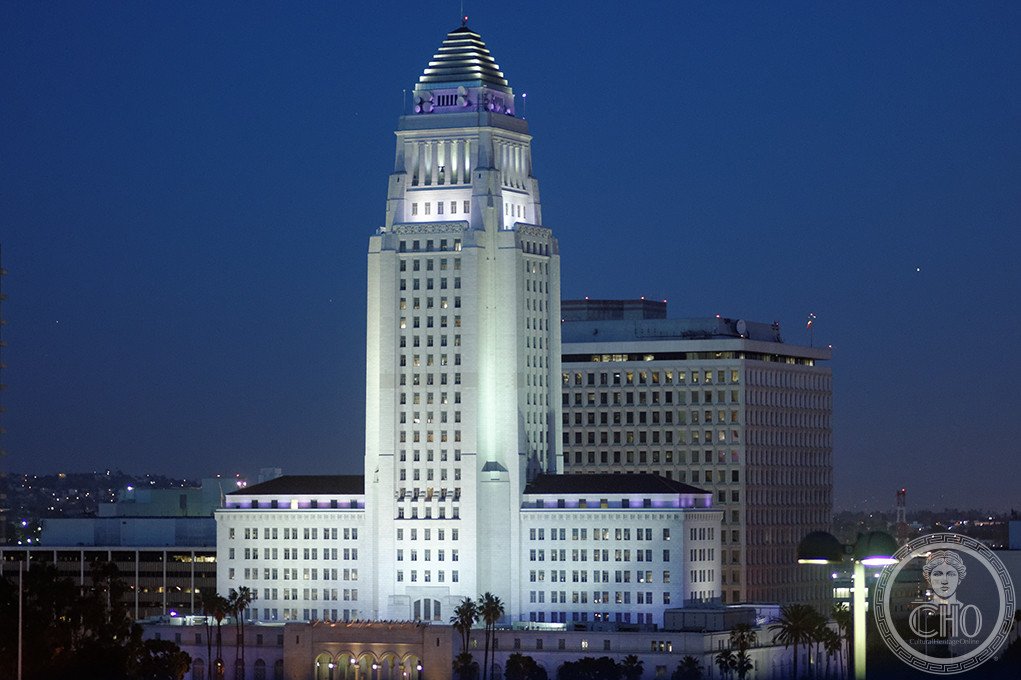
Standing 454 feet above the Civic Center, Los Angeles City Hall was the defining landmark of the young metropolis when it opened in 1928 — the only structure in the city permitted to exceed the 150-foot height limit then in force. Designed by John Parkinson, John C. Austin, and Albert C. Martin Sr., the tower blends Art Deco verticality with a Neoclassical base and a pyramidal crown modelled after the ancient Mausoleum at Halicarnassus. Its concrete contains sand gathered from all 58 California counties and water drawn from 21 historical missions, embedding the geography and history of the entire state into its fabric. The Lindbergh Beacon at its apex once guided aviators across the basin; the free public observation deck on the 27th floor still commands one of the most panoramic urban views in Southern California. Seismically retrofitted between 1998 and 2001, it is today the tallest base-isolated structure in the world — as much an engineering landmark as an architectural one.
At a glance
- Type
- Civic / government building
- Period
- Dedicated 26 April 1928; seismic retrofit 1998–2001
- Style
- Art Deco with Neoclassical base
- Location
- 200 North Spring Street, Civic Center, downtown Los Angeles, California, USA
- Coordinates
- 34.0536° N, 118.2430° W
- Architect(s)
- John Parkinson, John C. Austin, Albert C. Martin Sr.
Overview
Los Angeles City Hall was the tallest building in Los Angeles from its dedication in 1928 until 1964, when new construction finally overtook it. Its 32-storey mass is organised in three compositional zones: a broad Neoclassical base of white granite, a tapering Art Deco shaft faced in glazed terra cotta, and a stepped pyramid inspired by the Seven Wonders of the Ancient World. The building houses the Mayor’s office, the City Council chambers, and numerous municipal departments. It was designated Los Angeles Historic-Cultural Monument No. 150 in 1976 and listed on the National Register of Historic Places in 2025.
History
Planning for a grand civic headquarters began in the early 1920s as Los Angeles grew rapidly into a major American city. A bond measure was passed in 1923; construction ran from 1926 to 1928. The building was dedicated on 26 April 1928 and immediately became the visual symbol of the city, appearing on LAPD badges from 1940 onward. During the Cold War its rooftop bristled with communication antennae. The 1994 Northridge earthquake revealed serious seismic vulnerability; a $299 million base-isolation retrofit was completed in 2001, inserting 416 lead-rubber bearings beneath the foundation and allowing the structure to shift up to 24 inches during a major quake — the largest such engineering feat applied to a historic building in the world.
Architecture & Design
The architects drew on a deliberately eclectic vocabulary intended to assert civic dignity without imitating any single European precedent. The Neoclassical base with its colonnaded entrance portico gives way above the roofline to an Art Deco shaft decorated with vertical fins and abstracted ornament. The pyramid crown, set back in successive stages, references the Mausoleum at Halicarnassus — one of the Seven Wonders of the Ancient World — lending the building a monumental and timeless quality. Interior highlights include the rotunda with its barrel-vaulted ceiling, mosaic floors in the entry hall, and the ceremonial Council chambers. The Tom Bradley Room on the 27th floor serves as a public observation gallery open on weekdays.
Cultural significance
Few buildings in American cinema are more immediately recognisable: Los Angeles City Hall has stood in for the Daily Planet in Adventures of Superman, appeared in Dragnet, L.A. Confidential, War of the Worlds (1953), Perry Mason, and scores of other productions. Its silhouette is embedded in the collective visual memory of the twentieth century. Beyond its screen presence, the building represents the moment when Los Angeles consciously chose to present itself as a world-class city — grand, permanent, and built to endure. Its seismic retrofit became an international model for preserving heritage structures in earthquake-prone regions.
Visiting today
The building is open to the public on weekdays. The Tom Bradley Room observation deck on the 27th floor is free and offers 360-degree views of the Los Angeles Basin, the San Gabriel Mountains, and on clear days the Pacific Ocean. Self-guided tours of the rotunda and public areas are available; guided group tours can be arranged through the Mayor’s office. Photography is permitted in public areas. The surrounding Civic Center contains several other notable Moderne and Brutalist public buildings worth exploring on foot.
Getting there
The nearest Metro station is Civic Center / Grand Park on the B (Red) and D (Purple) lines, directly adjacent to City Hall on 1st Street. Lines A and E connect at 7th Street / Metro Center with a short transfer. By car, parking is available in the Civic Center garage on Main Street. The building entrance faces Grand Park lawn — itself a pleasant public green space — at 200 North Spring Street.
Sources & resources
Find it on the map
See this place and what’s around it →Record researched and written by Luigi De Marchi for Cultural Heritage Online, 2026.
📷 Become a Cultural Heritage Online photographer
Share your photos of places: they stay published under your name as the author. The more they're seen, the more you get noticed — and soon a contest will reward the most appreciated photos.
Log in or sign up free to add a photoIs this page about you?
This page is read by travellers and heritage enthusiasts who find it on Google. Tell us how you are connected to this place and we will take it from there.