
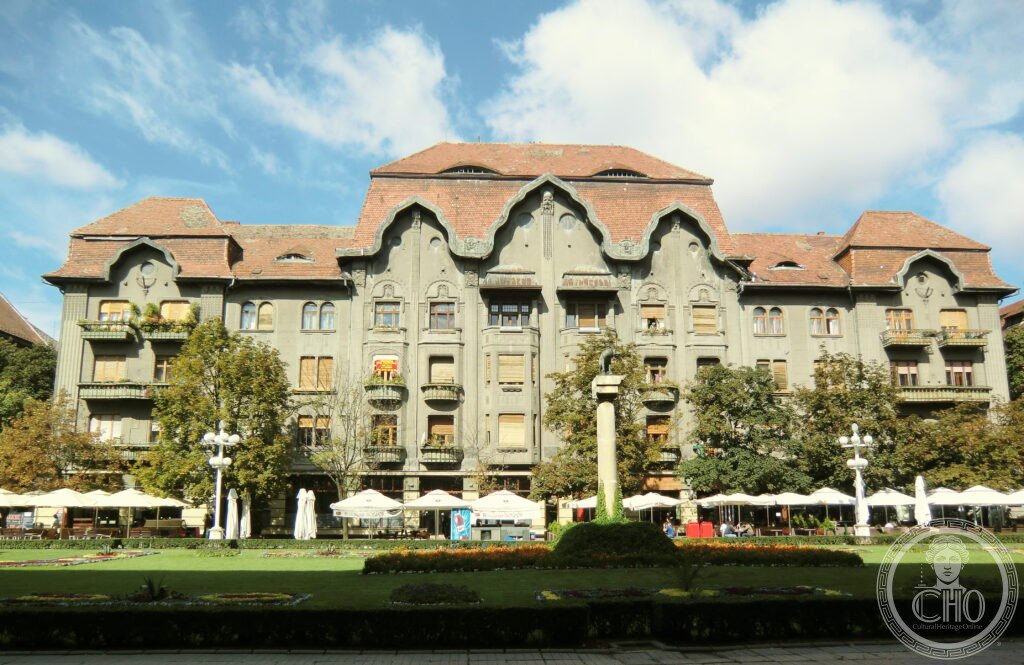
László Székely’s 1913 commission for restaurateur Georg Dauerbach stands on the Corso side of Victory Square; locals have always called it simply “the Palace” — the name borrowed from the celebrated restaurant that opened on its ground floor the day the building did.
At a glance
Dauerbach Palace occupies a prime position on the “Corso” strip of Piața Victoriei, the pedestrian promenade that was the social and commercial spine of Temesvár in the last years of Austro-Hungarian rule. Completed in 1913, the year before the outbreak of the First World War, it was the work of architect László Székely for the restaurateur Georg Dauerbach. The ground floor “Palace” restaurant gave the building its popular name, which stuck long after the restaurant changed ownership and concept. Today Dauerbach Palace is a listed historic building and part of the interwar Corso urban ensemble protected under Romanian heritage law.
Key facts
- Architect: László Székely
- Client: Georg Dauerbach, restaurateur
- Completed: 1913
- Style: Art Nouveau / Secession
- Also known as: “Palace” (from the ground-floor restaurant)
- Location: Piața Victoriei (“Corso” side), Timișoara, Romania
- GPS: 45.752534, 21.224789 — Google Maps
- Heritage status: Listed historic building, Corso urban ensemble
History
Georg Dauerbach’s brief to László Székely combined two ambitions in one structure: a residential and commercial palace that would anchor the most fashionable stretch of Temesvár’s central promenade, and a ground-floor restaurant worthy of the city’s German-speaking professional class. The “Palace” restaurant fulfilled both purposes, becoming one of the preferred meeting places for Temesvár’s lawyers, merchants, and officials in the years before the First World War.
The 1918–19 transition from Austro-Hungarian Temesvár to Romanian Timișoara brought changes to ownership patterns across the Corso, but the Dauerbach Palace’s architectural character survived intact. The building continued to host ground-floor commercial activity throughout the twentieth century, preserving the mixed residential-commercial character for which Székely designed it.
Romanian heritage authorities later designated the Corso strip — a sequence of Art Nouveau and Secession palaces along the western edge of Piața Victoriei — as a protected urban ensemble, ensuring the survival of Dauerbach, Merbl, Lloyd, and Löffler palaces as a coherent architectural group.
What you see
The façade is four storeys of pale stucco articulated by Secession ornament that owes more to the Viennese school than to the Magyar folk-art tradition of Lechner and Baumhorn. Floral cartouches frame the upper windows; a cornice band of stylised vegetation marks the transition between the commercial ground floor and the residential upper storeys. The main entrance portal is the most elaborate element, with relief work that uses the curvilinear plant forms characteristic of the continental Art Nouveau tradition.
From across Piața Victoriei, the Dauerbach Palace reads as the quietest of the Corso palaces — less exuberant than the Lloyd, less monumental than the Löffler — but its proportions are among the most resolved of the group, and its ornamental detail rewards close inspection at pavement level.
Practical information
- Exterior freely accessible from Piața Victoriei.
- Ground-floor commercial premises accessible during business hours.
- Best photography: morning light from the eastern edge of the square.
- The entrance portal ornament is richest at eye level — examine it closely.
Getting there
On Piața Victoriei in central Timișoara, between the Merbl and Löffler palaces on the western “Corso” side. Tram lines 1 and 8 from Gara de Nord reach the square in under 15 minutes. A 5-minute walk from the Romanian Orthodox Cathedral.
Nearby
- Merbl Palace — immediately adjacent, 1911 Secession residential block by Arnold Merbl
- Lloyd Palace — northern end of the Corso, Baumhorn’s 1910–12 Hungarian Secession landmark
- Timișoara Orthodox Cathedral — southern anchor of Piața Victoriei, Byzantine-Moorish Revival
Sources
- Wikidata entry Q515962 — Dauerbach Palace (GPS, inception data)
- Wikipedia: Palatul Dauerbach (Romanian) — architect László Székely, client Georg Dauerbach, 1913, “Palace” restaurant name, Corso ensemble listing
- Romanian heritage database — LMI ensemble code for Timișoara Corso
Find it on the map
See this place and what’s around it →📷 Become a Cultural Heritage Online photographer
Share your photos of places: they stay published under your name as the author. The more they're seen, the more you get noticed — and soon a contest will reward the most appreciated photos.
Log in or sign up free to add a photoIs this page about you?
This page is read by travellers and heritage enthusiasts who find it on Google. Tell us how you are connected to this place and we will take it from there.