
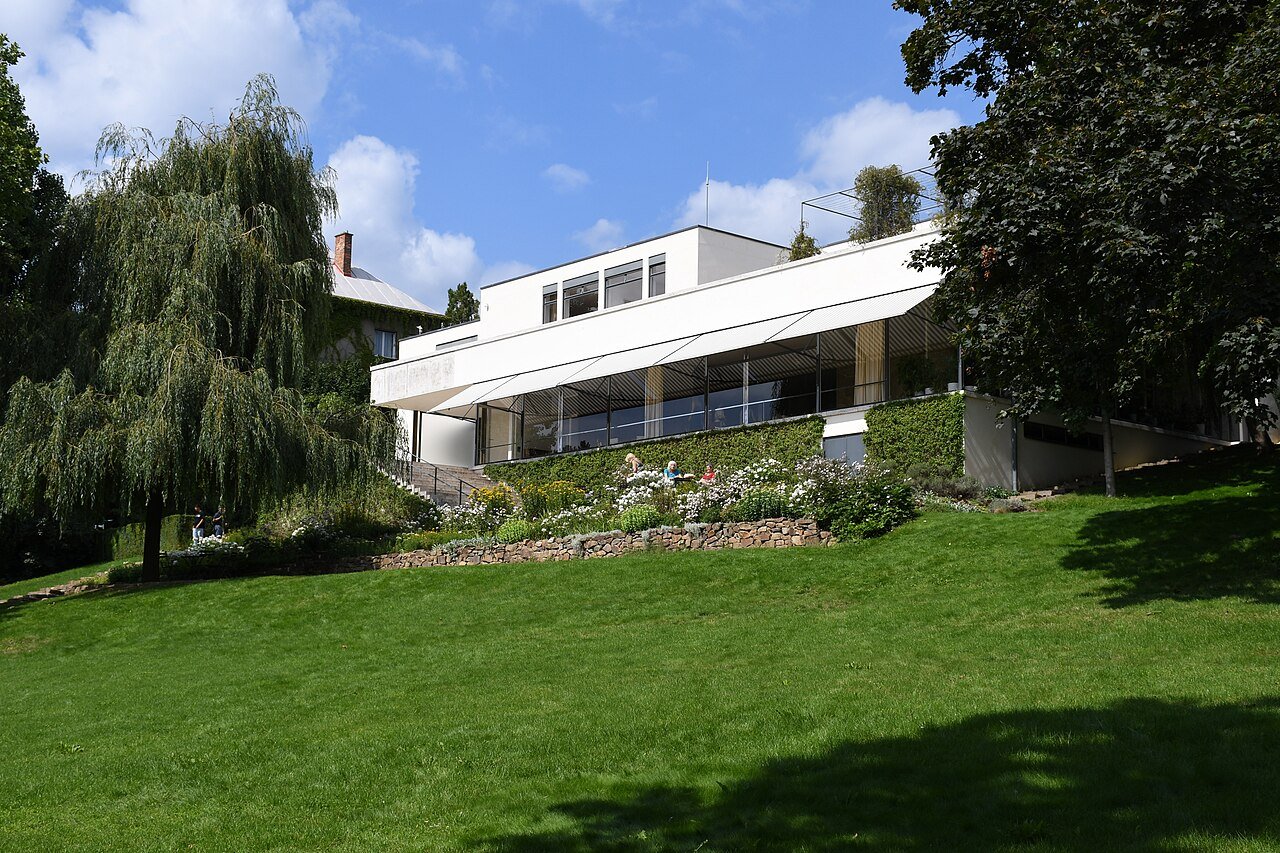
In the late 1920s Brno became a laboratory for the modern movement, and in Villa Tugendhat it produced one of its defining houses. The city pairs a UNESCO masterpiece with a wider fabric of Czech functionalism.
At a glance
Brno, the Moravian capital, rose during the First Czechoslovak Republic as a centre of industry and progressive design. Between the wars its architects embraced functionalism — the conviction that form should follow use, with steel, glass and reinforced concrete replacing historical ornament. The most celebrated result is Villa Tugendhat, built in 1928–1930 by Ludwig Mies van der Rohe with Lilly Reich and inscribed on the UNESCO World Heritage List in 2001. But the villa does not stand alone: Bohuslav Fuchs and his contemporaries gave Brno cafes, hotels and public buildings in the same spirit, and the Brno Exhibition Centre of 1928 framed the whole movement as a national statement.
Key facts
- Country: Czech Republic
- Key period: 1920s–1930s functionalism
- Key figures: Ludwig Mies van der Rohe (1886–1969), Lilly Reich, Bohuslav Fuchs (1895–1972)
- UNESCO: Villa Tugendhat, inscribed 2001
- Essential sites: Villa Tugendhat, Avion Hotel, Brno Exhibition Centre
History
Villa Tugendhat was commissioned by Fritz and Greta Tugendhat, a wealthy German-Jewish couple, who gave Mies van der Rohe an open brief and a sloping site above the city. Designed between 1928 and 1930 and completed in 1930, the house was radical for a private commission: rather than a sequence of closed rooms, Mies built an iron framework that carried the structure and freed the interior, allowing a single flowing living space on the garden level. Lilly Reich, his long-standing collaborator, worked with him on the interiors and furnishings.
The family lived in the house for only a few years. As the threat from Nazi Germany grew, the Tugendhats fled Czechoslovakia in 1938. After the German occupation the property was confiscated; the Gestapo seized it in 1939, the Messerschmitt aircraft firm used it for offices from 1942, and Soviet forces occupied it in 1945. In the postwar decades it served institutional uses, including a children’s physiotherapy centre, and its original fittings were dispersed or damaged.
Recognition came slowly. The villa was placed on the UNESCO World Heritage List in 2001 as a masterpiece of the modern movement. A full reconstruction was carried out between 2010 and 2012, returning the house to its 1930 state, and it reopened to the public in March 2012 as a museum administered by the city of Brno.
What you see
The house reads as a low white volume from the street and opens dramatically toward the garden, where its glazed living level steps down the slope. Inside, the famous main room is held up by slender chrome-clad steel columns instead of walls, so the space is divided only by free-standing planes: a curved screen of Macassar ebony and, above all, a wall of brown-gold onyx quarried in the Atlas Mountains, which catches the light differently through the day. Two of the floor-to-ceiling windows retract completely into the floor, dissolving the boundary between room and garden. The Tugendhat chair and the Brno chair, designed by Mies and Reich for the house, are still in production today.
The villa can be seen only on guided tours, which protect the restored interiors and explain the engineering behind them, from the early air-conditioning system to the mechanism of the sinking windows. Beyond the villa, Brno rewards walking: Bohuslav Fuchs’s Avion Hotel of 1927 squeezes a fully functionalist interior into a narrow plot and now houses a museum of functionalism, while the Brno Exhibition Centre, opened in 1928 for the Exhibition of Contemporary Culture, still shows the parabolic arch of its Hall A.
Practical information
- Advance booking is essential; tickets often sell out weeks ahead.
- The interior can be visited on guided tours only, in limited groups.
- Allow about 1.5 to 2 hours for the standard tour and the garden.
- Official site and booking: tugendhat.eu.
- Combine the villa with a half-day walking route through Brno’s functionalist core.
Getting there
Brno sits on the main line between Prague and Vienna, with frequent fast trains from both (roughly two and a half hours from Prague, under two hours from Vienna). From Brno’s main railway station, trams and a short uphill walk reach the Černá Pole district where Villa Tugendhat stands; the Avion Hotel and the Exhibition Centre are likewise reachable by tram from the centre.
Related in CHO
- Berlin & Dessau — Gropius, the Bauhaus and German Modernism
- Chicago — Wright, Mies and the architecture of modernity
- Vienna — Capital of the Vienna Secession
Sources
Find it on the map
See this place and what’s around it →
📷 Become a Cultural Heritage Online photographer
Share your photos of places: they stay published under your name as the author. The more they're seen, the more you get noticed — and soon a contest will reward the most appreciated photos.
Log in or sign up free to add a photo