
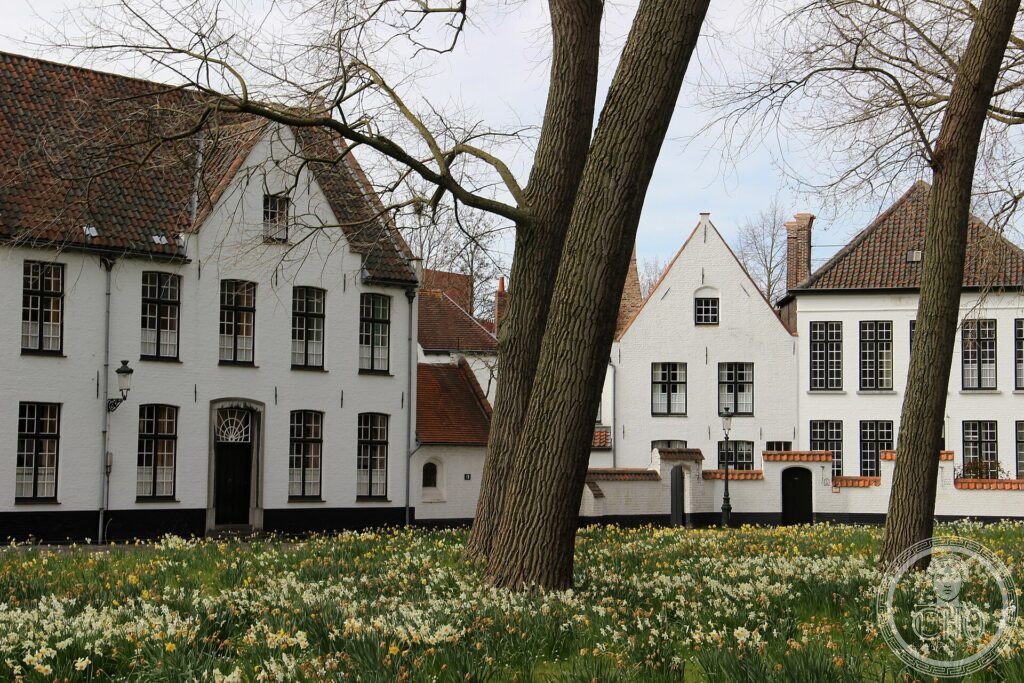
In the Middle Ages, pious women who did not wish to become nuns created a world of their own in Flanders: béguinages, close-knit communities of small houses around a courtyard or green, autonomous and devout. Thirteen of these ensembles survive as a unique testimony to a women’s path to religious life.
At a glance
The béguinages of Flanders are a group of thirteen walled communities founded from the 13th century for beguines — pious women who lived a religious life without taking the vows of nuns. Each béguinage is a self-contained world of small houses around a church, courtyard or green, often entered through a single gate. A unique architectural and social phenomenon of the medieval Low Countries, they offered women independence and devotion outside the convent. The Flemish Béguinages were inscribed by UNESCO in 1998.
Key facts
- UNESCO: World Heritage since 1998 (Flemish Béguinages)
- Thirteen sites: a serial listing across Flanders
- Beguines: lay religious women who lived devoutly without monastic vows
- From the 13th century: a movement of the medieval Low Countries
- Self-contained: houses around a church and green, behind a gate
- Bruges: the Begijnhof Ten Wijngaerde is among the most visited
History
From the early 13th century, in the prosperous towns of Flanders, communities of women known as beguines chose a life of prayer, work and charity without entering an enclosed order. Free to keep their property and to leave if they wished, they built or were given clusters of houses that grew into béguinages, miniature towns within the town, each with its church, infirmary and gate.
The movement flourished for centuries, surviving suspicion and reform, as the beguines spun, nursed the sick and prayed. Their numbers dwindled in the modern era, and the last beguines have died out, but the béguinages survive — some still lived in, some turned to other uses — as a rare record of an independent religious life for women.
What you see
The béguinages share a quiet, enclosed character: rows of whitewashed or brick houses around a central green or court, a modest church, and a single gateway shutting out the bustle of the town. At Bruges, the Begijnhof Ten Wijngaerde is famous for its grassy court spread with daffodils in spring, framed by white houses and tall trees.
Each town’s béguinage — Ghent, Leuven, Kortrijk, Lier and the rest — has its own character, from green courtyards to street-like lanes.
Practical information
- Visiting: the courts are open to respectful visitors; some houses are private homes
- Time needed: under an hour each
- Note: tread quietly; several are still residential or convent-run
- Bruges: the Begijnhof is a short walk from the Minnewater lake
Getting there
The thirteen béguinages are spread across the Flanders region of Belgium, in towns including Bruges, Ghent, Leuven, Kortrijk, Lier and Diest. The Bruges béguinage is a short walk south of the historic centre. GPS (Bruges): 51.2017° N, 3.2233° E.
Nearby
- Bruges historic centre — the canals and belfry of the medieval city
- Ghent — with its own UNESCO béguinages
- Minnewater — the “Lake of Love” beside the Bruges béguinage
Sources
- UNESCO World Heritage Centre — “Flemish Béguinages” (ref. 855)
- Visit Flanders — official tourism body
- Encyclopaedia Britannica — Beguines and Beghards
Find it on the map
See this place and what’s around it →📷 Become a Cultural Heritage Online photographer
Share your photos of places: they stay published under your name as the author. The more they're seen, the more you get noticed — and soon a contest will reward the most appreciated photos.
Log in or sign up free to add a photo