
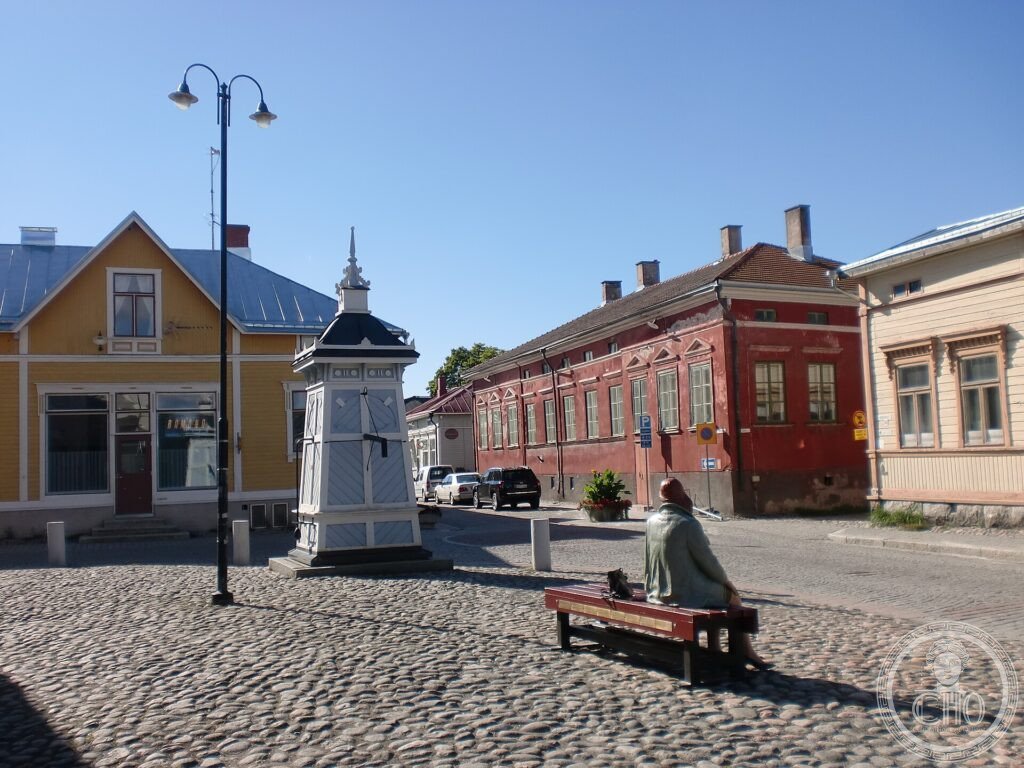
On the coast of the Gulf of Bothnia, Rauma preserves an entire historic centre of wooden houses: the largest unified wooden town in the Nordic countries. Cobbled lanes, softly coloured facades, courtyards and workshops — a rare example of a wooden Scandinavian town that has stayed alive and inhabited.
At a glance
Old Rauma, on the Gulf of Bothnia, is the largest unified wooden town in the Nordic countries. Around its medieval street plan stand some 600 wooden houses, built and rebuilt from the 18th and 19th centuries on plots going back to the Middle Ages, painted in soft colours and lined along cobbled lanes. A living town of homes, shops and craft workshops, famous also for its lace-making, it is an exceptional and well-preserved example of a Nordic wooden town. It was inscribed by UNESCO in 1991.
Key facts
- UNESCO: World Heritage since 1991 (Old Rauma)
- Largest of its kind: the biggest unified wooden town in the Nordic countries
- About 600 houses: mostly 18th–19th-century wooden buildings
- Medieval plan: the irregular street layout dates from the Middle Ages
- Lace-making: Rauma is famous for its bobbin lace tradition
- Living town: still inhabited, with homes, shops and cafés
History
Rauma grew as a medieval trading and seafaring town on the Finnish coast, chartered in 1442 around its convent and church. Built in wood, like most Nordic towns, it suffered the fires that periodically swept such places, but always rebuilt to its old, winding plan, so that the medieval street pattern survived beneath later wooden houses.
From the 18th and 19th centuries date most of the present buildings, low wooden houses with carved doors and painted boards, set along the lanes with their yards and outbuildings behind. While other wooden towns were demolished or burned, Rauma kept its old centre, which became a protected and living heritage town and a centre of the local lace-making craft.
What you see
The old town is a network of narrow cobbled lanes lined with single-storey wooden houses, each with its painted boards, carved details and gated courtyard. The main square and the streets around it hold shops, cafés and craft workshops; the medieval Church of the Holy Cross, of stone, stands among the timber.
In summer the town fills for its lace week, and the soft colours of the wooden facades are the lasting image.
Practical information
- Old town: freely walkable; the houses are mostly private homes and shops
- Time needed: half a day
- Note: a living town — respect the residents
- Lace Week: the lace festival fills the town in late July
Getting there
Rauma is on the west coast of Finland, about 90 km north of Turku. It is reached by road and bus; the nearest larger city is Turku. GPS: 61.1289° N, 21.5114° E.
Nearby
- Sammallahdenmäki — the Bronze Age burial cairns, also UNESCO-listed, nearby
- Turku — Finland’s oldest city, to the south
- Gulf of Bothnia — the coast and archipelago
Sources
- UNESCO World Heritage Centre — “Old Rauma” (ref. 582)
- City of Rauma — official authority
- Encyclopaedia Britannica — Rauma
Find it on the map
See this place and what’s around it →📷 Become a Cultural Heritage Online photographer
Share your photos of places: they stay published under your name as the author. The more they're seen, the more you get noticed — and soon a contest will reward the most appreciated photos.
Log in or sign up free to add a photo