
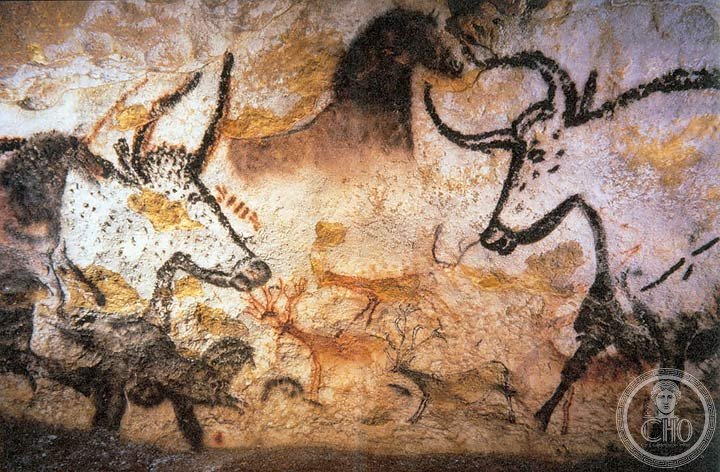
The most famous Paleolithic cave in the world and the site of some of the finest paintings ever made by human hands — Lascaux, hidden beneath a limestone ridge above the Vézère River in the Périgord Noir of south-western France, was painted by Cro-Magnon artists approximately 17,000 years ago with a skill and aesthetic confidence that the Renaissance masters would not have been ashamed of.
At a glance
Lascaux (part of the UNESCO WHS “Prehistoric Sites and Decorated Caves of the Vézère Valley” 1979; the valley contains 147 prehistoric sites and 25 decorated caves — the most concentrated prehistoric landscape in France; the Vézère Valley has the highest density of Paleolithic sites in the world); the discovery (the most dramatic cave discovery in 20th-century French archaeology: on 12 September 1940, four teenagers — Marcel Ravidat (18), Jacques Marsal, Georges Agnel, and Simon Coencas — and Marcel’s dog Robot discovered the cave on the Lascaux estate hill while looking for an old fox hole that was said to lead to an underground passage to the Château de Montignac; the most serendipitous single cave discovery in the history of European archaeology; Robot fell into the hole first (the most archaeologically significant single dog stumble in history); the paintings (the most important statistical summary: approximately 600 painted or engraved animal figures including 364 horses (the most depicted animal in Paleolithic cave art worldwide; the most horses in any single Paleolithic cave), 90 stags, 36 aurochs, and 29 bison; the Hall of the Bulls (the most impressive section: 4 aurochs (up to 5.5 m long; the largest single Paleolithic paintings of any animal in any cave in the world); the Chinese Horse (the most perfectly executed single Paleolithic painting: a small yellow pony, 1.4 m long, in the Lateral Passage; the finest example of volumetric painting in Lascaux); the Shaft of the Dead Man (the most mysterious single image in Paleolithic art: a stick figure of a bird-headed man falling backwards before a bison — the only clearly human figure in Lascaux and the most debated single image in the entire Paleolithic art catalogue).
Key facts
- The paintings — the oldest evidence of human symbolic thought: the most profound artistic achievement in human prehistory — the dating (Lascaux is dated to approximately 17,000 BP (Before Present) — the Magdalenian cultural period of the Upper Paleolithic (the most artistically productive period of prehistoric humanity; Magdalenian culture (c. 17,000–12,000 BP) produced the finest cave paintings in Europe and the most technically complex lithic (stone) tools of any Paleolithic tradition); the pigments (the most thoroughly analysed Paleolithic pigments in any cave: the Lascaux pigments are a mixture of iron oxides (red and yellow ochre), manganese oxide (black), calcium carbonate (white), and kaolin clay; the pigments were prepared by grinding the mineral oxides on stone palettes (the most specialised tool use in the Paleolithic painter’s kit) and mixed with animal fat, blood, or cave water; the application (the brushes (the most ancient painting tool: the Lascaux painters used brushes made from animal hair and plant fibres (the most complex tool assembly for any Paleolithic art tradition); they also blew pigment through bone tubes to create spray effects (the most aerosol-like painting technique before the invention of the spray can; the most accurately reproduced Paleolithic painting technique in modern art-historical experiments)); the perspective (the most sophisticated spatial technique in Paleolithic art: the Lascaux painters used the three-dimensional relief of the cave walls to create the illusion of a three-dimensional animal body — the most spatially aware non-perspective artistic technique in any pre-modern European art tradition)
- The closure and the Lascaux IV replica: the most consequential heritage conservation decision in French prehistory — the closure (the original cave was opened to the public in 1948 and quickly became the most visited site in south-western France; 1,200 visitors per day at peak; within 15 years (by 1963) the CO₂ from visitors’ breath had caused the growth of green algae and white calcite deposits on the paintings (the most destructive impact of human respiration on any heritage site in France); in 1963 Culture Minister André Malraux ordered the cave closed permanently (the most decisive single heritage conservation closure in France; Malraux said “Lascaux must be closed so that Lascaux can live” — the most frequently quoted single sentence in French conservation history); a black fungus (Fusarium solani) appeared in 2007 despite conservation efforts — the most alarming fungal growth in any closed European heritage cave); the replicas (Lascaux II (1983): a partial replica of the most important sections (Hall of Bulls + Axial Gallery); 200 m from the original cave; the most visited archaeological replica in France (300,000+ visitors per year); Lascaux IV (2016): the full-scale complete replica with digital technology and a museum at the International Cave Art Centre (Centre International de l’Art Pariétal; the most technically advanced Paleolithic cave replica in the world: every surface of the cave is reproduced at full scale using photogrammetry and CNC-milled limestone resin — the most accurate physical replica of any cave in the world; 350,000+ visitors per year — the most visited heritage museum in the Dordogne by a large margin))
- Chauvet Cave (the oldest paintings) and the Vézère Valley: the broader Paleolithic art context — Chauvet (the Grotte Chauvet-Pont d’Arc; UNESCO WHS 2014; 400 km south-east of Lascaux in the Ardèche; dated to approximately 36,000 BP — the oldest reliably dated cave paintings in the world (the most consequential single radiocarbon date in the history of cave art: 36,000 BP predates Lascaux by 19,000 years; the discovery in 1994 overturned the entire previous narrative of Paleolithic art evolution (the linear progression from simple to complex art was falsified by the Chauvet paintings, which are as technically sophisticated as Lascaux)); the Vézère Valley sites (Font-de-Gaume: the only prehistoric cave in France with polychrome paintings still open to the public (15 km from Lascaux; the most authentic surviving Paleolithic cave accessible in the 21st century; limited to 80 visitors per day to prevent the same fate as Lascaux — the most strictly visitor-capped archaeological cave in France); the Roc de Sers; Les Combarelles)
- Heritage: UNESCO World Heritage Site, Prehistoric Sites and Decorated Caves of the Vézère Valley, inscribed 1979 (Lascaux is the most important single site in the inscription)
- GPS: 45.0536° N, 1.0814° E
History
Paleolithic occupation (the Périgord region (the Dordogne River valley and the Vézère Valley) was continuously inhabited by Homo sapiens from approximately 35,000 to 10,000 BP — the most densely Paleolithic-inhabited valley in France; the Magdalenian hunters (c. 17,000–12,000 BP; the most artistically productive prehistoric cultural period in Europe; the people who painted Lascaux were anatomically modern humans (Homo sapiens sapiens) of the Cro-Magnon physical type (a non-technical name for early European modern humans, first named after the Cro-Magnon rock shelter in the Dordogne 5 km from Lascaux — the most important single skeletal find location in the history of European palaeoanthropology); they hunted aurochs, horses, stags, bison, mammoths, and rhinoceros (the most diverse large-mammal prey list of any Paleolithic cultural group in France)); the modern history (the cave was discovered 1940; opened to visitors 1948; closed 1963 (described in Key Facts); UNESCO WHS 1979 (Vézère Valley prehistoric sites); Lascaux II opened 1983; Lascaux IV opened 2016); the ongoing conservation (the original cave is monitored 24/7 by a team of French government conservators — the most intensively monitored natural environment in any closed French heritage site; the humidity, CO₂ levels, and biological growth are checked daily; access is limited to 1–2 researchers per week — the most restricted access to any UNESCO site in France).
What you see
The Lascaux visit (visitors cannot enter the original cave; the visit is to Lascaux IV (the full-scale replica at the CIAP museum 1.5 km from the original cave entrance); the experience (the most complete immersive Paleolithic cave experience available anywhere in the world; the museum (the permanent exhibition on Paleolithic art, Cro-Magnon culture, the pigments, and the discovery story); the replica cave (a complete full-scale physical reproduction of the cave interior reproduced by digital scanning and CNC limestone-resin carving; the paintings applied by the atelier de réplique using the same pigment composition and application techniques as the originals; the most technically faithful replica of any prehistoric painted cave in the world; the visitor enters the replica in complete darkness and is guided by low directional lighting — the most archaeologically atmospheric single visitor experience available in the French prehistoric landscape); the Font-de-Gaume visit (for the most serious Paleolithic art visitors: the only actual polychrome Paleolithic paintings accessible (15 km from Lascaux; limited 80 visitors per day; book days in advance at the Font-de-Gaume ticket office)).
Practical information
- Getting there: the nearest airports (Brive-la-Gaillarde Airport (BVE; 45 km north; Air France flights from Paris Orly (1h; 2 per day); the most convenient airport for the Dordogne); Bergerac Airport (EGC; 65 km south-west; Ryanair flights from London Stansted (1h 50min), Bristol (1h 40min), Paris Beauvais (1h), Brussels Charleroi (1h 20min), and Dublin (2h); the cheapest international gateway to the Dordogne); by train (Paris Gare de Montparnasse to Périgueux (3h TGV) and then regional train to Montignac-Lascaux (1h 30min; the most scenic rural French rail approach to any prehistoric site)); by car (the most flexible approach for the Dordogne: A89 autoroute from Bordeaux (1h 30min)); the Lascaux IV ticket (the International Cave Art Centre; CIAP; open year-round; timed-entry tickets; book online at lascaux.fr; the peak season (July–August) sell out weeks in advance; the off-season (September–June) can be purchased same-day; the most frequently sold-out heritage museum ticket in south-western France))
- The Périgord Noir and the Dordogne Valley: the finest medieval landscape in south-western France — the Périgord Noir (the Black Périgord; named for the dark oak forests that cover the region; the most historically rich of the four Périgord regions; the most important medieval landscape in south-western France: the châteaux, the bastide towns (the 13th-century planned grid-plan fortified towns built by both the English and the French during the Hundred Years War — the most complete surviving collection of bastide towns in France); the most important bastides: Domme (the finest hilltop bastide in the Dordogne; the best panoramic view of the Dordogne River meander — the most photographed river bend in France after the Seine from the Eiffel Tower); Monpazier (the most perfectly preserved bastide grid plan of any Périgord bastide)); the Château de Castelnaud (the most important medieval castle in the Périgord Noir: a Cathar fortress that was disputed between the English and the French throughout the Hundred Years War; the finest view of the Dordogne River from any castle in south-western France); the Château de Beynac (the Plantagenet stronghold; the most vertically dramatic castle approach in the Dordogne))
- The megalithic landscapes of Carnac (Brittany): the most extensive megalithic site in the world — Carnac (900 km north-west; a separate prehistoric landscape; the most important and the most extensive megalithic site in the world: approximately 3,000 standing stones (menhirs) arranged in parallel alignments covering 4 km of the Breton coast — more standing stones in a single landscape than anywhere else in the world; the most imperfectly explained prehistoric site in France: the purpose of the Carnac alignments (the most debated prehistoric purpose in French archaeology: astronomical calendar? ceremonial processional? territorial boundary marker? the most reliably honest answer is “we do not know” — the most satisfyingly honest single sentence in prehistoric French archaeology); the Grand Menhir Brisé (the largest single menhir ever erected: 20.6 m long; 280 tonnes; now fallen and broken in 4 pieces — the most ambitious single prehistoric stone erection and the most catastrophically broken prehistoric monument in France))
Getting there
Brive Airport (BVE) 45 km; Bergerac (EGC) 65 km. Lascaux IV (full replica + museum) 1.5 km from original cave. Book timed entry online at lascaux.fr (sells out weeks ahead in summer). Font-de-Gaume (actual paintings; 15 km; 80 visitors/day; book at site). GPS: 45.0536, 1.0814.
Nearby
- Font-de-Gaume (Vézère Valley UNESCO WHS 1979) — 15 km south-west of Lascaux; the only original polychrome Paleolithic cave still open to the public in France — described in Key Facts and Practical section; the essential day for serious Paleolithic art visitors: Lascaux IV in the morning (2h) + Font-de-Gaume in the afternoon (the 80-ticket cap means priority booking is essential); Font-de-Gaume is the most important single alternative to Lascaux: the reindeer paintings, the bison, the woolly mammoths — all original, in the cave, 12,000+ years old
- Rouffignac Cave and the Salon of 157 Mammoths — 25 km south-west of Lascaux; the most mammoth-dense single room in Paleolithic cave art — Rouffignac (the “Cave of a Hundred Mammoths”; approximately 157 mammoth engravings and paintings — the largest single concentration of woolly mammoth images in any Paleolithic cave in the world; the cave tour is made by electric train (the only Paleolithic cave in the world with an internal underground electric railway — the most unexpectedly comfortable Paleolithic cave experience); the Salon of Mammoths (the most impressive single room: a low-ceilinged chamber covered in engravings and paintings of facing mammoths, bison, and ibex in a frieze that encircles the entire ceiling)
- The Vézère Valley bastides and the Dordogne castles — the medieval landscape surrounding the Paleolithic sites — described in Practical section; the essential 3-day Périgord circuit: Day 1 (Lascaux IV + Montignac village + Font-de-Gaume); Day 2 (Rouffignac + Château de Castelnaud + Domme bastide + Dordogne river canoe); Day 3 (Château de Beynac + Sarlat-la-Canéda (the finest intact medieval town in south-western France; the golden limestone streetscape; the most photogenic Saturday morning market in the Dordogne))
Sources
- Wikipedia, Lascaux; Magdalenian; Vézère Valley, accessed June 2026
- UNESCO, Prehistoric Sites and Decorated Caves of the Vézère Valley, WHS reference 185, inscribed 1979
- Mario Ruspoli, The Cave of Lascaux: The Final Photographs, Harry N. Abrams, 1987
Find it on the map
See this place and what’s around it →📷 Become a Cultural Heritage Online photographer
Share your photos of places: they stay published under your name as the author. The more they're seen, the more you get noticed — and soon a contest will reward the most appreciated photos.
Log in or sign up free to add a photo