
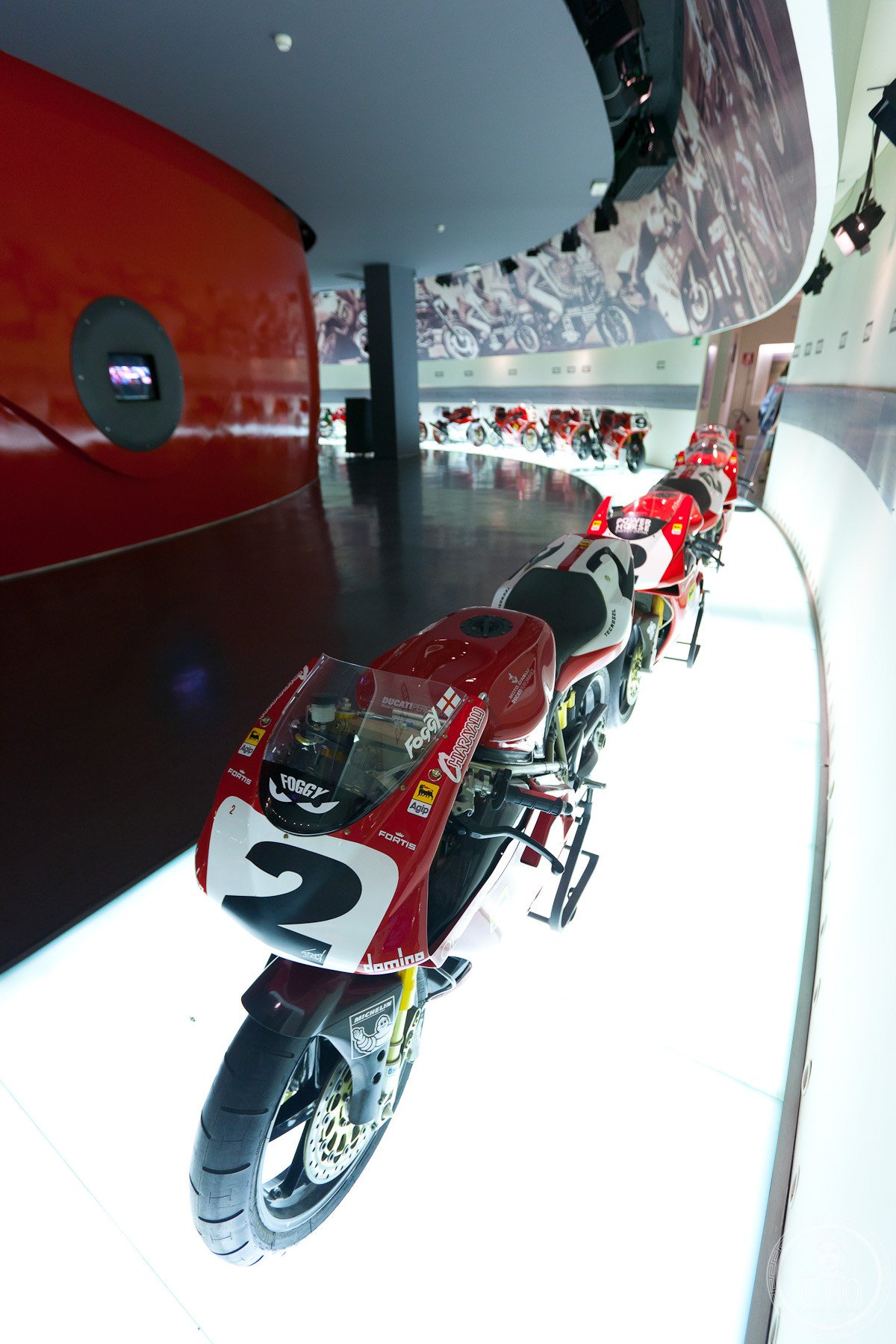
.jpg)
At the factory gates in Borgo Panigale where Ducati has built motorcycles since 1926, the company's own museum traces a century of Italian engineering obsession — from the pre-war Cucciolo to the Desmosedici MotoGP machine that ended Honda's dominance in 2007.
At a glance
The Museo Ducati occupies the historic factory complex at Via Ducati 3 in Borgo Panigale, a district of Bologna that Ducati effectively built around its manufacturing plant. Opened in 1998, the museum holds the company's full historic collection of motorcycles, engines, and racing machinery, tracing Ducati's evolution from a small manufacturer of radio components and precision parts (founded 1926) through the post-war Cucciolo auxiliary cycle engine, the single-cylinder racers of the 1950s, and the L-twin engine architecture — introduced with the 750GT in 1971 — that became Ducati's engineering signature. The museum is free to enter and integrated with the working factory, whose tours can be booked separately.
Key facts
- Opened: 1998
- Address: Via Ducati 3, 40132 Bologna (Borgo Panigale)
- GPS: 44.5162, 11.2684
- Admission: Free (factory tours ticketed separately)
- Notable exhibits: Cucciolo (1946), Mach 1 (1964), Desmosedici GP7 (2007), all World Superbike championship machines
- Website: ducati.com/museum
- Opened: presented on 12 June 1998 at the first World Ducati Week, opened on 16 October 1998
History
The Ducati story begins not with motorcycles but with electronics. In 1926, Adriano Cavalieri Ducati and his brothers founded the Società Scientifica Radio Brevetti Ducati in Bologna to manufacture radio components, capacitors, and vacuum tubes. The company grew rapidly, and by the late 1930s had expanded into camera accessories and optical instruments. The Borgo Panigale plant was established before the war; it was bombed in 1944 and rebuilt immediately after.
The pivot to motorcycles came in 1946 with the Cucciolo — a 48cc auxiliary engine designed by Aldo Farinelli and licensed by Ducati for attachment to bicycle frames. Its success led directly to the first complete Ducati motorcycle in 1950. The engineer Fabio Taglioni, who joined in 1954, transformed the company's technical direction with the desmodromic valve actuation system (which eliminates valve float at high revs using mechanical closure rather than springs), first raced in 1956 and patented in a form that Ducati still uses on every engine it makes.
The sporting reputation consolidated through the 1970s and 1980s on the race track: Mike Hailwood's win at the Isle of Man TT in 1978 (racing a Ducati he hadn't ridden before), the World Superbike championship founded in 1988 in which Ducati immediately dominated, and Carl Fogarty's four world titles between 1994 and 1999. The 2007 MotoGP championship won by Casey Stoner on the Desmosedici remains the only time a non-Japanese motorcycle has won the premier class world title in the modern era.
The collection’s standing has an unusual official seal: Italy’s Ministry of Cultural Heritage designated the museum’s archive of technical documents for inclusion in the National Archives — drawings and records of the Borgo Panigale factory treated as national heritage.
What you see
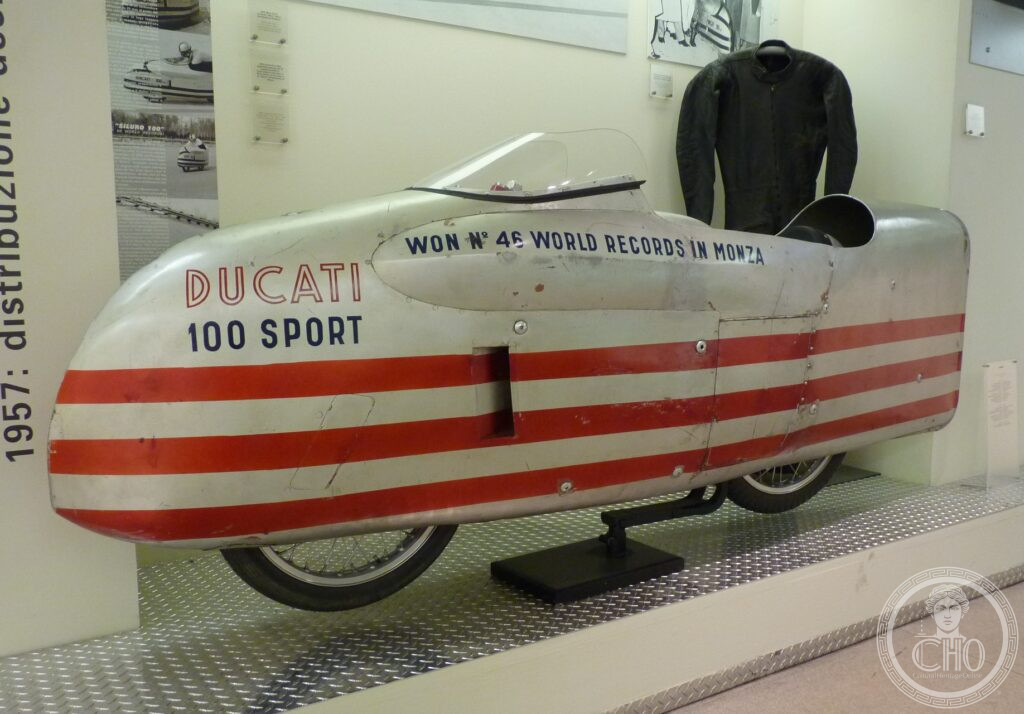
The museum's main gallery is a long industrial hall in which motorcycles are arranged chronologically and by theme, with race machines grouped by championship and road models by decade. The collection is not behind glass — the scale of the bikes and the relative intimacy of the space allow visitors to examine the engine details, the frame geometry, and the evolution of the fairing design across 70 years of Italian motorcycle production.
A separate section on the desmodromic valve system — the engineering feature that defines Ducati across all its eras — explains the mechanism with section models and cut-away engines. The contrast between the 1950s bevel-gear drive systems and the modern dry-clutch L-twin is one of the clearest available illustrations of how a single engineering philosophy can evolve across technological generations while remaining formally consistent.
Practical information
- Opening hours: Check ducati.com/museum for current schedule (typically Monday–Friday, some weekend slots)
- Admission: Museum free; factory tour €35 approx., advance booking required
- Time needed: 1 hour museum; 1.5 hours museum + factory tour
- Highlights: Cucciolo, 750GT, F1 (750), 916 (Tamburini), Desmosedici GP7, all WSBK championship bikes
Getting there
Borgo Panigale is 5 km west of Bologna's Piazza Maggiore. By bus: city lines 21 and 671 stop at Borgo Panigale; the Ducati complex is clearly signed. By car: take Via Emilia Ponente (SS9) westbound from Bologna; follow “Ducati” signs before the industrial district. Bologna Guglielmo Marconi Airport is 3 km north of the factory — the Ducati campus is the most recognisable landmark on the approach road from the terminal.
Nearby
- Bologna historic centre — 5 km east, the porticoes (UNESCO 2021), Piazza Maggiore, Due Torri
- MARANELLO — 50 km south, Galleria Ferrari
- Sant'Agata Bolognese — 30 km north-west, MUDETEC Lamborghini
- Autodromo Enzo e Dino Ferrari, Imola — 30 km south-east, Formula 1 circuit and museum
Sources
- Wikipedia (English): Ducati
- Ducati official museum: ducati.com/museum
- Wikimedia Commons: File:Ducati Museum (6080034108).jpg, Thad Zajdowicz, CC BY 2.0
- Nominatim / OpenStreetMap: GPS 44.5162, 11.2684
Find it on the map
See this place and what’s around it →📷 Become a Cultural Heritage Online photographer
Share your photos of places: they stay published under your name as the author. The more they're seen, the more you get noticed — and soon a contest will reward the most appreciated photos.
Log in or sign up free to add a photoIs this page about you?
This page is read by travellers and heritage enthusiasts who find it on Google. Tell us how you are connected to this place and we will take it from there.