
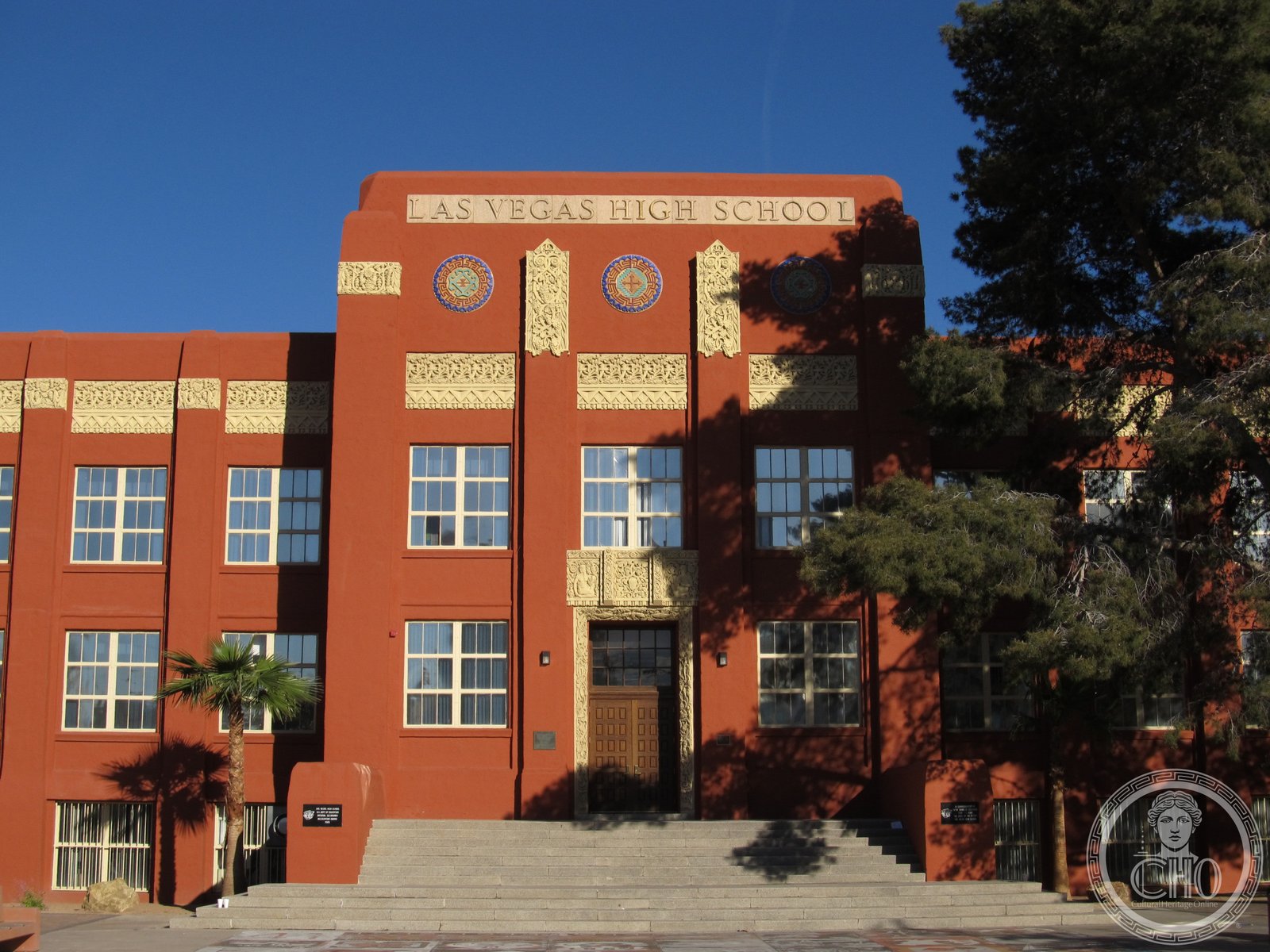
A Depression-era school campus where Art Deco geometry meets Aztec Moderne ornament, considered the finest surviving example of the style in Las Vegas.
At a glance
Designed in 1930 by the Reno father-and-son firm George A. Ferris & Son, the Las Vegas High School campus is consistently described as the best example of Art Deco architecture in a city that has since demolished most of its pre-casino heritage. Two of the original three buildings survive: the Academic Building and the Gymnasium, both constructed of stucco-covered reinforced concrete and animated by polychrome medallions, friezes of animals and plants, and a stylized Mayan arch at the gymnasium entrance. Listed on the National Register of Historic Places, the campus now operates as Las Vegas Academy of International Studies and Performing Arts.
Key facts
- Architects: George A. Ferris & Son (Reno, Nevada)
- Style: Art Deco / Aztec Moderne
- Construction: 1930
- Academic Building: Two stories, 208 × 82 feet, stucco reinforced concrete
- Gymnasium: 113 × 83 feet, stylized Mayan arch entrance
- NRHP listed: Academic Building + Gymnasium, September 24, 1986; entire district March 3, 2022
- Current use: Las Vegas Academy of International Studies and Performing Arts
History
By 1930, Las Vegas was still a small railroad town a decade away from its casino-resort transformation. The school board commissioned George A. Ferris & Son from Reno to design a new high school that would signal civic ambition. Ferris delivered something unusual: a campus whose ornamentation drew simultaneously from the machine-age geometry of Art Deco and from the pre-Columbian iconography then fashionable in American architecture following popular fascination with the Maya and Aztec civilizations.
Three buildings opened with the campus; one was demolished around 1950. The two survivors—the Academic Building and the Gymnasium—were listed on the National Register of Historic Places in September 1986. The Frazier Hall addition was incorporated into a full historic district designation in 2022. Through a half-century of Las Vegas’s explosive growth and erasure of its own past, these buildings remained standing where most of their contemporaries did not.
Since 1993 the campus has operated as the Las Vegas Academy, a magnet school for performing arts and international studies. The conversion to specialized use arguably saved the buildings from the redevelopment pressures that have eliminated similar historic schools elsewhere in Clark County.
What you see
The Academic Building’s two-story facade presents a disciplined grid of windows within a stucco-clad reinforced-concrete frame, then erupts at the cornice level: polychrome ceramic medallions alternate with friezes of stylized animals and flowering plants in deep-relief terracotta. The color is unexpected in the Nevada desert—rich ochres, greens, and blues that give the building the feel of an Aztec calendar translated into 1930s civic architecture.
The Gymnasium’s entrance is the campus showpiece: a stylized Mayan arch frames the doors in a shallow pointed form that owes nothing to European Gothic and everything to the ceremonial gateways of the Yucatán. Ferris pulled this motif from the popular architectural imagination of 1930 rather than from scholarship, but the result has a conviction that keeps it from feeling like pastiche. Together the two buildings demonstrate how Art Deco’s appetite for historical ornament could produce something genuinely regional in a city that had almost no architectural heritage to draw on.
Practical information
- Access: Active school campus; exterior freely visible from the street
- Address: 315 S. 7th Street, Las Vegas, NV 89101
- Recommended time: 20–30 minutes for exterior exploration
- Admission: Free (exterior viewing)
- Note: Respect school hours and campus access restrictions
Getting there
The campus occupies a full block at 315 South 7th Street in downtown Las Vegas, approximately one mile east of the Strip and four blocks from Fremont Street. The nearest airport is Harry Reid International (LAS), roughly 5 miles south via I-15. Las Vegas RTC bus routes serve the downtown corridor nearby, and street parking is available on surrounding blocks.
Nearby
- Fremont Street Experience: The historic downtown casino corridor, four blocks west
- Neon Museum: A collection of historic Las Vegas neon signs, 1 mile north on Las Vegas Boulevard
- Clark County Museum: Regional history collection, 5 miles southeast in Henderson
Sources
- Wikipedia, “Las Vegas High School Historic District” — en.wikipedia.org/wiki/Las_Vegas_High_School_Historic_District
- National Register of Historic Places, listed September 24, 1986; expanded March 3, 2022
- Nevada Division of Historic Preservation and Archeology (SHPO) records
Find it on the map
See this place and what’s around it →Record researched and written by Luigi De Marchi for Cultural Heritage Online, 2026.
📷 Become a Cultural Heritage Online photographer
Share your photos of places: they stay published under your name as the author. The more they're seen, the more you get noticed — and soon a contest will reward the most appreciated photos.
Log in or sign up free to add a photoIs this page about you?
This page is read by travellers and heritage enthusiasts who find it on Google. Tell us how you are connected to this place and we will take it from there.