
Langhe-Roero e Monferrato

Langhe Piedmont wine landscape rolling hills Nebbiolo Barolo Barbaresco harvest autumn vineyard UNESCO 2014
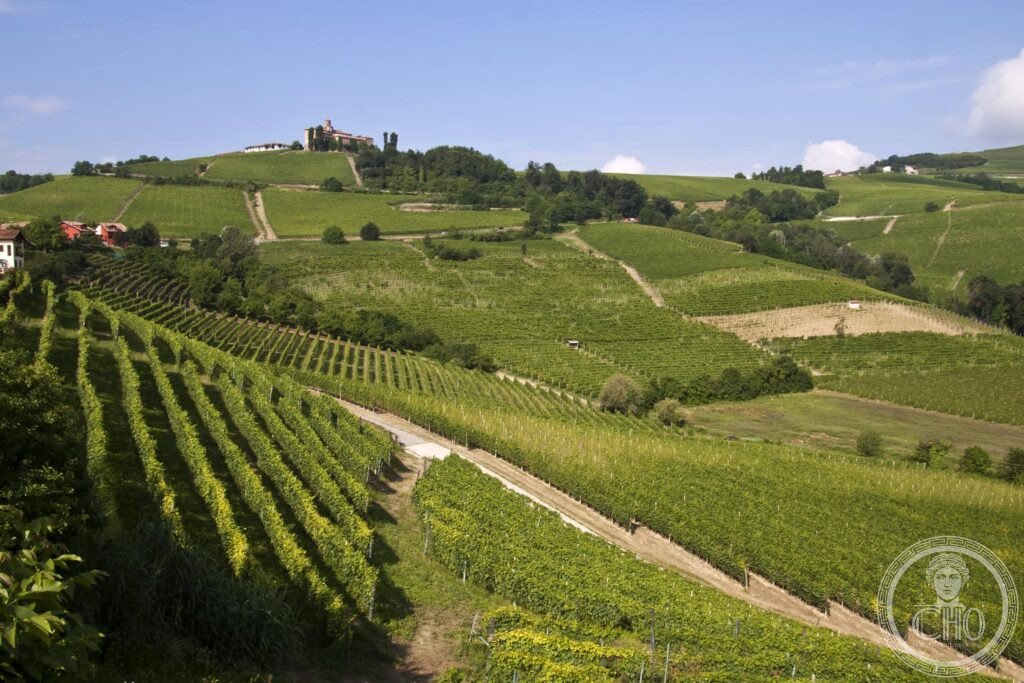
The Langhe hills near Alba in autumn harvest season (the specific landscape: the low Apennine foothills of the Cuneo and Asti provinces rise in a series of rounded ridges running roughly north-south; the ridgelines are planted with Nebbiolo and Barbera varieties; the valley floors and lower slopes are planted with Dolcetto; the farmhouses (cascine) sit on the ridge crowns above the vineyards; the November fog (the nebbia — from which Nebbiolo takes its name) fills the valley bottoms and is visible from the ridge roads as a white layer below eye level; this is the only Italian UNESCO wine landscape where the fog is a named element of the production: the Nebbiolo grape is traditionally harvested when the November fog begins (the Italian name nebbiol means “little fog” — the grape harvested in the fog season)), Province of Cuneo/Asti, Piedmont, Italy. UNESCO World Heritage Site 2014 (reference 1390). Photo via Wikimedia Commons.
Provinces of Asti, Alessandria, Cuneo, Piedmont, Italy · 6 inscribed areas; Nebbiolo/Barbera/Moscato/Dolcetto vines; medieval castle network; truffle oak woods; UNESCO WHS 2014 (reference 1390)

Langhe-Roero e Monferrato

The Piedmont wine landscape (UNESCO 2014) is the most varied wine territory in Italy — six inscribed areas spanning the Langhe hills (Barolo and Barbaresco; the most age-worthy Italian red wines), the Asti hills (Moscato and Barbera), and the Monferrato plains (Grignolino, Cortese) — unified by the November fog, the oak-and-truffle woodland corridors between vine plots, and a network of medieval castle-villages that has remained unchanged in outline since the 12th century.

At a glance

Langhe-Roero Monferrato (the most precisely LanghePiedmont serial Asti Alessandria Cuneo Piemonte Italy 44.7026 N 7.9819 E UNESCO WHS 2014 reference 1390 serial 6 areas: the 6 inscribed areas: Area 1 — Le Colline del Barolo (the Barolo production zone; the municipalities of Barolo, Castiglione Falletto, Serralunga d’Alba, La Morra, Cherasco, Verduno, Novello, Diano d’Alba, Grinzane Cavour; approximately 1,700 ha of Nebbiolo vineyards; the Barolo wine (the “King of Italian wines”; DOCG since 1980; 100% Nebbiolo; minimum 38 months aging (62 months for Riserva); the wine that King Victor Emmanuel II of Savoy received as a gift from the Marchesa Falletti di Barolo in the 1850s)); Area 2 — Le Colline del Barbaresco (the Barbaresco production zone; Nebbiolo exclusively; 3 municipalities: Barbaresco, Neive, Treiso; approximately 700 ha; Barbaresco DOCG (100% Nebbiolo; minimum 26 months aging; a wine that Gaja and Giacosa made internationally famous in the 1970s)); Area 3 — Canelli e l’Asti Spumante (the Moscato Bianco production zone; the Canelli underground cellars (cantine; carved into the tufa sandstone; the largest underground wine caves in Italy after the Champagne cellars; UNESCO subcriteria for “outstanding industrial landscape”); Asti DOCG (100% Moscato Bianco; sweet sparkling wine; the most exported DOC wine from Italy by volume)); Area 4 — Nizza Monferrato e il Barbera (Barbera d’Asti DOCG zone; Barbera is the high-acid, low-tannin red grape that Giacomo Bologna (Braida winery; Rocchetta Tanaro) transformed in the 1980s from a bulk wine into a critically acclaimed wine (the “Giacomo Bologna revolution”: oak aging for Barbera, previously unheard of)); Area 5 — Il Monferrato degli Infernot (the Monferrato plain; the infernot (from “inferno” — small underground stone-carved storage rooms carved by individual families into the local sandstone; used for wine storage and food preservation; the infernot have no ventilation by design — hence the infernal name; they maintain a constant temperature of 12–14°C year-round; hundreds survive in private homes throughout the Monferrato; the most accessible for visitors are at Cella Monte (the “Ecomuseo della Pietra da Cantoni” (open May–October)))); Area 6 — Acqui Terme e il Moscato (Acqui Terme thermal spa town; Brachetto d’Acqui DOCG; the only Italian wine produced both as a sweet still red wine and as a sweet sparkling red wine)).

Key facts

  • The Barolo MGA system and why the village name on the label matters for the landscape visit: the Barolo wine is produced in 11 municipalities (those listed in Area 1 above); since 2010 CE the consorzio has formalized a system of 181 named vineyard sites called Menzioni Geografiche Aggiuntive (MGA — the Italian equivalent of Burgundy’s “premiers crus”); these MGA names appear on the label after “Barolo” (e.g., “Barolo Brunate” or “Barolo Cannubi”); the MGA system allows visitors to link the wine they are tasting to a specific hillside; Brunate (La Morra/Barolo border; south-facing; the most powerful Barolo style); Cannubi (Barolo municipality; the only MGA spanning the entire historical Barolo zone; the most famous single vineyard name in Italy; documented since 1752 CE); Serralunga Falletto (Castiglione Falletto; the most age-worthy Barolo style; the soils are Helvetian (25 million years old) compact tufa — the oldest soils in the Barolo zone); the practical implication for a landscape visit: the MGA names are signposted in the vineyards (the Barolo MGA trail markers were installed along the vineyard paths in 2012 CE; a free map is available at the Enoteca Regionale del Barolo at the Barolo castle)
  • GPS Alba (Langhe centre): 44.6993° N, 8.0362° E
  • GPS Barolo village: 44.6083° N, 7.9388° E

History

From Piedmontese medieval castle network to Savoy court wine to global prestige (the most precisely LanghePiedmont single medieval wine documentation: the hills of the Langhe are documented as wine-producing territory in Asti episcopal records of the 11th century CE; the castle network: the landscape is characterized by castle-villages (the “Langhe castle belt”: Barolo castle (Marchesi Falletti; 13th century; now the Enoteca Regionale del Barolo and the Museo del Vino WiMu (the wine museum designed by Francois Confino; 2010 CE; one of the most theatrical museum design projects in Italy)); Grinzane Cavour castle (13th century; home to Camillo Benso, Conte di Cavour (1810–1861 CE; the architect of Italian unification; he managed the castle estates as a vineyard in the 1830s and was instrumental in improving Barolo wine production via collaboration with the French oenologist Louis Oudart and the Marchesa Giulia Colbert Falletti di Barolo); Cavour kept detailed journals of his vineyard management that are the most complete agricultural record of mid-19th century Piedmont wine production available); Serralunga d’Alba castle (14th century; the best-preserved Monferrato castle in the Langhe; the internal stair system (a triple helix staircase — three separate stairs coiled in the same tower without ever intersecting — the only surviving triple-helix stair in Italy, built by the Falletti family c.1340 CE for defensive purposes: each stair connected a different floor directly to the outside without allowing movement between staircases in the tower interior)); 1850s CE the Barolo revolution: Louis Oudart (a French oenologist from Reims; in Piedmont from the 1840s) and the Marchesa Falletti introduced dry Barolo production (previous Barolo was often sweet or semi-sweet because fermentation was interrupted by winter cold before completion); 2014 CE UNESCO inscription reference 1390.

What you see

The vineyard circuit, the castle villages, and the Alba truffle season (the most precisely LanghePiedmont single visit sequence: the Langhe wine landscape is best visited in September–November (harvest and the truffle season); the visit circuit (2–3 days): Alba base (the best hotels for a Langhe visit are in Alba; the Hotel Langhe and the hotel-restaurant La Coccinella in Treiso; Alba is on the Torino–Bra rail line (1h from Turin); car essential for the winery visits); Day 1 Langhe: Barolo castle (Enoteca Regionale; WiMu wine museum; €12 combined ticket; 1.5 hours); Grinzane Cavour castle (10 min from Barolo; Cavour’s museum room; the most important annual truffle auction in the world is held here every November — the “Grinzane Cavour Prize” auction; the 2022 auction sold a single white truffle (600 grams) for €120,000 to a bidder in Vienna); 3 winery visits in the afternoon (the Barolo wineries that receive visitors without appointment: Borgogno (Barolo; the oldest winery (1861); the library of vertical vintages dating back to the 1960s is open for tasting (the oldest bottles in the vertical are priced at €200+ per glass; the more recent vintages from 1999–2005 are the most recommended for tasting: they represent the peak of the current Barolo style)); Day 2 Barbaresco: Gaja winery (Barbaresco; appointment required; the most internationally famous producer in Piedmont; a visit is prestigious and expensive; the winery itself is not architecturally interesting but the conversation with the export staff is informative); Produttori del Barbaresco (the cooperative winery; the most accessible and best-value tasting room in the Barbaresco zone; no appointment needed (Monday–Friday, 9 AM–6 PM); the cooperative controls 110 ha of Barbaresco vineyards and produces the “Rabajà,” “Ovello,” and “Montestefano” Riservas that are critical benchmarks for the appellation at a fraction of Gaja prices)).

Practical information

  • The white truffle of Alba and the Fiera del Tartufo (October–November season): the white truffle (Tuber magnatum; the “Tartufo Bianco d’Alba”; the most expensive food ingredient in the world by weight in years of normal supply; approximately €3,000–5,000 per kilogram at the 2023–2025 season; comparable to Périgord black truffle in France but botanically distinct and culinarily sharper); the Alba truffle market (the Fiera del Tartufo di Alba; runs every Saturday and Sunday from the first Saturday of October through the first Sunday of December; in the Cortile della Maddalena and the surrounding streets of the old town; open 9 AM–7 PM; free entry; the truffle stalls sell whole truffles in individual glass jars; the most truffle-forward restaurant experience nearby: Osteria dell’Arco in Alba (the truffle menu during the season: a shaved truffle over egg pasta + a shaved truffle over raw Fassona beef carpaccio + a shaved truffle over taleggio fondue; the shaved white truffle creates a distinct aroma — sulfurous, garlicky, and earthy simultaneously — that disappears within 1–2 days of harvest, which is why white truffle can only be experienced in situ and cannot be preserved or shipped); practical: the truffle season coincides with the Barolo harvest; the combination (white truffle + Nebbiolo grape harvest) makes late October the single best week to visit the Langhe)

Getting there

Train to Alba from Turin (1h, €5.50; Trenitalia Cuneo line). Car essential for winery circuit (rental from Turin or Cuneo). Best base: Alba (hotels from €80/night). White truffle: Fiera del Tartufo every Sat-Sun Oct-Dec in Alba. Barolo castle: 20 min from Alba by car. GPS Alba: 44.6993, 8.0362.

Nearby

  • Residenze Sabaude, Turin — 60 km north (UNESCO WHS 1997; the Savoy royal residences; Venaria Reale (1675 CE; the largest royal palace complex in Italy; the Galleria di Diana by Michelangelo Garove; 1km of royal apartments); Reggia di Stupinici (Juvarra 1729; the hunting palace; the “white staircase”))
  • Sacra di San Michele — 50 km northwest (the 10th-century monastery on a rocky promontory above the Susa valley; the inspiration for Umberto Eco’s Il Nome della Rosa; Juvarra redesigned the access staircase in 1715 CE; the “Zodiac Gate” carved with astrological reliefs (12th century) is the primary architectural object)

Sources

  • Wikipedia, Vineyard landscape of Piedmont: Langhe-Roero and Monferrato; Barolo wine; Barbaresco; White truffle, accessed June 2026
  • UNESCO, Vineyard Landscape of Piedmont: Langhe-Roero and Monferrato, WHS reference 1390, inscribed 2014
  • Consorzio di Tutela Barolo Barbaresco Alba Langhe e Dogliani. Annual Report 2024. Alba, 2024

Hero image: Langhe hills, Piedmont, Italy, Wikimedia Commons. Editorial text © Cultural Heritage Online, 2026.

📷 Diventa un fotografo di Cultural Heritage Online

Condividi le tue foto dei luoghi: restano pubblicate con la tua firma come autore. Più vengono viste, più ti fai conoscere — e presto un concorso premierà le foto più apprezzate.

Accedi o registrati gratis per aggiungere una foto
📋 Copy & share on social
Scroll to Top