

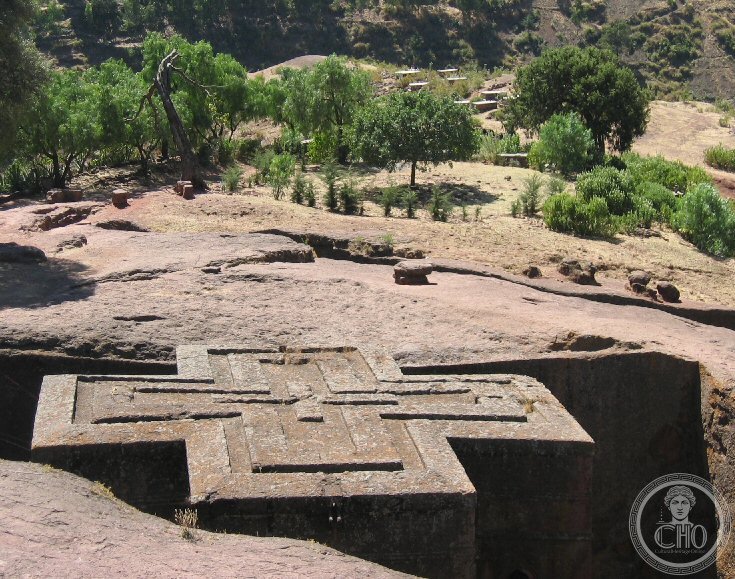
Eleven churches carved out of solid rock — not built on the ground but cut downward into it, each excavated from a single block of red volcanic tuff, their interiors hollowed out by hand, still used as working churches and pilgrimage sites by Ethiopian Orthodox Christians who regard them as the New Jerusalem built on earth by King Lalibela in the 12th century.
At a glance
Lalibela is a small town in the Amhara Region of northern Ethiopia, at an altitude of 2,630 metres in the Lasta mountains. It is the site of 11 medieval monolithic churches carved from the red volcanic tuff of the rock, tradition attributing their construction to the reign of King Gebre Meskel Lalibela (r. c. 1181–1221 AD) of the Zagwe dynasty. The churches are not built above ground from assembled stone — they are excavated downward from the surface, each carved from a single block of rock with its interior hollowed out, its walls, columns, arches, and decorative details all chiselled directly from the living rock. They are still functioning churches, used daily by the Ethiopian Orthodox Tewahedo Church for liturgy, and still the destination of major pilgrimages (most importantly, the Timkat / Epiphany celebration in January). Lalibela was inscribed as a UNESCO World Heritage Site in 1978.
Key facts
- Eleven churches: divided into two groups (the North-Western Group and the South-Eastern Group) connected by underground tunnels; Bete Medhane Alem (largest, supported by 36 exterior columns), Bete Maryam (oldest, with the most elaborate carving), Bete Golgotha-Mikael (contains a replica of Christ’s tomb and is closed to women), Bete Giyorgis (most famous, isolated on its own hillock in a cross-shaped pit)
- Bete Giyorgis (Church of St George): the most celebrated church; carved from a single block of rock, its exterior a 12 × 12 × 12-metre cube with a roof decorated with three Greek crosses in raised relief; accessed by a trench cut through the rock; the precision of the carved cross motifs and the quality of the exterior finish are extraordinary given the tools available
- Carving technique: the builders had only iron chisels and hammers; the sequence of work was to excavate a trench around the block, then remove the interior, then cut the architectural details; the work of hollowing the interior of a monolithic block from the top down, creating columns, arches, and decorated ceilings, without the ability to undo errors, required extraordinary skill and planning
- Living churches: all 11 churches are active; priests and deacons live on the premises; the Ethiopian Orthodox liturgy (Ge’ez rite, approximately 1,600 years old) is celebrated daily; visitors must remove shoes and not enter during services
- Pilgrimage: Timkat (Ethiopian Epiphany, celebrating the baptism of Christ) is celebrated on 19–20 January each year; thousands of white-robed pilgrims gather at Lalibela; one of the most extraordinary living religious festivals in Africa
- Heritage: UNESCO World Heritage Site, Rock-Hewn Churches, Lalibela, inscribed 1978
- GPS: 12.0321° N, 39.0444° E
History
The Zagwe dynasty (c. 900–1270 AD) ruled the Ethiopian highland kingdom from their capital at Lalibela (originally called Roha) during a period when the traditional Aksumite capital of Aksum was inaccessible to Christian pilgrimage because of Muslim territorial control of the northern lowlands. King Lalibela — whose name means “honey is recognised by the bees” in the local language, referring to the Ge’ez text’s description of bees swarming around the future king at his birth as a sign of his destiny — is said to have undertaken the construction of the churches after a divine vision in which he was commanded to build a new Jerusalem in Ethiopia. The churches were consequently laid out as a symbolic geography of Jerusalem: the Jordan River (a water channel), Golgotha, a tomb of Adam, and the Garden of Gethsemane all have corresponding features in the Lalibela complex.
The construction of 11 churches carved from solid rock, completed within a single reign according to tradition, has been the subject of scholarly debate: the Ge’ez hagiographic text claims the work was accomplished with the help of angels, who worked through the night to complete what the human workers had done by day. Archaeological analysis suggests the work spanned a longer period and may have involved earlier excavations extended or completed by Lalibela; the Bete Giyorgis church may postdate Lalibela himself. Regardless of the precise construction sequence, the achievement of the Lalibela complex — its architectural sophistication, its theological programme, and the quality of its carved decoration — is one of the most extraordinary in the history of world architecture.
Lalibela remained the capital of the Zagwe kingdom until the dynasty was replaced by the Solomonic dynasty (claiming descent from King Solomon and the Queen of Sheba) in 1270. The town continued as a pilgrimage centre under the Solomonic emperors; Emperor Haile Selassie visited in 1925 and undertook restoration work. UNESCO’s 1978 inscription led to international conservation involvement, including controversially large shelter roofs built over some churches to protect them from rain damage, which have been extensively debated for their visual impact.
What you see
Bete Giyorgis is approached through a deep trench cut through the rock; the church comes into view suddenly from below, its 12-metre cube rising from the pit, the cross-pattern roof carvings at eye level as you descend. The quality of the cut — the vertical precision of the walls, the sharp edges of the crosses — is remarkable for work done entirely with hand tools. The interior has a single room with a central column and the iconic ceiling painting: an elaborate cross filling the dome, in ochre and red on a dark background.
The North-Western Group is more complex: interconnected by underground passages and trenches, the churches crowd each other, their facades carved at different depths into the cliff. Bete Maryam’s exterior has the most elaborate decoration — carved friezes, windows in the aksumite style, relief crosses — and its interior is painted in an extraordinary state of preservation (partially damaged by water infiltration). Bete Medhane Alem, the largest, is a house-form church with 36 exterior columns supporting a pitched roof; it is the only church type in Lalibela with exterior columns rather than monolithic construction. The priests who live in the compound, in white robes, reading their goatskin manuscripts on the church steps at dawn, are as much part of the experience as the architecture.
Practical information
- Admission: USD 50 for a three-day ticket covering all churches; guides are mandatory and assigned at the ticket office (USD 20–30 tip); the guides are knowledgeable about the liturgy and the architectural programme
- Hours: churches open to visitors approximately 6 am–noon and 2 pm–6 pm; closed during services (especially early morning Eucharist)
- Dress: long trousers or skirt (below the knee), covered shoulders; shoes must be removed at each church and carried
- Timkat festival: 18–20 January; book accommodation 3–6 months in advance; the entire town and campgrounds fill with pilgrims; the night of 18–19 January when the tabot (Ark replica) is taken to the Jordan pool and the all-night singing and dancing begins is among the most intense religious events in the world
Getting there
Ethiopian Airlines flies from Addis Ababa to Lalibela Airport (LLI) twice daily (45 minutes; the only practical option). The airport is 22 km from town; a shared minibus or hotel transfer (USD 20–30) takes 45 minutes on an unpaved road. GPS: 12.0321, 39.0444.
Nearby
- Yemrehanna Kristos Church — a pre-Lalibela church (c. 1050 AD) built inside a cave in the Lasta mountains, 50 km north of Lalibela; Aksumite architectural style using alternating stone and wooden beams; still contains the naturally mummified remains of pilgrims who died at the site over centuries; one of the most remarkable church interiors in Africa
- Ashetan Maryam — a cliff church above Lalibela at 3,150 metres; 2-hour walk up the mountain; panoramic views over the Lasta highlands; the original medieval paintings partially surviving
- Aksum — the ancient capital of the Aksumite Empire (c. 100–700 AD) in northern Ethiopia; the obelisks (the tallest 33 metres, fallen), the Church of St Mary of Zion (claimed to house the Ark of the Covenant), and the archaeological museum; UNESCO WHS; 2 hours by air from Lalibela
- Gondar — the 17th-century imperial capital with the walled Royal Enclosure containing six castles; UNESCO WHS; 1 hour by air from Lalibela
Sources
- Wikipedia, Lalibela, accessed June 2026
- UNESCO, Rock-Hewn Churches, Lalibela, WHS reference 18, inscribed 1978
- David Phillipson, Ancient Ethiopia, British Museum Press, 1998
- Georg Gerster, Churches in Rock: Early Christian Art in Ethiopia, Phaidon Press, 1970 — the definitive photographic survey of the Lalibela churches
Find it on the map
See this place and what’s around it →📷 Become a Cultural Heritage Online photographer
Share your photos of places: they stay published under your name as the author. The more they're seen, the more you get noticed — and soon a contest will reward the most appreciated photos.
Log in or sign up free to add a photoIs this page about you?
This page is read by travellers and heritage enthusiasts who find it on Google. Tell us how you are connected to this place and we will take it from there.