

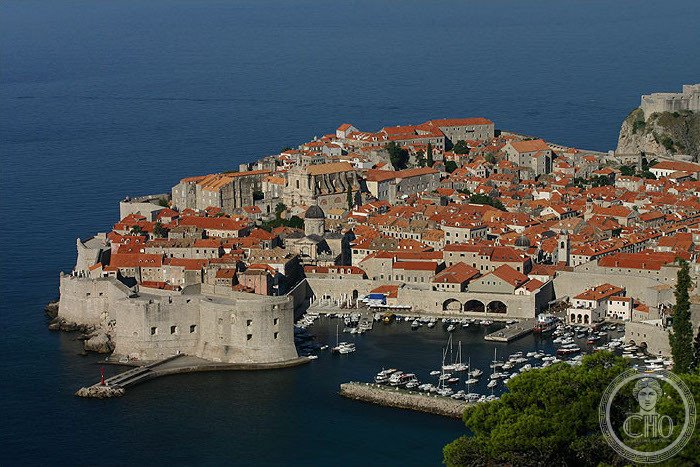
The Republic of Ragusa lasted 450 years by being cleverer than its neighbours. It was a merchant city-state that traded with everyone and paid off the Ottomans and the Venetians simultaneously. It built a city of white limestone and terracotta that Byron called “the pearl of the Adriatic”. The city survived a 1991–1992 siege to become one of the most visited cities in Europe.
At a glance
The Old City of Dubrovnik is the walled historic core of the city on the southern Dalmatian coast of Croatia. Its limestone buildings and terracotta roofs are enclosed by 2 km of medieval walls (13th–16th century) rising directly from the Adriatic Sea. The city was the capital of the Republic of Ragusa (Republika Dubrovačka), an independent maritime merchant republic that operated from the 14th century until Napoleon dissolved it in 1808. Its prosperity was built on trade between the Ottoman Empire and Western Europe. It exploited its position as the only Christian trading intermediary that maintained good relations with the Ottomans. The Old City was heavily shelled during the Croatian War of Independence (siege of Dubrovnik, 1991–1992). The subsequent restoration of its buildings and its nomination as a UNESCO World Heritage Site (1979) have made it the preeminent heritage destination on the Adriatic coast.
Key facts
- City walls: 1,940 metres in circumference. 16 towers, 3 fortresses, 6 bastions and 2 corner fortifications, among them the Minčeta Tower at the north-west corner, the Revelin Fortress to the east and the freestanding Fort Lovrijenac on its cliff to the west. Up to 25 metres high, and 4–6 metres thick on the landward side against 1.5–3 metres facing the sea, where the cliffs themselves do the defending. The circuit is walkable in its entirety and the wall walk is the single most popular thing to do in Dubrovnik. The present outline was fixed in the 13th century and the last bastion, St Stephen, was finished in 1660.
- Republic of Ragusa: an independent city-state from 1358 (when it purchased independence from Venice) until 1808 (when Napoleon dissolved it). At its peak in the 15th–16th century, it had the third-largest merchant fleet in the Mediterranean. Its network of commercial representatives extended from London to Constantinople and to sub-Saharan Africa. It abolished the slave trade in 1416, among the first states in Europe to do so. Its motto — Non bene pro toto libertas venditur auro (freedom is not sold for all the gold in the world) — is carved above the entrance to Fort Lovrijenac.
- Stradun: the 300-metre main street running east-west through the Old City. It is lined with identical limestone baroque buildings rebuilt after the 1667 earthquake, the standard town-planning response of Ragusa to the earthquake that destroyed the medieval city. Onofrio’s Large Fountain, sixteen-sided, built in 1438 by the Neapolitan engineer Onofrio della Cava, still runs at the western end, fed by an aqueduct that carries water 12 km from the mountains.
- 1991–1992 siege: during the Croatian War of Independence, Yugoslav People’s Army and Montenegrin forces besieged Dubrovnik from October 1991 to May 1992. Approximately 2,000 shells hit the Old City and 563 buildings were damaged. The restoration (1994–2000), with UNESCO support, repaired the damage to an extraordinary degree. The site was placed on the List of World Heritage in Danger in 1991 and removed in 1998. From the walls the repair is still legible as a patchwork, the weathered orange of the surviving tiles against the brighter red of the replacements.
- Game of Thrones: the Old City was used as the filming location for “King’s Landing” in the HBO series (2011–2019). This has significantly increased visitor numbers but also changed the relationship between the city and its residents.
- Heritage: UNESCO World Heritage Site, Old City of Dubrovnik, inscribed 1979
- GPS: 42.6413° N, 18.1102° E
History
The site of Dubrovnik was settled by refugees from the Roman city of Epidaurum (modern Cavtat) following Slavic and Avar attacks in the 7th century. They settled on a small rocky island called Laus, later renamed Ragusa. This island was subsequently joined to the mainland by filling in the channel between them; the present-day Stradun was that channel. The Latin-speaking Ragusan population gradually merged with the Slavic population of the mainland. The city’s language became a Slavic dialect (Ragusan), but its culture remained Latin and Italian-oriented.
The political history of Ragusa from the 11th to the 14th century involved successive overlordships (Byzantine, Norman, Venetian) until 1358, when the city purchased independence from Venice for a large sum. The Republic of Ragusa that emerged was a sophisticated oligarchic merchant republic, governed by a council of noble families. Its institutional arrangements were specifically designed to prevent the concentration of power in a single individual. The Rector, the nominal head of the Republic, served a one-month term. He was not allowed to leave his palace, and was not permitted two consecutive terms. The Republic navigated between the competing powers of Venice and the Ottoman Empire by paying tribute to both, claiming neutrality, and building up an intelligence network through its merchant representatives.
The earthquake of 1667 killed approximately 5,000 people (a significant portion of the city’s population) and destroyed most of the medieval buildings. The systematic baroque rebuilding of the Stradun and its flanking streets in uniform limestone facades gave the Old City its present appearance. The Republic continued until Napoleon dissolved it in 1808. It was subsequently incorporated into the Austro-Hungarian Empire, then into Yugoslavia. The 1991–1992 siege was the first time the city had been attacked since the 16th century. The precision with which Yugoslav artillery targeted the historic core (a UN-protected site) was widely condemned internationally. This became one of the defining images of the war in the former Yugoslavia.
What you see
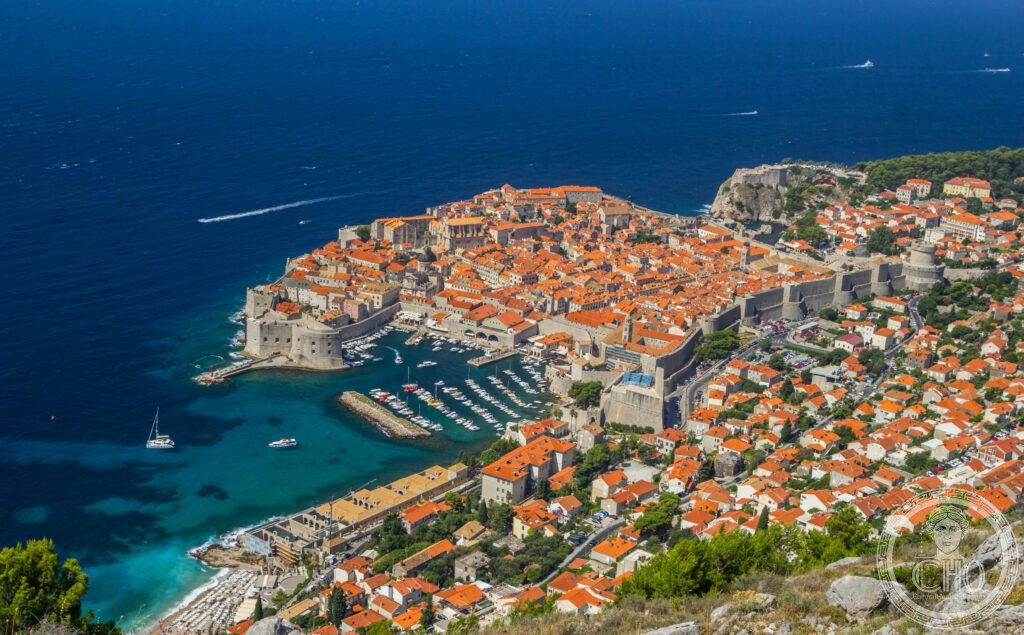
The walls circuit (2 km, 1.5–2 hours) gives the definitive spatial experience of the Old City. The view from the battlements includes the terracotta-roofed limestone buildings below, the Adriatic on three sides, and the pattern of the streets and plazas visible from above. The Minčeta Tower at the north-west corner gives the best view. The section above the harbour on the east side offers the most dramatic setting. The colour contrast between the pale limestone and the warm terracotta of the roofs is the visual signature of the city from the sea and from above. The terracotta tiles were replaced after 1991 with Croatian tiles from the same local tradition.
Within the walls, the Stradun runs straight through the heart of the city from the Pile Gate (west) to the Ploče Gate (east). Its surface is polished smooth by centuries of foot traffic. The Rector’s Palace (now a museum) on the east side of the street is the finest Gothic-Renaissance building in the city, with an atrium and loggia of great refinement. The inscription above the door — “Obliti privatorum publica curate” (Forget private affairs, take care of public ones) — is the republic’s civic motto. The Sponza Palace is the one building inside the walls to come through the 1667 earthquake intact. It sets Gothic against Renaissance in a single facade. It now holds the State Archives, where ten centuries of Ragusan diplomatic correspondence are kept. The Dominican Monastery on the north-east corner of the walls has a beautiful Gothic-Renaissance cloister and a remarkable collection of 15th–16th century Ragusan paintings (Nikola Božidarević, Lovro Dobričević).
Practical information
- Address: Old City (Stari Grad), Dubrovnik. Main entrance through Pile Gate on the west.
- City walls: daily 8 am–6:30 pm (summer) and 9 am–3 pm (winter). EUR 35 (adults). The walls circuit begins and ends at the Pile Gate. The second access point is near the Dominican Monastery.
- Best time: May–June and September–October are ideal. July–August is extremely crowded and hot; cruise ships disembark 8,000+ day-trippers simultaneously. The city’s resident population has nearly halved in the past decade due to tourism pressure and short-term rental conversion.
- Cable car: runs from above the Ploče Gate to the summit of Mount Srđ (412 metres). EUR 16. The view from the top over the Old City, the islands, and the Adriatic coastline is the best available. The cable car was destroyed in the 1991–1992 siege and rebuilt in 2010.
- Game of Thrones tours: numerous operators. The main filming locations (the Stradun, the walls, Fort Lovrijenac) are all within the Old City.
Getting there
Dubrovnik Airport (DBV), 15 km south of the city (shuttle bus 30 minutes or taxi 20 minutes). Ferries from Split (3–4 hours) and from Bari, Italy (9–10 hours overnight). The Old City itself is pedestrian-only. The bus terminus is at Pile Gate. GPS: 42.6413, 18.1102.
Nearby
- Lokrum Island — uninhabited island 600 metres from the Old City, accessible by boat (15 minutes). Features include Benedictine monastery ruins, a peacock colony, a botanical garden, and swimming. Richard the Lionheart was shipwrecked here in 1192. No overnight stays permitted.
- Elafiti Islands — the small island group north-west of Dubrovnik. It includes Šipan, the largest, with Roman villa remains; Lopud, a car-free island with sandy beaches; and Koločep, with 7th-century church frescoes. Accessible by ferry from Dubrovnik.
- Kotor, Montenegro — the best-preserved walled medieval town on the Adriatic, with a UNESCO WHS bay. It is 90 km south of Dubrovnik. The city walls climb the mountain behind the town to a fortress 260 metres above sea level.
- Mostar — 150 km north, in Bosnia and Herzegovina. The Stari Most, the Ottoman bridge of 1566 by Mimar Hayruddin, was destroyed in the Bosnian War in November 1993. It was rebuilt in 2004 with limestone from the original quarry (UNESCO World Heritage 2005).
- Korčula — the island town sometimes claimed as the birthplace of Marco Polo. A scaled-down Dubrovnik, quieter and less visited, with a fine Gothic cathedral. Accessible by catamaran from Dubrovnik (2 hours).
Sources
- Wikipedia, Dubrovnik, accessed June 2026
- UNESCO, Old City of Dubrovnik, WHS reference 95, inscribed 1979
- Society of Friends of Dubrovnik Antiquities, The City Walls, citywallsdubrovnik.hr — the body that manages the walls, for their measurements
- Robin Harris, Dubrovnik: A History, Saqi Books, 2003 — the standard English-language history of the Republic of Ragusa
Find it on the map
See this place and what’s around it →Historical events at this place (3)
📷 Become a Cultural Heritage Online photographer
Share your photos of places: they stay published under your name as the author. The more they're seen, the more you get noticed — and soon a contest will reward the most appreciated photos.
Log in or sign up free to add a photo