

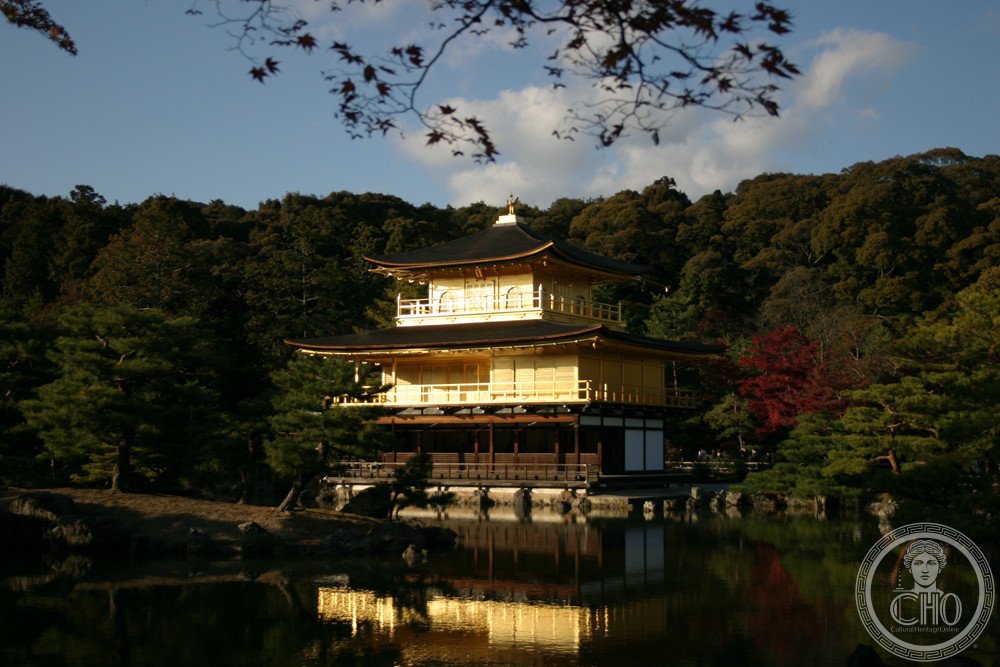
The three-storey gold-leaf pavilion that Ashikaga Yoshimitsu built as his retirement villa in 1397 — each storey in a different architectural style, the upper two clad entirely in pure gold, its mirror-image reflection in the pond below creating a composition so perfectly resolved that a disturbed monk burned it in 1950 because he found its beauty intolerable.
At a glance
Kinkaku-ji (金閣寺, Temple of the Golden Pavilion), officially named Rokuon-ji, is a Zen Buddhist temple in the north of Kyoto, its principal structure a three-storey boathouse-pavilion covered in gold leaf standing in a large pond garden. The site was the retirement villa of the shogun Ashikaga Yoshimitsu (r. 1368–1394), who had the central pavilion built in 1397 as part of a complex that unified the aristocratic shinden-zukuri, samurai bukke-zukuri, and Zen karayō architectural styles in its three storeys. At Yoshimitsu’s death in 1408, the estate became a Zen temple. The original structure was burned by a disturbed apprentice monk in 1950 (the event that inspired Mishima Yukio’s 1956 novel The Temple of the Golden Pavilion); the current structure is a 1955 reconstruction with historically accurate gold-leaf cladding. Kinkaku-ji is part of the UNESCO World Heritage Site “Historic Monuments of Ancient Kyoto,” inscribed 1994.
Key facts
- Architecture: three storeys; ground floor (Hōsuiin) in the Heian-period shinden-zukuri style with white plastered walls and no gold; second floor (Chōon-dō) in the samurai bukke-zukuri style, covered in gold leaf, with a shuttered facade and a small Kannon (Bodhisattva of Mercy) shrine inside; third floor (Kukyōchō) in the Zen karayō (Chinese style), fully gold-leafed inside and out, topped by a bronze phoenix
- Gold leaf: the 1950 reconstruction (1955) used 20 kg of gold leaf; re-gilded in 1987 with five times the original gold thickness (0.5 microns in the original 14th-century structure; 2.5 microns in the 1987 re-gilding); the gold leaf is applied in sections and maintained by a specialist team
- Pond garden: the Kyōko-chi (Mirror Pond) reflects the pavilion; its design incorporates islands and stones in the shinden-zukuri style; the garden is part of the original 14th-century design and is among the finest surviving examples of a Muromachi period stroll garden
- The 1950 arson: on 2 July 1950, a 21-year-old apprentice monk named Hayashi Yōken set fire to the temple and attempted to die with it by suicide on the hillside behind (he was discovered and survived); his obsession with the pavilion’s beauty and his own ugliness was described in his later statements; Mishima Yukio’s 1956 novel recreated and fictionalised the event
- Heritage: UNESCO World Heritage Site, Historic Monuments of Ancient Kyoto (Kyoto, Uji and Otsu Cities), inscribed 1994
- GPS: 35.0394° N, 135.7292° E
History
Ashikaga Yoshimitsu was the third and most powerful shogun of the Ashikaga (Muromachi) shogunate, who effectively ruled Japan from Kyoto for 26 years. Unlike his predecessors, Yoshimitsu cultivated a direct political relationship with the Emperor of China (Ming dynasty), receiving the title “King of Japan” from the Chinese emperor in 1401 — a politically controversial act that placed the shogun in a tributary relationship to China rather than asserting full Japanese independence. His retirement villa complex (Kitayama-dono) was designed to embody this synthesis of Japanese and continental (Chinese Zen) culture: the architecture of the pavilion deliberately combining three Japanese architectural traditions in one building, the garden combining the aristocratic pond garden with elements from Chinese literati culture.
The Kitayama culture that Yoshimitsu fostered around his villa — and that the pavilion represents architecturally — was one of the most productive periods in Japanese cultural history, producing the formal Nō theatre (Zeami Motokiyo composed his masterworks under Yoshimitsu’s patronage), the kare-sansui (dry rock garden) tradition, and the tea ceremony (chado) in their canonical forms. The gold-leaf cladding of the upper storeys was not merely decorative wealth display but a Buddhist claim: the golden colour of the pavilion reflected Jōdo (Pure Land) Buddhist iconography, in which the western paradise of Amida Buddha was described as golden — Yoshimitsu was placing his retirement villa, and himself, within the geography of Buddhist paradise.
After the 1950 arson, the Japanese government and Rokuon-ji temple undertook a full reconstruction; the new building (1955) was based on detailed records and photographs of the original. The 1987 re-gilding corrected a deficiency in the 1955 reconstruction: the original specifications called for thicker gold application than had been achieved in the post-war shortages; the 1987 project applied five times the 1955 thickness, resulting in the brilliant gold appearance that characterises the pavilion today.
What you see
The approach through Rokuon-ji’s entrance garden (a simple planted path) leads to the view from the Mirror Pond’s north bank, which is the canonical composition: the pavilion standing in the water, its three storeys visible above the surface, and the near-perfect reflection below. The composition is designed to be seen from this specific point and at this specific relationship; the view was planned as a picture before the first stone of the garden was laid. At different seasons, different elements of the garden change: snow on the eaves in January and February, spring cherry blossoms framing the gold, autumn maples in red and orange around the water.
The pavilion itself is not accessible to visitors (the interior rooms are not open); the entire experience is of the exterior and garden. The stroll path around the pond reveals the building from different angles; the second viewing point, from the western bank, shows the pavilion against the forested hillside. The Fudō-dō (Fudō Shrine), on a small hill in the rear garden, is a surviving structure from the Nanbokuchō period (14th century) and predates the current reconstruction.
Practical information
- Address: 1 Kinkakujicho, Kita Ward, Kyoto; the main entrance is on Kitayama-dori street
- Hours: daily 9 am–5 pm
- Admission: JPY 500 (approximately EUR 3); one of the cheapest major temples in Kyoto
- Crowds: among the most visited sites in Japan; arrive at opening (9 am) to avoid the worst; the crowds peak between 10 am and 3 pm; the view from the Mirror Pond is the same regardless of the number of people — position yourself and frame out the crowds
- Photography: the Mirror Pond reflection is at its best on still, windless mornings; a slight wind creates interesting ripples but breaks the perfect mirror; winter snow is the most photogenic season but requires early morning
Getting there
From Kyoto Station: city bus no. 101 or 205 to Kinkakuji-michi stop (40 minutes); or bus no. 12 to Kinkakujicho (45 minutes). By taxi: 20 minutes from central Kyoto (JPY 2,000–2,500). No metro station nearby. GPS: 35.0394, 135.7292.
Nearby
- Ryōan-ji — the most famous kare-sansui (dry rock garden) in Japan: 15 stones in white gravel, the arrangement of which has never been definitively explained; 1 km south of Kinkaku-ji; UNESCO WHS; part of the same walking circuit
- Ninna-ji — the imperial temple complex founded 888 AD with a five-storey pagoda (17th century), cherry orchard of the “Omuro sakura” (late-blooming, shorter tree variety), and excellent sub-temple gardens; 1.5 km south
- Kyoto Imperial Palace — the former imperial residence in central Kyoto; the Sento Imperial Palace garden is one of the finest stroll gardens in Japan; accessible by advance reservation
- Arashiyama — the western mountain district with the bamboo grove, Tenryū-ji garden (UNESCO WHS), and the Togetsukyo bridge; 5 km south-west of Kinkaku-ji
Sources
- Wikipedia, Kinkaku-ji, accessed June 2026
- UNESCO, Historic Monuments of Ancient Kyoto, WHS reference 688, inscribed 1994
- Mishima Yukio, The Temple of the Golden Pavilion (金閣寺 Kinkaku-ji), 1956 — the novel that made Kinkaku-ji internationally famous
Find it on the map
See this place and what’s around it →📷 Become a Cultural Heritage Online photographer
Share your photos of places: they stay published under your name as the author. The more they're seen, the more you get noticed — and soon a contest will reward the most appreciated photos.
Log in or sign up free to add a photoIs this page about you?
This page is read by travellers and heritage enthusiasts who find it on Google. Tell us how you are connected to this place and we will take it from there.