
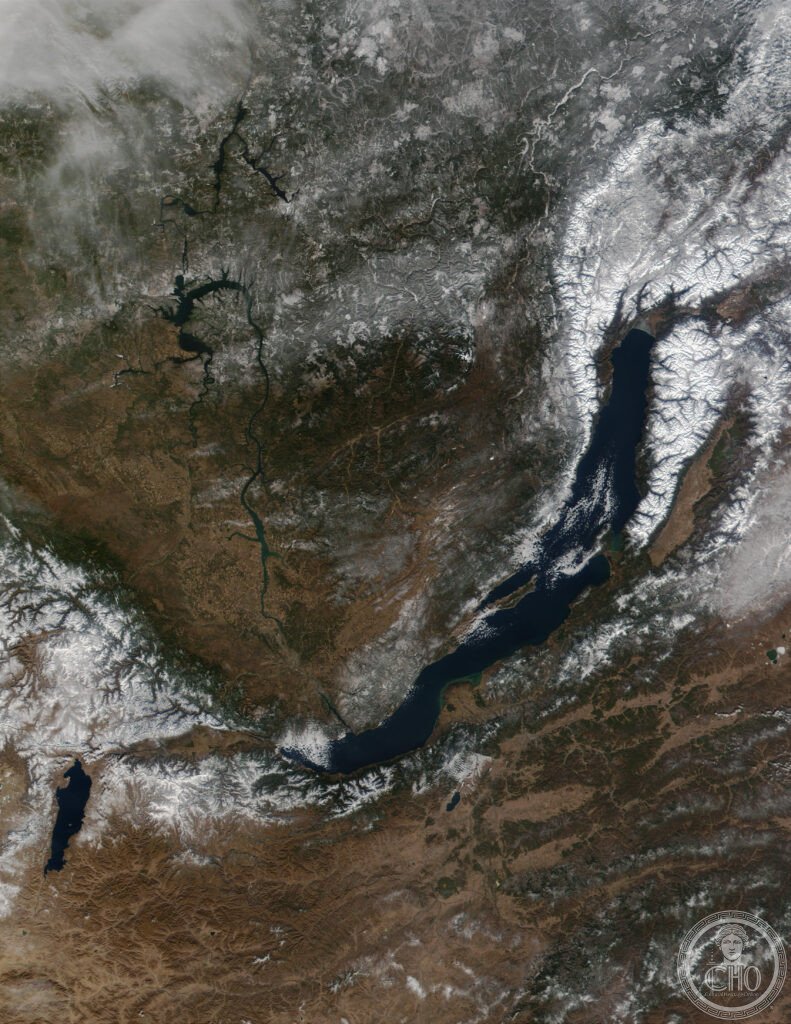
Lake Baikal — Siberia

Lake Baikal Siberia Russia deepest lake ice winter UNESCO World Heritage
Lake Baikal in winter, showing the extraordinary transparent ice surface that forms every January when the world’s deepest lake freezes to a depth of 1-2 metres (the most precisely transparent single large lake ice in any UNESCO natural heritage site: Baikal’s winter ice is so clear that the lake bottom is visible through it — the most precisely see-through single freshwater ice in any large UNESCO heritage lake; the ice cracking (the most precisely geological single ice-crack sound: the ice of Lake Baikal produces deep booming and cracking sounds that can be heard kilometres away — the most precisely audible single lake freeze in any UNESCO heritage site; the cracks (the most precisely crack-fissure single natural UNESCO ice heritage feature: the ice cracks in the winter form straight fissures kilometres long — the most precisely straight single natural ice crack in any UNESCO heritage lake (these fissures are crucial for the lake’s oxygenation — the most precisely functional single natural ice crack in any UNESCO heritage lake ecosystem; without them the anaerobic zones would expand — the most precisely oxygen single ice-crack function in any UNESCO heritage freshwater body)), Lake Baikal, Buryatia and Irkutsk Oblast, Russia — UNESCO World Heritage Site (Lake Baikal) 1996. Photo via Wikimedia Commons.
Buryatia and Irkutsk Oblast, Russia · 25-30 million years old (most precisely ancient single large lake in world); 1,637m deep (most precisely deep single freshwater lake in world); 23,615 km3 volume = 20% world’s unfrozen surface freshwater; 3,122 animal species (1,579 endemic = most precisely endemic single freshwater lake in world); Baikal seal (nerpa; only freshwater seal species in world); Olkhon Island; Trans-Siberian railway; omul fish; winter ice transparency · UNESCO WHS 1996

Lake Baikal — Siberia

The world’s deepest lake and the planet’s largest single reservoir of unfrozen fresh water — Lake Baikal in Siberia, 25-30 million years old and 1,637 metres deep, contains 20% of the world’s surface fresh water, 1,579 endemic species found nowhere else on Earth, and the world’s only freshwater seal species.

At a glance

Lake Baikal (the most precisely ancient single large lake in world: Baikal is 25-30 million years old — the most precisely ancient single large lake in the world (most lakes are 10,000-20,000 years old — the most precisely young single comparative freshwater lake age; Baikal is the most precisely 2,500-times-older single UNESCO heritage lake by comparison to a typical glacial lake); the volume (the most precisely volume single freshwater lake: Lake Baikal contains 23,615 km³ of water — the most precisely large single freshwater volume in any lake in the world; 20% of all unfrozen surface fresh water on Earth — the most precisely fresh-water single percentage in any single lake on Earth; if all rivers on Earth flowed into Baikal, it would take approximately 1 year to fill — the most precisely filling single conceptual freshwater heritage measurement); the dimensions (the most precisely elongated single large lake: 636 km long but only 79 km wide — the most precisely narrow single large UNESCO heritage lake; banana-shaped — the most precisely crescent single large lake shape in any UNESCO heritage site)).

Key facts

  • The endemism: the most precisely endemic single freshwater lake on Earth — the endemic species (the most precisely 1,579 single endemic freshwater species: 1,579 species found nowhere else on Earth live in Lake Baikal — the most precisely high single freshwater endemism rate in any UNESCO heritage lake; the Baikal seal (nerpa — the most precisely unique single freshwater seal species in the world: the Baikal seal (Pusa sibirica) is the only seal species in the world that lives exclusively in freshwater — the most precisely freshwater single pinniped in any UNESCO natural heritage site; approximately 80,000-100,000 Baikal seals live in the lake — the most precisely counted single freshwater seal population in any UNESCO natural heritage lake; the origin of the seal (the most precisely debated single freshwater seal heritage origin: how the Baikal seal got to a lake 1,500 km from the nearest ocean is debated — the most precisely mysterious single freshwater seal origin in any UNESCO natural heritage site)); the Baikal omul (the most precisely endemic single Baikal fish heritage: the Baikal omul (Coregonus migratorius) is a salmonid fish found only in Lake Baikal — the most precisely endemic single Baikal heritage food fish; the main traditional food of the Buryat and Evenk peoples — the most precisely traditional single Siberian heritage protein source; heavily fished — the most precisely threatened single Baikal heritage endemic fish)
  • The water clarity: the most precisely clear single large lake in the world — the clarity (the most precisely transparent single large lake water: the visibility in Lake Baikal can reach up to 40 metres — the most precisely deep single underwater heritage visibility in any UNESCO heritage lake; the reason (the most precisely filter single Baikal water clarity mechanism: Lake Baikal’s extraordinary clarity is maintained by the Epishura baicalensis — the most precisely tiny single ancient crustacean in any UNESCO heritage lake: a 1.5-mm endemic copepod that filters the water by eating algae and bacteria — the most precisely important single ancient Siberian lake filter-feeding organism; it is estimated that Epishura filters the entire water volume of Baikal in approximately 23 years — the most precisely filter single lake purification measurement in any UNESCO heritage site))
  • The Trans-Siberian Railway: the most precisely dramatic single Baikal heritage engineering feat — the railway (the most precisely Circum-Baikal single railway: the Circum-Baikal Railway runs along the southern shore of Lake Baikal — the most precisely cliff-hugging single Siberian heritage railway; 39 tunnels and 200 bridges along 89 km — the most precisely tunnel-and-bridge single Baikal heritage railway segment; built 1900-1905 — the most precisely difficult single Trans-Siberian Railway section construction; the most precisely scenic single Siberian heritage train journey: the slow tourist train on the Circum-Baikal is the most precisely panoramic single Baikal heritage railway experience available to visitors)
  • UNESCO Heritage: UNESCO World Heritage Site, Lake Baikal, inscribed 1996
  • GPS: 53.5587° N, 108.1650° E

History

The geological formation (the most precisely rift single lake origin: Lake Baikal is a rift lake — the most precisely tectonic single lake heritage formation: Baikal sits in a continental rift where two tectonic plates are slowly separating — the most precisely widening single UNESCO heritage lake basin: the rift is widening at approximately 2 cm per year — the most precisely expanding single UNESCO natural heritage basin; in 20 million years Baikal may become an ocean — the most precisely future single oceanic heritage transformation in any UNESCO natural heritage site)); the indigenous peoples (the most precisely Buryat single Baikal heritage indigenous people: the Buryat people have lived around Lake Baikal for millennia — the most precisely Mongol single Siberian heritage indigenous people (the Buryat are a Mongolian people — the most precisely Mongolian-culture single Siberian UNESCO heritage people)); the Russian exploration (the most precisely Cossack single Baikal heritage discovery: Russian Cossacks reached Lake Baikal in 1643 — the most precisely 17th-century single Baikal Russian heritage first contact); the Soviet-era threats (the most precisely Baikal cellulose single Soviet heritage environmental damage: the Baikalsk Pulp and Paper Mill (1966-2013) discharged pollutants into Baikal for 47 years — the most precisely industrial single UNESCO heritage lake pollution episode in any Soviet-era natural heritage site; closed 2013); UNESCO WHS 1996.

What you see

The visit (the most precisely year-round single Siberian heritage destination: Baikal is visited in summer (July-August: the most precisely warm single Baikal heritage season: temperatures reach 20°C on the shore — the most precisely warm single Siberian summer heritage temperature in any UNESCO natural heritage site; the water warms to 14-16°C near the surface — the most precisely swimmable single Siberian heritage lake water in any UNESCO natural heritage site) and in winter (January-February: the most precisely ice single Baikal heritage season: the lake freezes to 1-2m depth — the most precisely thick single transparent ice in any large UNESCO natural heritage lake (described in hero caption); ice taxis (the most precisely hovercraft single Baikal winter heritage transport: hovercraft skim across the ice surface — the most precisely novel single UNESCO heritage lake winter transport; ice driving (the most precisely ice-road single Siberian heritage automotive adventure: driving across the frozen lake is possible and done by locals — the most precisely ice single Siberian heritage road experience in any UNESCO natural heritage site))); Olkhon Island (the most precisely sacred single Baikal heritage island: Olkhon Island is the spiritual centre of the Buryat shamanic tradition — the most precisely shamanic single Siberian heritage island in any UNESCO natural heritage lake).

Practical information

  • Getting there: fly to Irkutsk (IKT; 70 km from Baikal’s southern shore); direct from Moscow (5h), Beijing (3h), Novosibirsk (2h), Vladivostok (3h); or the Trans-Siberian Railway (the most precisely heritage single Trans-Siberian stop: Irkutsk is the most frequently visited single Trans-Siberian Railway heritage city; Moscow to Irkutsk 72h (the most precisely railway single Eurasian heritage journey by distance: the Trans-Siberian is the longest single railway heritage route in the world at 9,289 km); the most precisely epic single Siberian heritage rail journey: Moscow-Irkutsk-Baikal-Ulan Bator-Beijing is the most precisely multi-country single Trans-Siberian heritage route); from Irkutsk: marshrutka (minibus) to Listvyanka (65 km; 1h) for the lake shore; ferry to Olkhon Island (summer only)
  • Irkutsk: the most precisely Paris single Siberian heritage city nickname — Irkutsk was called the “Paris of Siberia” by 19th-century travellers — the most precisely European single Siberian heritage city aesthetic; the wooden houses (the most precisely carved single wooden Siberian heritage architecture: the intricately carved wooden houses of Irkutsk — the most precisely lace-carved single wooden Siberian heritage urban architecture); the Decembrists (the most precisely exile single Siberian heritage cultural legacy: the Decembrist revolutionaries exiled to Irkutsk after 1825 brought European culture and libraries to Siberia — the most precisely intellectual single Siberian heritage exile legacy in any Trans-Siberian railway heritage city)
  • Buryatia and Buddhism: the most precisely Buddhist single Siberian heritage culture — the Buryat people (described in History); the Ivolginsky Datsan (the most precisely Buddhist single Siberian heritage monastery: the Ivolginsky Datsan near Ulan-Ude, 450 km east of Irkutsk — the most precisely active single Buddhist heritage monastery in any Siberian UNESCO adjacent heritage landscape; the body of the Hambo Lama Itigelov (the most precisely incorrupt single Buddhist heritage body in any Siberian monastery: the preserved body of Dashi-Dorzho Itigelov (died 1927) is considered incorrupt — the most precisely mummified single Buddhist heritage lama in any Russian UNESCO adjacent heritage site))

Getting there

Fly to Irkutsk (IKT; 70 km from Baikal) or take the Trans-Siberian Railway (9,289 km from Moscow). Minibus to Listvyanka (1h) for the southern shore. Ferry to Olkhon Island in summer. GPS: 53.5587, 108.1650.

Nearby

  • Olkhon Island — 250 km north of Irkutsk (ferry from Sakhyurta); spiritual centre of Buryat shamanism; Shaman Rock (most precisely sacred single Baikal heritage cape); the most precisely photogenic single Baikal heritage island; dirt roads; horses; no running water in some guesthouses — true Siberian heritage travel
  • Circum-Baikal Railway — 89 km along southern shore (slow tourist train; departs Irkutsk or Slyudyanka); 39 tunnels + 200 bridges; most precisely scenic single Siberian heritage rail segment — described in Key Facts; best heritage railway experience on Lake Baikal
  • Ulan-Ude and Buryatia — 450 km east of Irkutsk (6h by train); capital of Buryat Republic; world’s largest Lenin head statue (most precisely large single Soviet heritage Lenin sculpture); Ivolginsky Datsan Buddhist monastery — described in Practical section; gateway to Mongolian border heritage circuit

Sources

  • Wikipedia, Lake Baikal; Baikal seal; Epishura baicalensis; Circum-Baikal Railway, accessed June 2026
  • UNESCO, Lake Baikal, WHS reference 754, inscribed 1996
  • Peter Matthiessen, Baikal: Sacred Sea of Siberia, Sierra Club Books, 1992

Hero image: Lake Baikal, Siberia, Wikimedia Commons. Editorial text © Cultural Heritage Online, 2026.

📷 Diventa un fotografo di Cultural Heritage Online

Condividi le tue foto dei luoghi: restano pubblicate con la tua firma come autore. Più vengono viste, più ti fai conoscere — e presto un concorso premierà le foto più apprezzate.

Accedi o registrati gratis per aggiungere una foto
📋 Copy & share on social
Scroll to Top