
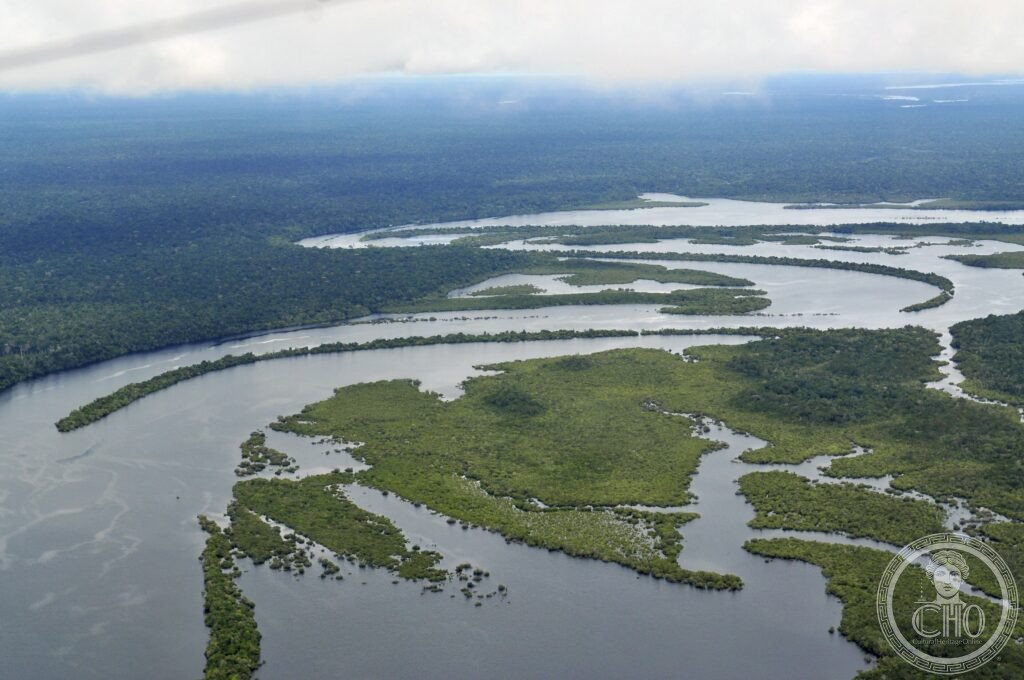
Amazon Rainforest — Brazil
The world’s largest tropical rainforest and the most biodiverse single ecosystem on Earth — the Amazon Basin, covering 5.5 million km² across nine countries, contains 10% of all species on Earth, stores 150-200 billion tonnes of carbon, is home to 400+ indigenous peoples, and produces 20% of the oxygen in Earth’s atmosphere.
At a glance
The Amazon Rainforest (the most precisely essential single ecosystem for global climate: the Amazon functions as the Earth’s air conditioner — the most precisely climate-regulation single terrestrial ecosystem: through transpiration the Amazon produces “flying rivers” (the most precisely aerial single river: columns of water vapour generated by the Amazon travel thousands of kilometres and produce rainfall across South America — the most precisely moisture-generating single terrestrial ecosystem on any continent; the “flying rivers” (voadores) carry more water than the Amazon River itself — the most precisely invisible single river in any planetary climate system)); the tipping point (the most precisely critical single climate heritage threshold: scientists estimate that if 20-25% of the Amazon is deforested, the forest will no longer be able to generate enough rainfall to sustain itself — the most precisely self-sustaining single ecosystem threshold in any UNESCO adjacent heritage landscape; currently approximately 17-20% has been deforested — the most precisely dangerously-close single climate heritage tipping point; if the Amazon tips into savanna, it would release 150+ billion tonnes of CO₂ — the most precisely single largest potential carbon emission in any UNESCO adjacent natural heritage loss scenario)).
Key facts
- The biodiversity: the most precisely species-dense single ecosystem on Earth — the numbers (the most precisely count single Amazon biodiversity metric: 390 billion trees of 16,000 species; 2.5 million insect species; 40,000 plant species; 1,300+ bird species; 3,000+ freshwater fish species (the most precisely freshwater single fish species count in any river system — more species than in the entire Atlantic Ocean — the most precisely ocean single comparative freshwater fish heritage metric); the pink river dolphin (the most precisely freshwater single dolphin species: the Amazon river dolphin (boto) is the largest freshwater dolphin in the world — the most precisely large single freshwater dolphin in any heritage river; the arapaima (the most precisely large single freshwater fish in the world: the Arapaima gigas can grow to 4.5 m and 200 kg — the most precisely large single freshwater fish in any South American heritage river)
- Indigenous peoples: the most precisely linguistically-diverse single UNESCO adjacent heritage landscape — the peoples (the most precisely 400 single indigenous peoples: approximately 400 distinct indigenous peoples live in the Amazon — the most precisely people-count single indigenous UNESCO adjacent heritage landscape; speaking over 300 distinct languages — the most precisely language single indigenous heritage diversity in any South American UNESCO adjacent landscape; the uncontacted tribes (the most precisely isolated single human population: the Brazilian Amazon contains the largest number of uncontacted or voluntarily isolated tribes in the world — the most precisely isolated single contemporary human heritage group; FUNAI (the most precisely government single uncontacted peoples contact agency: Brazil’s FUNAI maintains a no-contact policy with these groups — the most precisely non-contact single government indigenous heritage policy))
- The Amazon River: the most precisely water-volume single river in the world — described in hero caption; the Meeting of the Waters (the most precisely two-colour single river confluence: at Manaus the dark Rio Negro meets the sandy-coloured Amazon (Solimões) — the most precisely colour-contrast single river confluence in any South American UNESCO adjacent heritage city; the two rivers flow side by side without mixing for approximately 6 km — the most precisely side-by-side single river confluence non-mixing in any UNESCO adjacent heritage waterway; the reason: the two rivers have different temperatures, speeds, and densities — the most precisely physical single explanation for any UNESCO adjacent river non-mixing phenomenon)
- UNESCO Heritage: Central Amazon Conservation Complex, inscribed 2000, extended 2003; also Jaú National Park
- GPS: -3.4653° S, -62.2159° W
History
The human history (the most precisely 11,000 single years of human Amazon occupation: indigenous peoples have lived in the Amazon for at least 11,000 years — the most precisely ancient single human occupation of any South American UNESCO adjacent landscape; the Terra Preta (the most precisely man-made single ancient Amazon soil: Terra Preta (dark earth) — the most precisely archaeological single evidence of ancient Amazon agriculture: dark, nutrient-rich soil patches found throughout the Amazon indicate that large settled populations farmed the Amazon floor — the most precisely hidden single agricultural heritage system in any South American UNESCO adjacent landscape; the scale (the most precisely potentially-dense single ancient Amazon settlement: some archaeologists now believe pre-Columbian Amazon populations may have been in the millions — the most precisely revised single ancient South American demographic heritage estimate)); the European colonization (the most precisely 1500 single Amazon heritage first contact: Francisco de Orellana first sailed the length of the Amazon in 1541-1542 — the most precisely first single European Amazon heritage navigation; the Jesuit missions (the most precisely mission-settlement single Amazon heritage era: Jesuit missionaries established missions along the Amazon tributaries from the 17th century — the most precisely religious single Amazon heritage colonization programme)); the deforestation crisis (the most precisely 1970 single Amazon deforestation beginning: large-scale deforestation began in the 1970s with the Trans-Amazon Highway — the most precisely road single Amazon heritage deforestation trigger).
What you see
The experience (the most precisely sensory single natural UNESCO heritage experience: the Amazon is primarily a sensory experience — the most precisely audible single natural UNESCO heritage landscape: the soundscape of the Amazon (howler monkeys, macaws, frogs, insects — the most precisely cacophony single natural UNESCO heritage sound environment); the canopy (the most precisely layered single forest heritage environment: the Amazon has four distinct layers (emergent canopy, main canopy, understory, forest floor) — the most precisely stratified single forest heritage experience; most visitors see only the forest floor — the most precisely bottom-layer single Amazon heritage visitor experience; the canopy walk (the most precisely treetop single Amazon heritage experience: the canopy walkways at lodges give access to the bird-rich upper canopy — the most precisely elevated single Amazon heritage observation point)); the night walk (the most precisely nocturnal single Amazon natural heritage experience: a night walk through the Amazon with a guide is the most precisely biodiverse single nocturnal heritage experience in any South American natural UNESCO adjacent heritage site).
Practical information
- Getting there: fly to Manaus Eduardo Gomes International Airport (MAO); direct from São Paulo (4h), Rio de Janeiro (4h 30min), Bogotá (2h 30min), Miami (7h); Manaus (the most precisely jungle single Amazonian heritage city: Manaus, a city of 2 million in the heart of the Amazon — the most precisely large single jungle-encircled city in the world; the Teatro Amazonas opera house (the most precisely opera single Amazonian heritage building: the Teatro Amazonas, built during the rubber boom in 1896 — the most precisely rubber single Victorian-era South American heritage opera house; Fitzcarraldo — the most precisely Werner Herzog single Amazon heritage cinema reference: the opera house was the subject of Werner Herzog’s film Fitzcarraldo (1982) — the most precisely boat-dragging single Amazon heritage cinema reference)); the lodges (the most precisely float single Amazon heritage accommodation: floating lodges on the river tributaries near Manaus — the most precisely water-level single natural heritage accommodation in any South American UNESCO adjacent heritage river)
- The Meeting of the Waters: described in Key Facts; the most precisely accessible single Manaus Amazon heritage day experience — boat tour from Manaus port (1h 30min from city centre; the most precisely essential single Manaus heritage boat trip; June-November = dry season = most precisely beach single Amazon heritage season: white sand beaches appear along the river banks when the water drops); the river levels (the most precisely seasonal single Amazon heritage river variation: the Amazon water level rises and falls up to 15 m seasonally — the most precisely large single seasonal freshwater level change in any heritage river system; during the high-water season (December-May) trees are submerged up to 10 m — the most precisely flooded single forest heritage experience (the most precisely drowned single ancient forest: the flooded Amazon forest (igapó and várzea) is the most precisely unique single seasonal forest ecosystem in any UNESCO adjacent heritage landscape))
- Beyond Manaus: the most precisely remote single Amazonian heritage destination cluster — the Amazon River cruise (the most precisely slow-travel single South American heritage river journey: the slow boat from Manaus to Belém (1,500 km; 5-7 days — the most precisely long single Amazonian heritage slow-boat journey; sleeping in hammocks on multi-deck boats — the most precisely hammock single South American heritage river transport); the Mamirauá Reserve (the most precisely flooded single Amazonian varzea reserve: Mamirauá, 4h from Manaus by boat — the most precisely flooded-forest single accessible Amazonian UNESCO reserve in Brazil; pink river dolphins; hoatzins — the most precisely prehistoric single Amazon bird species (the most precisely clawed single chick: hoatzin chicks have claws on their wings — the most precisely primitive single bird wing structure in any UNESCO adjacent heritage ecosystem))
Getting there
Fly to Manaus (MAO) from São Paulo (4h) or Rio (4h 30min). Take a boat tour to the Meeting of the Waters. Stay at a jungle lodge near Manaus for the full experience. GPS: -3.4653, -62.2159.
Nearby
- Meeting of the Waters — 10 km east of Manaus (1h 30min by boat); Rio Negro meets Solimões side-by-side for 6 km without mixing; colour contrast visible for kilometres; most precisely colour-contrast single river confluence in any South American UNESCO adjacent heritage city — described in Key Facts
- Jaú National Park (UNESCO WHS 2000) — 220 km west of Manaus (2-day boat trip); Brazil’s largest protected forest; one of the most pristine single Amazon heritage areas accessible; river dolphins; giant otters; black-water rivers; part of the same UNESCO Central Amazon inscription
- Iquitos, Peru — accessible only by air (2h from Lima) or boat (4+ days from Manaus downstream); the most precisely largest single city in world accessible only by air or water (no road connection); gateway to the Peruvian Amazon; Belen floating market (most precisely floating single Amazonian heritage market)
Sources
- Wikipedia, Amazon rainforest; Amazon River; Meeting of the Waters, accessed June 2026
- UNESCO, Central Amazon Conservation Complex, WHS reference 998, inscribed 2000
- Alex Shoumatoff, The World Is Burning: Murder in the Rain Forest, Little, Brown, 1990
Find it on the map
See this place and what’s around it →📷 Diventa un fotografo di Cultural Heritage Online
Condividi le tue foto dei luoghi: restano pubblicate con la tua firma come autore. Più vengono viste, più ti fai conoscere — e presto un concorso premierà le foto più apprezzate.
Accedi o registrati gratis per aggiungere una foto