
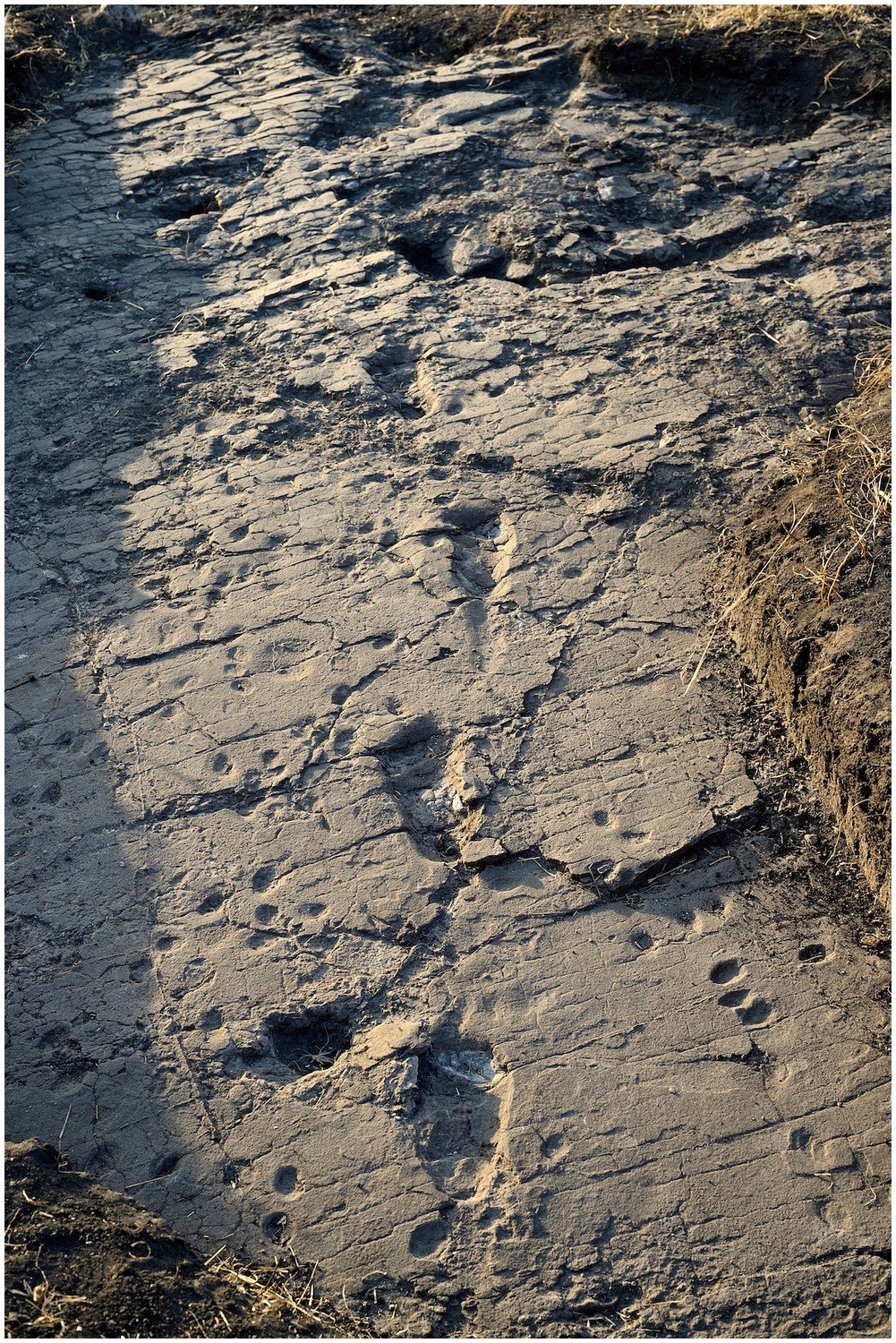
A site in northern Tanzania preserving the oldest footprints of upright-walking human ancestors ever discovered — a trackway of 70 fossilised steps that rewrote the story of when and why our lineage learned to walk.
At a glance
Laetoli lies in the Ngorongoro Conservation Area of northern Tanzania, approximately 45 kilometres south of Olduvai Gorge. It sits within a protected research zone and is not accessible to the public. Its significance rests on a single event 3.66 million years ago: three individuals walked across a plain of freshly rained-on volcanic ash, which dried and hardened, preserving their footprints until Mary Leakey uncovered them in 1978.
Discovery
In 1978, Mary Leakey and her team uncovered a fossilised trackway running 27 metres through hardened volcanic tuff at Laetoli Site G. The track formed when the Sadiman volcano deposited a layer of carbonatite ash. Rain briefly moistened the surface; three hominins walked across it; the sun dried it rapidly. Subsequent eruptions sealed the impressions under additional ash, preserving them for 3.66 million years. Leakey described her first sight: “They are remarkably similar to those of modern man. They are the oldest known footprints of our immediate ancestors.”
What the footprints reveal
The trackway preserves 70 individual footprints from at least three individuals, probably Australopithecus afarensis — the same species as the famous “Lucy” skeleton. The prints show a fully modern bipedal gait: the big toe aligned with the foot (not divergent, as in chimpanzees), the heel striking first, a longitudinal arch present, weight distribution matching modern human walking. This proved that bipedalism evolved more than a million years before the brain enlarged. Upright walking was not a consequence of growing intelligence — it preceded it by millions of years.
Three individuals, one moment
Two individuals walked side by side; one left a subtle additional compression suggesting an arm may have been draped across a companion (though this is contested). A smaller individual walked behind, placing feet into the footprints of the larger ahead. Whether this was a family group, a social band, or an accidental crossing cannot be determined. The spatial arrangement has made this one of the most emotionally resonant images in palaeoanthropology: three figures walking together, 3.66 million years ago, across a Tanzanian plain.
The volcanic ash record
Laetoli sits within the East African Rift Valley, one of the geologically most active regions on earth. Carbonatite ash from the Sadiman volcano has unusual cementing properties when wet, setting almost like concrete. The Laetoli tuffs contain not only hominin footprints but also the tracks of elephants, hipparions (extinct three-toed horses), guineafowl, hares, and insects — a snapshot of an entire ecosystem from 3.66 million years ago, preserved in stone.
Reburial and Site S
After excavation, the trackway was deliberately reburied in 1979 to protect it from acacia root damage and erosion. It remains buried today. A second set of footprints (Site S) was discovered in 2015 during a mapping project, adding evidence of a larger group crossing the plain in the same event. These too were reburied after documentation. The Laetoli trackways exist now only in casts, photographs, and measurements — the originals locked under metres of protective earth.
Scientific significance
Laetoli proved three things that transformed the study of human evolution. First: our ancestors walked upright 3.66 million years ago, over a million years before the first stone tools and nearly two million before Homo sapiens. Second: bipedalism and brain enlargement are independent evolutionary events. Third: the social behaviour suggested by the trackway — individuals walking together, possibly in physical contact — predates any other direct evidence of hominin group behaviour by millions of years. The site is not a monument built by human hands; it is a monument made by human feet.
Key facts
- Location
- Ngorongoro Conservation Area, northern Tanzania (~45 km south of Olduvai Gorge)
- Age of footprints
- 3.66 million years
- Species
- Probably Australopithecus afarensis
- Trackway length
- 27 metres (70 individual footprints, at least 3 individuals)
- Discovered
- 1978, Mary Leakey and team
- Site status
- Reburied and protected; not open to the public
- UNESCO designation
- Within Ngorongoro Conservation Area (WHS 1979)
Visiting
Laetoli itself is not open to visitors. The Olduvai Gorge Museum, 45 kilometres north, presents the Laetoli discoveries alongside the broader story of human evolution in the Rift Valley. It includes replica casts of the footprints and explanatory exhibits, and lies within the Ngorongoro Conservation Area — one of Tanzania’s most visited UNESCO World Heritage Sites.
Sources
- Mary D. Leakey & R.L. Hay, “Pliocene footprints in the Laetolil Beds at Laetoli, northern Tanzania,” Nature 278 (1979): 317–323
- William Harcourt-Smith & Leakey M.G., “Footprints and the evolution of hominin bipedalism,” Journal of Human Evolution 46 (2004)
- Getty Conservation Institute, The Conservation of the Laetoli Footprints (1996)
- Wikipedia, “Laetoli,” accessed 2026-06-11
- Ngorongoro Conservation Area Authority, site documentation
Find it on the map
See this place and what’s around it →📷 Become a Cultural Heritage Online photographer
Share your photos of places: they stay published under your name as the author. The more they're seen, the more you get noticed — and soon a contest will reward the most appreciated photos.
Log in or sign up free to add a photo