
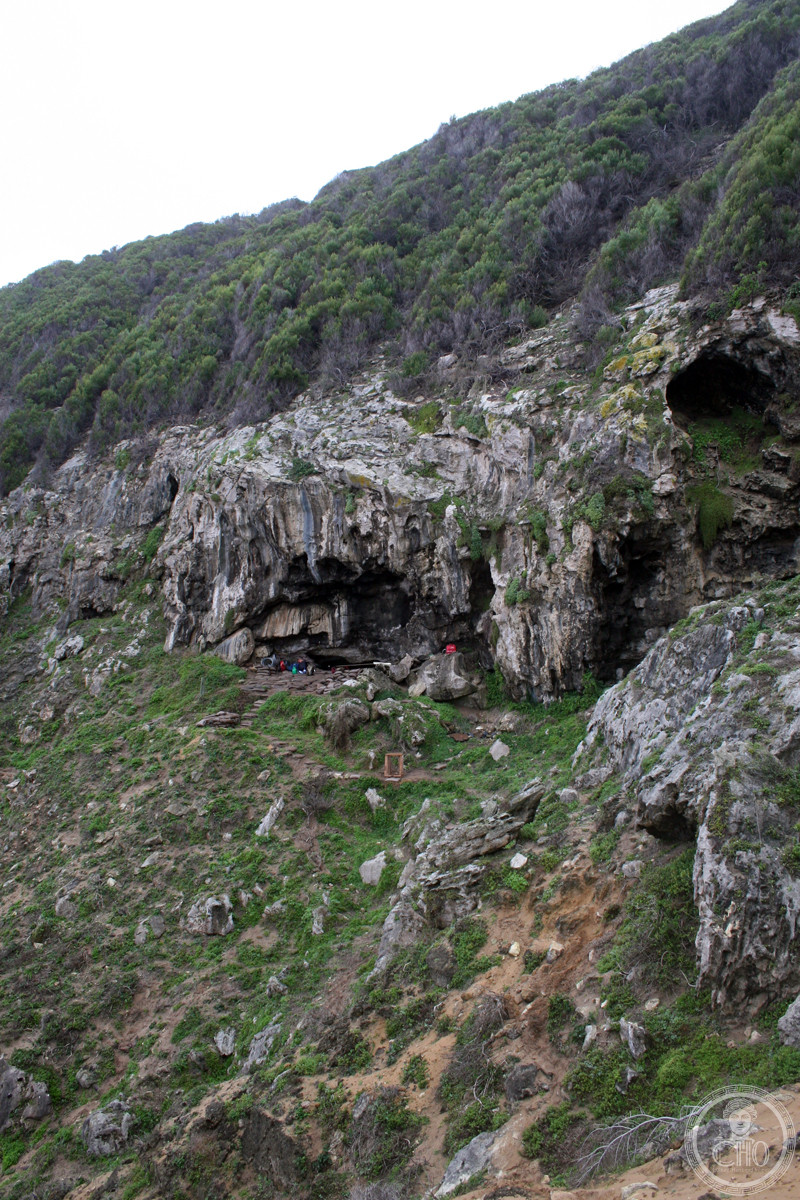
A cave on the southern Cape of South Africa that has yielded the oldest known examples of human symbolic behaviour: abstract engravings, personal jewellery, and a complete ochre-processing workshop, all dating to 75,000–100,000 years ago.
At a glance
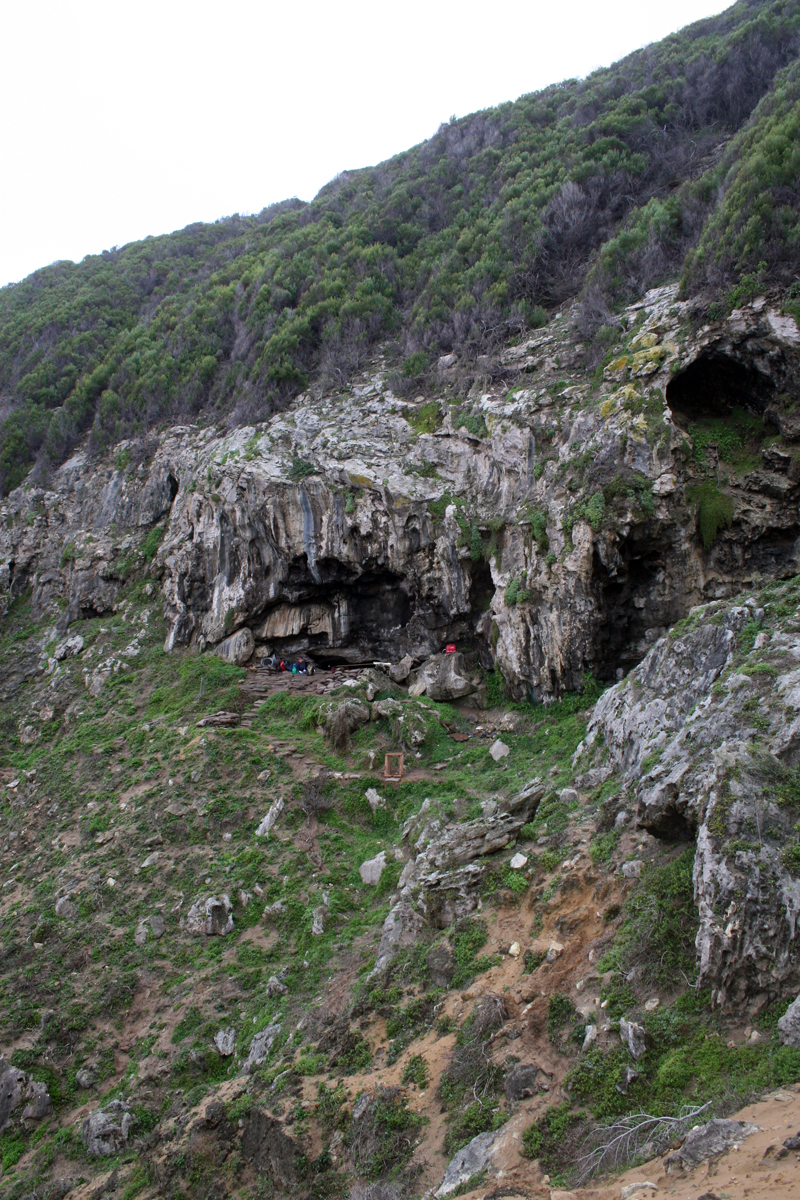
Blombos Cave sits on a cliff face above the Indian Ocean on the Still Bay coast of the Western Cape, approximately 300 kilometres east of Cape Town near the town of Still Bay. The cave is small — roughly 35 square metres of floor area — and is periodically flooded by the ocean during wet season, which has paradoxically aided its preservation by sealing deposits under sand. It is not open to the public; access is restricted to researchers under permit from the South African Heritage Resources Agency.
Discovery and excavation
Blombos Cave was identified by Christopher Henshilwood (University of Bergen / University of the Witwatersrand) who began excavations in 1991. Earlier layers of the cave had been disturbed by early 20th-century collectors, but the deeper Middle Stone Age deposits proved undisturbed. Systematic excavation has continued in campaigns since 1992, progressively deeper into deposits dating from approximately 100,000 to 70,000 years ago, with additional Later Stone Age layers above. Each season yields new finds that have repeatedly pushed back the earliest-known date for symbolic human behaviour.
The ochre engravings
The most famous finds from Blombos are pieces of ochre — iron-rich clay — bearing deliberately engraved geometric patterns. The most studied specimen (designated M1-6) carries a cross-hatch pattern of nine lines, precisely engraved with a stone tool, dated to approximately 75,000–77,000 years ago. Multiple other ochre pieces carry lines, cross-hatches, and geometric motifs. The patterns are intentional, systematic, and abstract — that is, they do not represent any specific object or figure from the natural world. They are art in the oldest and most precise sense: deliberate marks made for their own expressive meaning.
The oldest known jewellery
In deposits dated to 77,000 years ago, Henshilwood’s team found 41 small shells of the species Nassarius kraussianus — a tiny tick shell found in estuaries, not on the open coast near Blombos. The shells had been deliberately perforated and stained with ochre. They are too small to eat and have no practical use other than to be strung and worn. This makes them the oldest known personal jewellery in the world. Personal ornamentation implies something profound: a sense of self, an awareness of how one appears to others, a desire to communicate identity or status through visible markers. These are the cognitive building blocks of all later human social complexity.
The ochre paint workshop
In 2011, Henshilwood’s team announced a find without parallel in the archaeological record: two abalone shells (genus Haliotis) containing a mixed pigment compound dated to approximately 100,000 years ago. The shells served as containers. Inside each: a mixture of ochre, bone powder, charcoal, and liquid — effectively a prepared ochre paint, ready to be applied to a surface or a body. Associated stone grinders, ochre chunks, and a bone spatula were found nearby, constituting a complete toolkit for pigment production. At 100,000 years old, this is the oldest known chemical compound deliberately prepared by humans, and the oldest known evidence of a multi-ingredient production process.
Why Blombos rewrote prehistory
Before Blombos, the dominant theory of human cognitive evolution was the “Creative Explosion” model: art, symbolism, and abstract thought appeared suddenly in Europe around 40,000 years ago, when anatomically modern humans arrived and began producing cave paintings and carved figurines. Europe seemed to be where the mind became modern.
Blombos dismantled this model. The evidence shows that symbolic behaviour — art-making, personal ornamentation, pigment production — was already present in Africa 77,000 years ago, at least 37,000 years before the European “explosion.” Since humans migrated out of Africa approximately 65,000 years ago, this means the cognitive revolution happened inside Africa, long before the expansion. The creativity that produced the Lascaux cave paintings was not born in France: it was born in a cave on the South African coast and carried out of Africa by the people who became all of us.
Key facts
- Location
- Still Bay coast, Western Cape, South Africa (~300 km east of Cape Town)
- Key period
- c. 100,000–70,000 years ago (Middle Stone Age)
- Principal excavator
- Christopher Henshilwood (from 1991)
- Key finds
- Engraved ochre (oldest abstract art); perforated shells (oldest jewellery); abalone-shell paint kits (oldest compound pigment)
- Oldest artefact
- Ochre paint workshop, c. 100,000 years old
- Access
- Restricted to researchers; cave sealed seasonally by ocean flooding
Visiting
Blombos Cave is not open to the public and is inaccessible for much of the year due to ocean flooding. The Iziko South African Museum in Cape Town holds significant collections from the Middle Stone Age period and provides context for the Blombos discoveries. The Diaz Museum in Mossel Bay addresses the broader history of the southern Cape coast. Still Bay itself is a small coastal town approximately 70 kilometres west of Mossel Bay, accessible by road from George or Cape Town.
Gallery
Find it on the map
See this place and what’s around it →📷 Become a Cultural Heritage Online photographer
Share your photos of places: they stay published under your name as the author. The more they're seen, the more you get noticed — and soon a contest will reward the most appreciated photos.
Log in or sign up free to add a photo