
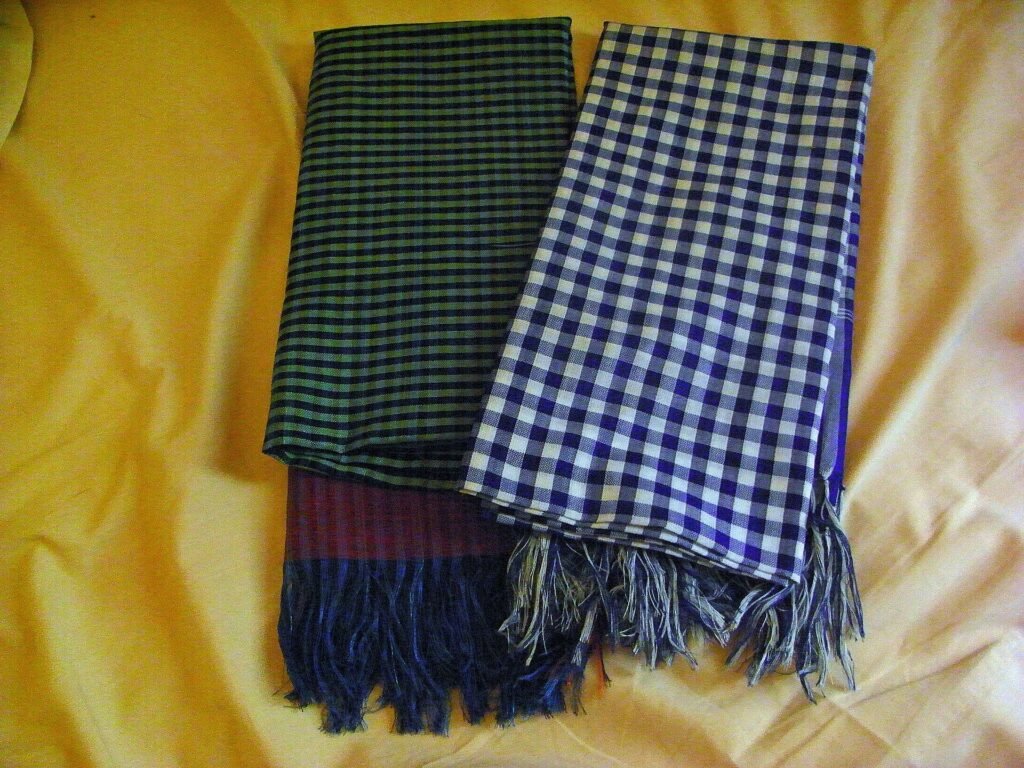
The krama is a sturdy, multipurpose textile woven in traditional patterns that serves as scarf, headwrap, child’s hammock, and symbol of Cambodian identity. Worn by all ages and genders, it embodies centuries of practical craftsmanship and cultural belonging.
At a glance
A krama is a versatile woven cloth integral to Cambodian daily life and ceremony. Most kramas feature a gingham pattern in traditional red or blue, though ornate variations exist. The textile functions as clothing, accessory, child-carrier, and ceremonial object—and holds status as the Cambodian national symbol.
Origins & history
The krama’s exact origins are rooted in Cambodia’s weaving traditions, though detailed historical documentation is limited. What is clear is that the textile became deeply embedded in Cambodian culture as both everyday necessity and marker of national identity, worn across all social strata and age groups.
The practice
Weavers produce krama cloth on traditional looms, creating the characteristic gingham weave that defines the garment. The finished textile is wrapped, draped, and tied in multiple ways: around the head as a bandanna or turban, across the shoulders as a scarf, wound around the waist, or secured as a sling for carrying infants.
The cloth is worn by men, women, and children alike. Bokator fighters—practitioners of Cambodia’s ancient martial art—incorporate the krama into their discipline, wrapping it around the waist, head, and fists, and historically using it as a garrote. Beyond martial and daily use, the krama serves decorative purposes in both domestic and ceremonial settings.
Cultural significance
The krama transcends functional clothing to become a statement of Cambodian identity and heritage. Its universal adoption across gender and age boundaries, combined with its designation as the national symbol, reflects its deep cultural resonance. The practice of weaving and wearing krama connects contemporary Cambodians to ancestral knowledge and aesthetic traditions.
Key facts
- Primary country: Cambodia
- Anchor community: Phnom Penh
- Coordinates: 11.56928, 104.92655
- Traditional colors: red and blue
- UNESCO Intangible Cultural Heritage inscription: 2024 (Reference 02115)
- Status: National symbol of Cambodia
Where to experience it
Phnom Penh and throughout Cambodia, the krama remains ubiquitous in daily life. Markets sell finished kramas; workshops continue traditional weaving practices. To witness the textile in its full cultural context—worn as practical garment, ceremonial cloth, and emblem of belonging—visit Cambodia and observe how people of all ages integrate it into their lives.
Sources & resources
- Krama — Wikipedia
- Cultural Practices and Expressions Linked to Krama — UNESCO Intangible Cultural Heritage
- Cultural Heritage Online
Find it on the map
See this place and what’s around it →📷 Become a Cultural Heritage Online photographer
Share your photos of places: they stay published under your name as the author. The more they're seen, the more you get noticed — and soon a contest will reward the most appreciated photos.
Log in or sign up free to add a photo